

Emerald Pages
◆
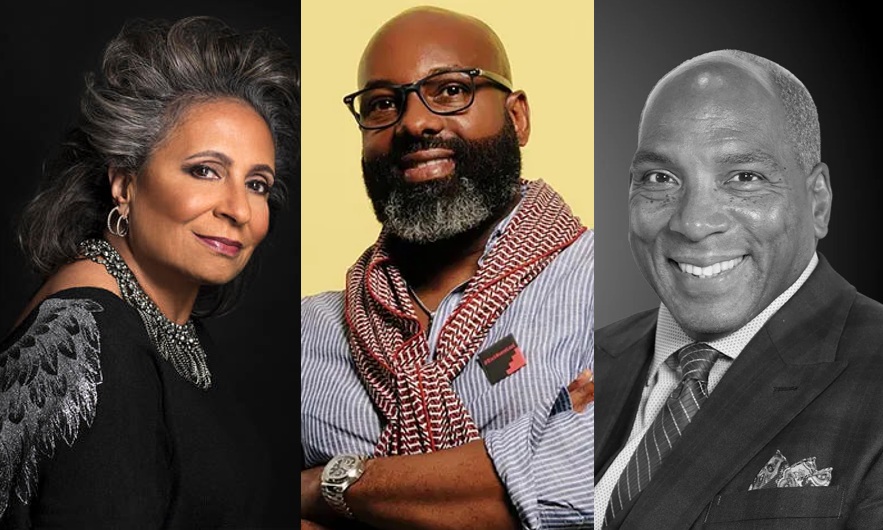
Owners Cathy Hughes (Urban One, left), Richelieu Dennis (Essence Venture, center), Earl "Butch" Graves Jr. (Black Enterprise, Right) Photo: Emerald Book Image
When we talk about "Black-owned media," we are often describing a mirage. In the modern landscape, giants like BET are subsidiaries of Paramount Global, and influencers like Blavity, despite Black founders, answer to venture capital firms like GV (Google Ventures) and Comcast. After a rigorous analysis of corporate structures, voting rights, and capital sources, only three major media companies can credibly claim to be both Black-owned and genuinely pro-Black in their governance: Urban One, Essence Ventures, and Black Enterprise.
The distinction is not merely academic; it is financial and political. In the media and advertising industries, a company is officially classified as "Black-owned" only if it is at least 51% owned, operated, and controlled by African Americans. Corporate investment is not the same as corporate ownership. While Blavity Inc. and Group Black do important work, their reliance on massive institutional capital or structural pivots to "multi-ethnic" audiences dilutes the definition of autonomous Black power.
Urban One: The Unshakeable Broadcasting Giant
Headquartered in Maryland, Urban One (formerly Radio One) is the largest African-American-owned broadcasting company in the United States. Founded by Cathy Hughes in 1980, the company operates over 50 radio stations, TV One, and CLEO TV. But what makes them "pro-Black" is their defense mechanism against dilution. Though Urban One is publicly traded on the NASDAQ, founder Cathy Hughes and her son, CEO Alfred Liggins, control a dual-class share structure that gives them approximately 83.24% of the voting power. This structure ensures that even with public shareholders, the Black family retains the final say.
Their production slate reflects this autonomy. Unlike conglomerates that chase algorithms, Urban One produces culturally specific legacy content like Unsung, Uncensored, and The Rickey Smiley Morning Show—content that prioritizes Black narrative over mass-market appeal.
Essence Ventures: The Liberian-Led Resurgence
Essence Ventures represents the rare case of repatriation. When Essence Magazine was sold by Time Inc. in 2018, it was purchased by Richelieu Dennis, a Liberian-born entrepreneur and founder of Sundial Brands (SheaMoisture). Importantly, Essence Ventures is not backed by traditional venture capital. Dennis financed the acquisition personally using proceeds from the $1.6 billion sale of Sundial Brands to Unilever. This makes Essence a private holding company, not a speculative asset.
Today, Essence Ventures operates under the Sundial Media & Technology Group umbrella. It is 100% Black-owned, with a board that historically included Michelle Ebanks and equity stakes held by an all-Black female executive team. While recent legal disputes (such as the 2026 lawsuit filed by former CEO Caroline Wanga) highlight internal governance challenges, the company's equity structure remains untouchable by outside corporate interests—a rarity in the publishing world.
Black Enterprise: The Graves Family Legacy
Founded by Earl Graves Sr. in 1970, Black Enterprise has successfully transitioned from a legacy business print magazine into a major digital, broadcast, and live events hub. Like Urban One, Black Enterprise remains wholly owned and family-operated by the Graves family. It has avoided the "acquisition trap" that claimed other legacy titles, allowing it to maintain a sharp focus on Black wealth-building and entrepreneurship without shareholder pressure to dilute its mission.
- Urban One - Controlled via dual-class stock (Cathy Hughes/Alfred Liggins: 83% voting power).
- Essence Ventures - Private ownership via Richelieu Dennis; zero traditional VC debt.
- Black Enterprise - 100% family-operated since 1970; no outside board control.
The Omissions: Why Blavity and Group Black Don't Make the Cut
It is important to distinguish between "Black-founded" and "Black-owned." Blavity Inc., founded by Morgan DeBaun, is a successful digital network for Black millennials. However, it has raised over $11 million in institutional venture capital from GV (Google Ventures) and Comcast Ventures. These corporations hold minority equity stakes and board seats. While DeBaun maintains operational control, the presence of corporate venture arms creates a fiduciary duty to outside investors who are not Black.
Similarly, Group Black—while founded by Black executives Travis Montaque and Richelieu Dennis—has undergone a structural pivot. Rebranded as Group Black Holdings, the company has launched Portrait Media Group, an AI-powered unit targeting "Gen Next" cross-cultural audiences rather than exclusively Black demographics. Furthermore, internal legal disputes and a massive $75 million ad spending partnership with global agency WPP/GroupM have shifted the company from a grassroots collective to a complex media accelerator. While technically Black-owned by equity definition, its current operational focus is on multi-ethnic scale, not specifically pro-Black advocacy.
The Elephant in the Room: Byron Allen and Allen Media Group
No discussion of Black media ownership is complete without addressing Byron Allen and his Allen Media Group (AMG). By the strictest definition of Black ownership, Allen Media Group is not just a major player; it is the largest solely Black-owned media conglomerate in the United States. Founded and wholly owned by Byron Allen, AMG owns The Weather Channel, TheGrio Network, over a dozen local broadcast affiliates (ABC, NBC, CBS, Fox), Entertainment Studios, and a 52% majority stake in BuzzFeed Inc. (acquired May 2026 for $120 million, including HuffPost).
So why isn't Allen Media Group considered "pro-Black" in the same way as Urban One, Essence, or Black Enterprise? The answer lies not in ownership structure—AMG is 100% Black-owned—but in mission, audience, and personal symbolism.
The Portfolio Problem: General Market vs. Black-Focused
Urban One, Essence, and Black Enterprise exist specifically to serve Black audiences. Their programming, editorial content, advertising partners, and cultural touchpoints are intentionally, unapologetically Black. Allen Media Group, by contrast, is a general market conglomerate that happens to be Black-owned. The Weather Channel, local news affiliates, and BuzzFeed serve predominantly white and mainstream audiences. While AMG owns TheGrio (a Black-focused digital platform), it is a small fraction of the overall portfolio. Byron Allen has built an empire by acquiring mainstream assets, not by building Black institutions.
The Personal Question: Marriage and Authenticity
Then there is the question that many in the Black community ask quietly but few publications address directly: Byron Allen is married to a white woman. His wife, Jennifer Lucas, is a blonde-haired, blue-eyed white woman from Los Angeles, California. They have been married since 2007 and have three children together.
For some, this personal detail is irrelevant—a man's marriage has no bearing on his business acumen or his ability to fight for Black economic justice. And fight he has: Allen has filed historic multibillion-dollar racial discrimination lawsuits against Comcast, McDonald's, and Charter Communications, forcing corporations to dramatically increase ad spending with Black-owned media. His legal warfare has arguably done more to open corporate wallets than any other single executive.
But for others, the question is deeper. How can a man be the face of "pro-Black" media when he has chosen to build his most intimate life—his marriage, his children, his home—outside the Black community? The argument goes: if you believe Black people are not superior or inferior to any other race, interracial marriage is a non-issue. But "pro-Black" is not the same as "not racist." Pro-Black implies a preference for and commitment to Black people specifically. Choosing a white spouse signals, at minimum, that Blackness is not a requirement for your closest personal relationships.
The Verdict: Where Does AMG Belong?
Allen Media Group belongs on any list of Black-owned media companies. It does not, however, belong on a list of pro-Black media companies—because "pro-Black" requires more than a Black CEO and a Black ownership certificate. It requires a mission, a cultural commitment, and often, a personal alignment that Allen has not demonstrated.
Cathy Hughes (Urban One) is married to a Black man. Richelieu Dennis (Essence) keeps his personal life private, but his business empire—SheaMoisture, Essence, New Voices Fund—has consistently centered Black women. The Graves family (Black Enterprise) has married within the race across generations. Whether by coincidence or by design, the leaders of the three most trusted Black media institutions have not asked the community to separate their personal choices from their professional missions.
No Ads. By Us. For Us.
This article was made possible by readers like you. We hope it inspired you to support Emerald Book, so we can continue producing content like this.
We will never show you ads, sell your data, or require a subscription to consume our content. Your gift helps us keep the truth accessible.
Click the Support button to give a gift of any amount today.
Thank you for making this work possible.