

Emerald Pages
◆
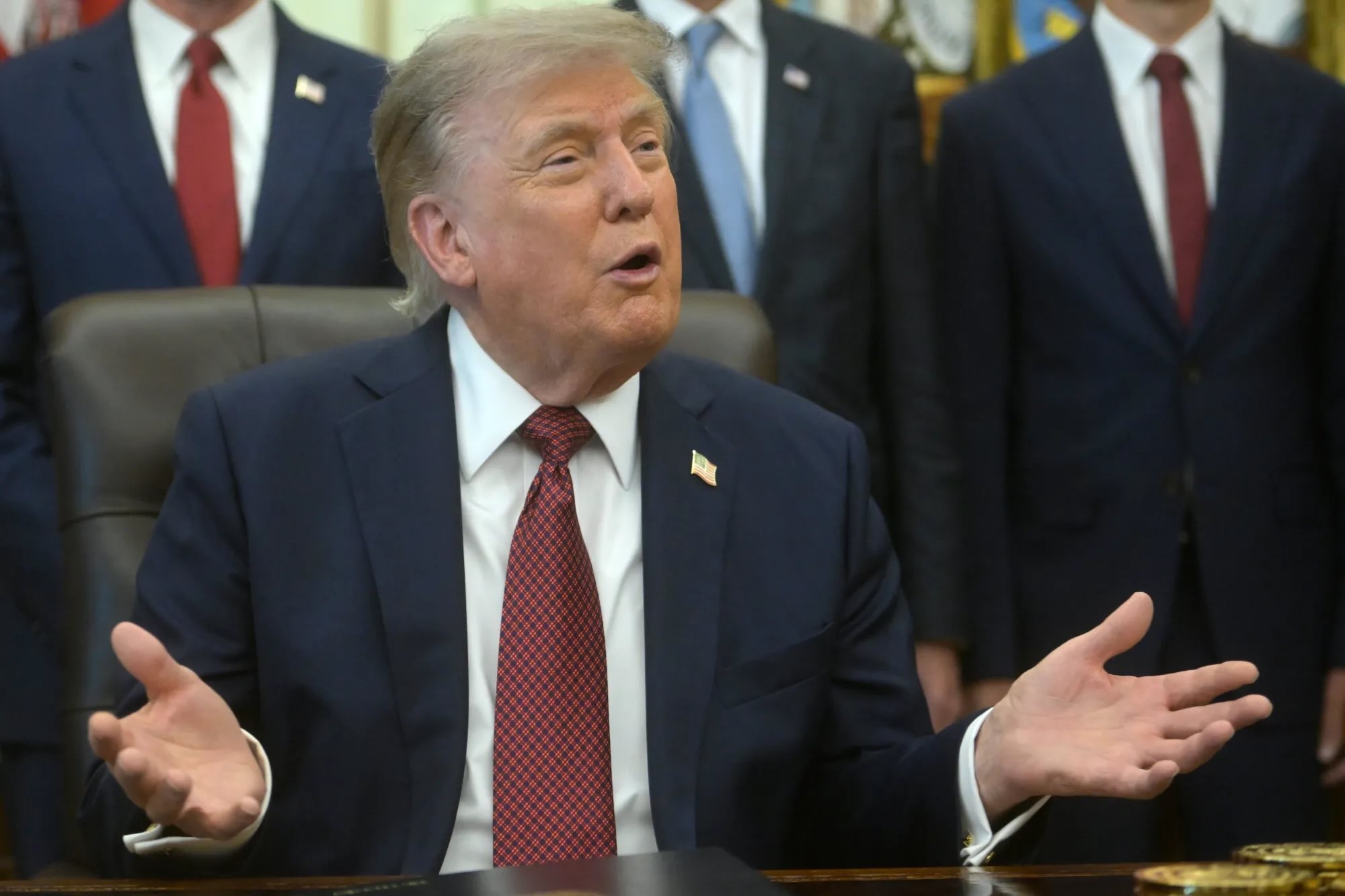
Photo: Evan Vucci | AP
The sheer audacity of it would be laughable if the stakes weren't so devastatingly real. On July 24, 2026, Donald Trump—a man whose documented history of racism spans five decades, whose policies have systematically eroded civil rights protections, and whose rhetoric has given comfort to white nationalists—stood in the Oval Office and called LeBron James "maybe a racist." The accusation, leveled against one of the greatest Black athletes in American history, is not just an insult. It is a masterclass in projection, a cynical manipulation of language designed to deflect from the undeniable truth: Donald Trump is the single greatest threat to Black progress in modern American history.
The remark came during a routine press availability when a reporter asked Trump to weigh in on the perennial "GOAT" basketball debate. Instead of sticking to sports, Trump escalated a decade-long political feud into a racial accusation. "Well, Michael Jordan's a guy that's a friend of mine... And I think LeBron is — maybe he's a racist, but maybe he doesn't like Trump? I don't know but I only like people that like me, so I would say Michael Jordan all the way." In that single, rambling response, Trump revealed everything: the accusation had nothing to do with racism and everything to do with personal grievance.
The hypocrisy is staggering. LeBron James is a basketball player. Even as a billionaire and global icon, he lacks the institutional power to enact systemic racism against anyone—let alone the President of the United States. Under the sociological definition of racism—prejudice plus power—a citizen cannot commit racism against a head of state. Trump, however, has spent his entire public life wielding that power to harm Black communities. Yet when a Black man exercises his constitutional right to political dissent, Trump weaponizes the very language of oppression to silence him.
The Historical Record: Five Decades of Racism
Let us be unequivocal: Donald Trump has been accused of racism longer than most Americans have been alive. The record is not ambiguous. It is not a matter of interpretation. It is a documented pattern of behavior spanning more than fifty years:
- 1973: The Department of Justice sued Trump Management for systematically discriminating against Black apartment applicants. Trump settled and signed a consent decree.
- 1989: Trump spent $85,000 on full-page newspaper ads calling for the execution of the Central Park Five—five Black and Latino teenagers later exonerated by DNA evidence. He has never apologized.
- 1992: The Trump Plaza Hotel and Casino was fined $200,000 after a judge ruled that Trump accommodated a gambler's request to remove Black dealers from his table.
- 2011–2016: Trump became the face of the racist "birther" conspiracy, falsely claiming Barack Obama—the first Black president—was not born in the United States.
- 2015: He launched his campaign by calling Mexican immigrants "rapists" and criminals.
- 2016: Trump claimed a federal judge of Mexican heritage couldn't be impartial because of his "Mexican heritage."
- 2017: After a white nationalist rally in Charlottesville, Trump said there were "very fine people on both sides."
- 2018: He referred to Haiti and African nations as "shithole countries" in an Oval Office meeting.
- 2019: Trump told four congresswomen of color—three of whom were born in the U.S.—to "go back" to the "crime infested places from which they came."
This is not a list of misunderstandings. This is a pattern. And the pattern didn't stop when he returned to office. In 2025, his administration erased a rule from the 1960s that explicitly banned federal contractors from having segregated facilities. Civil rights groups called it a return to Jim Crow. The Southern Poverty Law Center documented efforts to remove the names of Harriet Tubman and the Navajo Code Talkers from federal exhibits.
The Policy Reality: A Direct Threat to Black Progress
Trump's defenders will point to economic statistics—record-low unemployment for Black Americans pre-pandemic, the First Step Act, Opportunity Zones. These arguments are, at best, misleading. At worst, they are cynical attempts to mask the systematic dismantling of civil rights protections that Black communities spent generations fighting to secure.
The reality is stark. Under Trump, the Department of Justice scaled back "pattern-or-practice" investigations that held racist police departments accountable. His judicial appointments—hundreds of conservative federal judges and three Supreme Court justices—directly led to the dismantling of affirmative action and the weakening of the Voting Rights Act. Federal diversity, equity, and inclusion programs were gutted. Civil rights enforcement was systematically defanged.
And then there are the numbers his supporters don't want to discuss. Even at its "historic low," Black unemployment was nearly double that of white workers. Underemployment—particularly for Black women, who earn roughly 63 to 67 cents for every dollar earned by white men—remained a structural crisis. Over 700,000 Black women were unable to find work or had stopped looking entirely, trapped by a lack of childcare, systemic hiring bias, and wages that don't support a family. These are not "wins." These are failures dressed up in statistics.
The Power to Weaponize Language
Which brings us back to the absurdity of Trump calling LeBron James a racist. This is not a random insult. It is a deliberate rhetorical strategy. Dominant groups co-opt civil rights language to dilute its meaning and protect the status quo. By using "racist" as a casual, retaliatory insult against a Black athlete who disagrees with him, Trump strips the word of its systemic meaning. It becomes just another weapon in his arsenal of grievance.
Trump's own defense—"I only like people that like me"—reduces racism to a matter of personal courtesy and flattery, completely erasing the historical, systemic dimensions of oppression. It is a profound act of linguistic violence designed to invalidate a critic and protect authority from accountability.
The accusation is not just false. It is impossible. LeBron James cannot be racist against Donald Trump because he lacks the power to oppress the most powerful man on earth. But Donald Trump has spent a lifetime accumulating and wielding that power against Black communities. He has eroded voting rights. He has weakened civil rights enforcement. He has given comfort to white nationalists. He has rolled back anti-segregation protections. He has made Black lives harder, Black progress slower, and Black voices easier to ignore.
And then he has the gall to call LeBron James a racist.
The absurdity is not in the accusation. The absurdity is in the man making it. A man who is, without exaggeration, the single greatest threat to Black progress in modern American history. A man who has done more to roll back civil rights than any president since before the Civil Rights Act. A man who looks at a Black athlete using his platform to speak truth to power and sees—not a citizen, not a patriot, not a human being—but a target for projection.
LeBron James is not a racist. He is a basketball player, a father, a philanthropist, and a citizen who refuses to stay silent in the face of injustice. Donald Trump is a man who has built a political career on racism and now wants to use the language of anti-racism to silence his critics. That is not just hypocrisy. That is a profound and dangerous inversion of reality—and it should be recognized as such.
No Ads. By Us. For Us.
This article was made possible by readers like you. We hope it inspired you to support Emerald Book, so we can continue producing content like this.
We will never show you ads, sell your data, or require a subscription to consume our content. Your gift helps us keep the truth accessible.
Click the Support button to give a gift of any amount today.
Thank you for making this work possible.