

Emerald Pages
◆
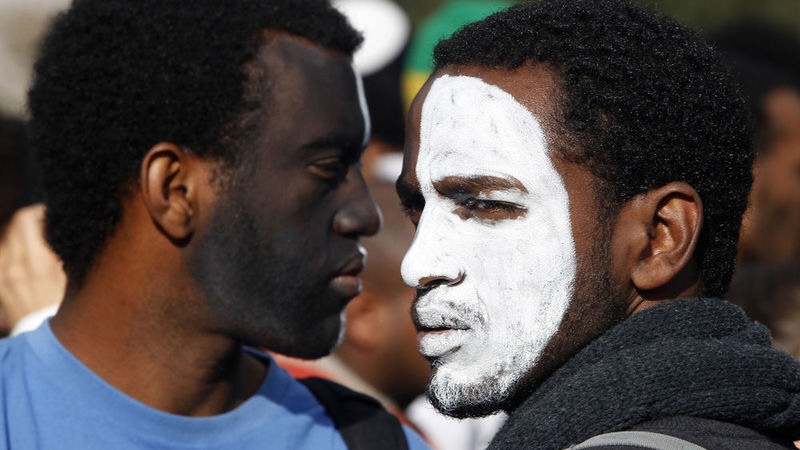
Photo: Mail Guardian
In recent years, a significant linguistic and cultural shift has accelerated across American public discourse. Terms like code-switching, dehumanization, and systemic racism—once deeply rooted in the specific, life-altering experiences of Black Americans—have been increasingly repurposed by white individuals to articulate personal grievances. This is not a case of simple semantic evolution. Sociologists and political scientists have documented a marked rise in this trend, identifying it as a direct response to shifting demographics, corporate Diversity, Equity, and Inclusion (DEI) initiatives, and the legal dismantling of affirmative action. What is unfolding is a sophisticated weaponization of civil rights language designed to neutralize critiques of systemic privilege and preserve the status quo.
The phenomenon is driven by a need to regain status. As the nation becomes more racially diverse and institutions attempt to address historical inequities, a subset of the white majority experiences what sociologists call "status anxiety." When a historically dominant group perceives its exclusive hold on institutional power is slipping, it rarely fights back by admitting a desire to keep its advantages. Instead, it utilizes the moral language of victimhood to wage a counter-offensive. By claiming struggles like reverse racism or forced code-switching, dominant groups effectively reframe the preservation of white privilege as a fight for civil rights—a tactic that has proven highly effective in courts, legislatures, and corporate boardrooms.
A Documented Rise: From Niche to Mainstream
The mainstreaming of these terms is not an anecdotal observation; it is a measurable phenomenon. In recent years, there has been a noticeable increase in the use of terms like "reverse racism" and "code-switching" in mainstream discourse, particularly on social media platforms and in workplace settings. The term "code-switching" has been aggressively rebranded in workplace blogs and LinkedIn posts to describe the general professional etiquette of shifting communication styles, stripping it of its racial survival context. This linguistic shift has been accelerated by political figures and media commentators who amplify these grievances, embedding them into the fabric of everyday political discourse. The result is a public sphere where the distinct struggles of Black Americans are increasingly conflated with the discomfort of a dominant group facing competition.
The Impossibility of Systemic Oppression for the Dominant Group
To understand why these claims are weaponized, it is crucial first to acknowledge their systemic impossibility. For a struggle to be systemic, it must be backed by institutional power—laws, judicial systems, economic markets, and generational wealth. When white individuals claim they have to "code-switch," they are conflating situational etiquette with racial assimilation.
Code-Switching: Historically, this term referred to Black Americans adapting their speech and demeanor to navigate white-dominant spaces to survive systemic bias. For a Black person, failing to code-switch can lead to being stereotyped as dangerous, resulting in economic disenfranchisement, housing discrimination, or physical harm. For a white person, shifting from casual friend-speak to corporate email-speak is a matter of professional etiquette, not survival. The workplace culture matches their racial identity; they are modifying tone, not their identity. Yet, surveys indicate that a growing number of white professionals now believe they "code-switch" at work—a trend that sociologists say reflects a profound misunderstanding of the term's origins and stakes.
"Reverse Racism": While any individual can experience interpersonal prejudice, racism requires systemic and institutional power to execute. To claim systemic reverse racism, one must prove that Black people hold the institutional power to oppress white people on a macro scale—which they do not. Sociological data consistently shows that white Americans retain massive structural advantages in hiring, medical care, generational wealth, and criminal justice. Despite this, research indicates that a significant and growing number of white Americans believe that anti-white discrimination is as substantial a problem as anti-Black discrimination—a perception that has intensified since the post-2020 racial reckoning.
Dehumanization: This is the psychological process of reducing a group to sub-human status to justify violence. White people in America have never been legally classified as property, subjected to state-sanctioned segregation based on their whiteness, or systemically targeted for genocide. When white commentators claim they are being dehumanized, they are usually pointing to online criticism or political polarization—conflating social discomfort with historical atrocities. This rhetorical move has become a hallmark of the current backlash, with pundits framing critiques of whiteness as equivalent to the dehumanization of slavery.
The Psychology of "Dominant Group Threat"
Sociological research confirms that the loudest voices claiming these grievances are rarely people who want a more equitable society. Instead, they are the ones most invested in the traditional hierarchy. This is explained by Group Threat Theory, which posits that when a dominant group believes its cultural monopoly is slipping, its members experience intense anxiety. The recent rise in these claims correlates directly with the implementation of DEI initiatives and the demographic shift towards a "majority-minority" nation, which has triggered a protective response among those with high racial resentment.
- Status Protection: Individuals with high Social Dominance Orientation (SDO) believe society should have winners and losers. They use civil rights language to safely steer society back to a system where they face no competition from marginalized groups.
- Opportunity Hoarding: When equity initiatives threaten to share resources equitably, those who support the status quo cannot publicly say, "I want to keep my unfair advantages." Instead, they say, "I am being dehumanized," allowing them to fight for their exclusive monopoly while pretending to fight for fairness.
- Weaponized Victimhood: The strategy relies on DARVO (Deny, Attack, Reverse Victim and Offender). When Black communities advocate for diversity to fix historic disparities, opponents claim these initiatives are "reverse racism." The conversation shifts entirely, forcing institutions to defend themselves against the grievances of the dominant group, effectively stalling progress. This tactic has been notably successful in the recent wave of lawsuits against corporate DEI programs.
The Legal and Legislative Backlash
This rhetoric has been codified into policy at an unprecedented rate over the last several years. Following the landmark 2023 Supreme Court decision in Students for Fair Admissions v. Harvard, conservative legal groups weaponized "colorblindness" and "reverse discrimination" to aggressively target race-conscious initiatives. More recently, the same framework was used to successfully sue the Fearless Fund—a venture capital firm for Black women—forcing it to shut down its grant program. By defining inclusion programs as discriminatory, these litigants have created massive legal and financial liabilities for universities and corporations, forcing many to self-censor and preemptively dismantle their diversity programs to avoid federal investigations and costly lawsuits.
Ultimately, this is not a misunderstanding of English vocabulary. It is a highly effective political and cultural counter-offensive that has surged in the current era. By taking the tools Black Americans built to fight for survival and turning them inside out, the backlash successfully reframes the preservation of white privilege as a fight for civil rights. The evidence is clear: these claims are not struggles for equality; they are sophisticated weapons designed to ensure the systemic power structure remains unchallenged as the nation continues to change.
No Ads. By Us. For Us.
This article was made possible by readers like you. We hope it inspired you to support Emerald Book, so we can continue producing content like this.
We will never show you ads, sell your data, or require a subscription to consume our content. Your gift helps us keep the truth accessible.
Click the Support button to give a gift of any amount today.
Thank you for making this work possible.