

Emerald Pages
◆
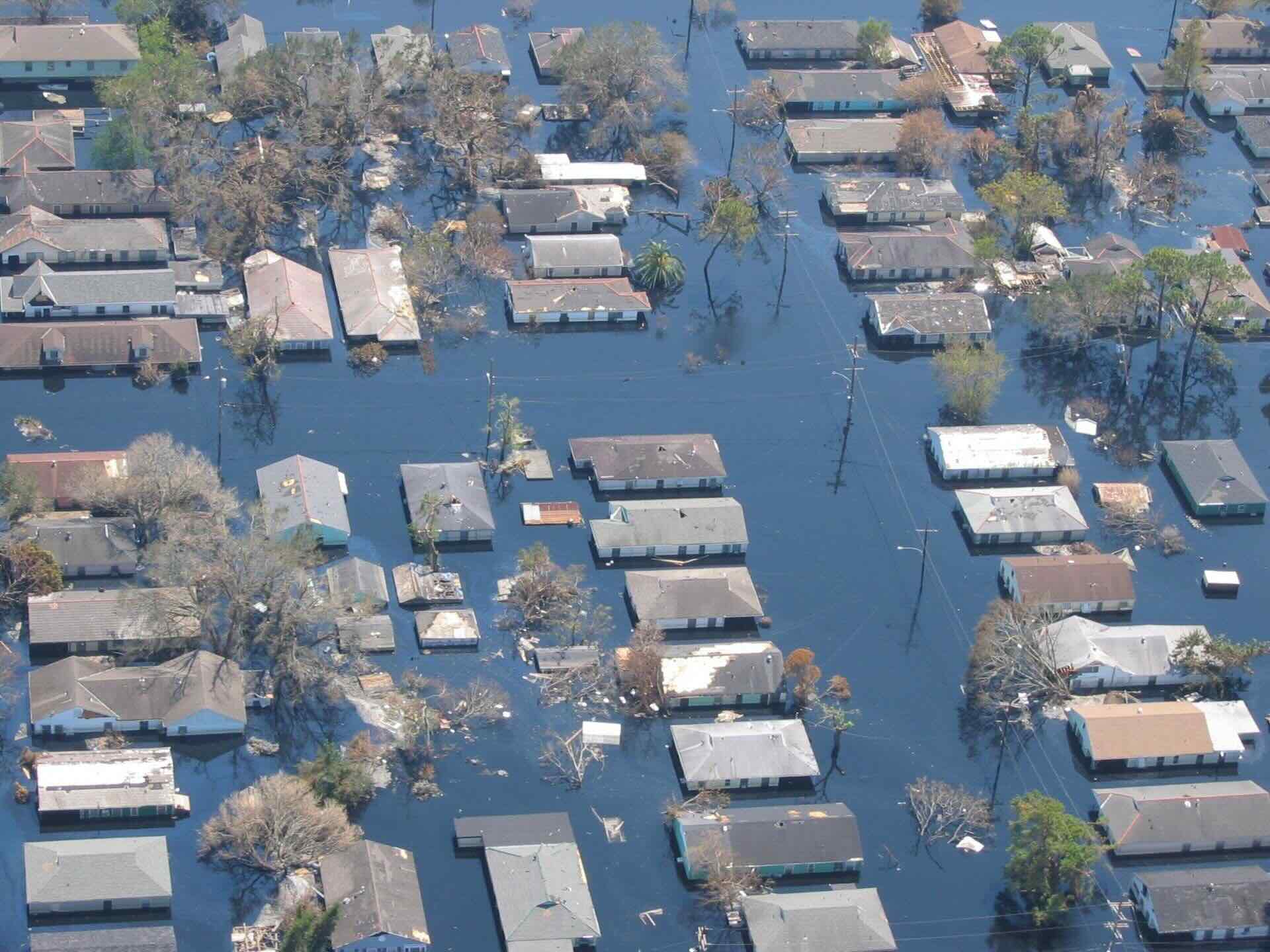
Photo: Lieut. Commander Mark Moran | NOAA
In May 2026, a study published in Nature Sustainability sent shockwaves through the climate community. Led by Tulane University geologist Torbjörn Törnqvist, the research concluded that coastal Louisiana has crossed a geological threshold, suggesting the Gulf of Mexico could migrate up to 62 miles inland by the end of the century, effectively turning New Orleans into a stranded island. The study ignited a fierce debate: is the cradle of jazz past the point of no return?
The optimists point to the Dutch, who have successfully lived below sea level for centuries. They argue that with enough political will, an advanced system of levees and storm surge barriers can keep the city dry. However, this argument relies on a fundamental assumption: that the United States has the collective will to fight a forever war against the sea. A sobering look at the financial cost of saving the city, and the historical pattern of the U.S. government's reaction to disaster, makes it painfully clear that the optimists are likely wrong. We are not the Netherlands.
The primary weapon of the optimists is engineering. The post-Katrina $14.5 billion Hurricane and Storm Damage Risk Reduction System (HSDRRS) is a marvel of modern infrastructure, featuring massive barriers like the Lake Borgne Surge Barrier. Yet, even this system is sinking into the soft soils of the Mississippi Delta. The Army Corps of Engineers estimates it requires an additional $1 billion just to raise the current walls by a mere 1 to 2 feet to keep pace with immediate sea-level rise. This is merely the maintenance cost for the current system, not the upgrade required to survive the century.
The $100 Billion Math Problem
To truly "save" New Orleans as we know it, the investment must be staggering. The Louisiana Coastal Master Plan outlines a 50-year strategy costing upwards of $50 billion to $100 billion. This breaks down into roughly $19 billion for coastal restoration and dredging to rebuild the wetland buffers, another $15 billion for levee retrofits, and over $11 billion for internal urban green infrastructure to manage rainfall.
The state's primary funding source for these monumental projects is the multi-billion dollar legal settlement from the 2010 BP Deepwater Horizon oil spill. However, this fund is projected to run out within the next decade. Without a permanent, massive federal commitment, the city cannot afford the ongoing maintenance, let alone the future upgrades. This funding gap is not a theoretical problem; it is a slow-motion economic strangulation.
- Cost of Coastal Restoration: ~$19 billion to rebuild the storm buffer, but funding is projected to run out in 10 years.
- Cost of Hard Defenses: ~$15 billion+ to upgrade levees, yet the current system is already sinking.
- Insurance Death Spiral: Premiums surged over 40%, driving residents and the tax base away before the water even arrives.
The History of Too Little & Too Late
The historical record of the U.S. government's response to hurricanes reveals a deeply ingrained cycle of reactive, chaotic spending that precludes long-term survival. Before Hurricane Katrina struck in 2005, scientists had spent years warning that the federal levee system was inadequate. The government failed to act preemptively. When the levees breached, the Federal Emergency Management Agency (FEMA) response famously collapsed, leaving thousands stranded for days.
After the catastrophe, the government pivoted to hyper-reactive spending, appropriating over $100 billion for recovery and building the new HSDRRS. Yet, it failed to establish a permanent funding stream for the long-term maintenance of those same projects. The pattern is clear: Congress is willing to spend billions after a tragedy to be seen as fixing a problem, but it routinely fails to fund the boring, decades-long upkeep required to prevent the next one.
The Modern Austerity Era
The current federal approach has moved away from the massive bailouts of the Katrina era toward a framework of austerity. A recent federal review panel recommended transforming FEMA into a "payer of last resort," drastically raising the damage thresholds required to trigger a major federal disaster declaration. Furthermore, bureaucratic bottlenecks have locked up over $17 billion in approved disaster funds due to strict cost-cutting policies, leaving local governments to take on heavy debt just to rebuild their basic infrastructure.
For a city sitting below sea level, relying on a government that waits for a disaster to act is a death sentence. The city does not need a quick fix; it needs a permanent, non-negotiable national priority. History proves the U.S. government is fundamentally incapable of providing that.
The people who argue New Orleans can be saved are not wrong about the physics; human engineering is powerful enough to keep the city dry. However, they are dangerously naive about the politics and economics. The cost is simply too high for a polity that cannot even fund routine maintenance, and history proves that the federal government's response is cyclical, reactive, and ultimately insufficient. The city may not physically sink for decades, but the economic and political abandonment has already begun.
No Ads. By Us. For Us.
This article was made possible by readers like you. We hope it inspired you to support Emerald Book, so we can continue producing content like this.
We will never show you ads, sell your data, or require a subscription to consume our content. Your gift helps us keep the truth accessible.
Click the Support button to give a gift of any amount today.
Thank you for making this work possible.