

Emerald Pages
◆
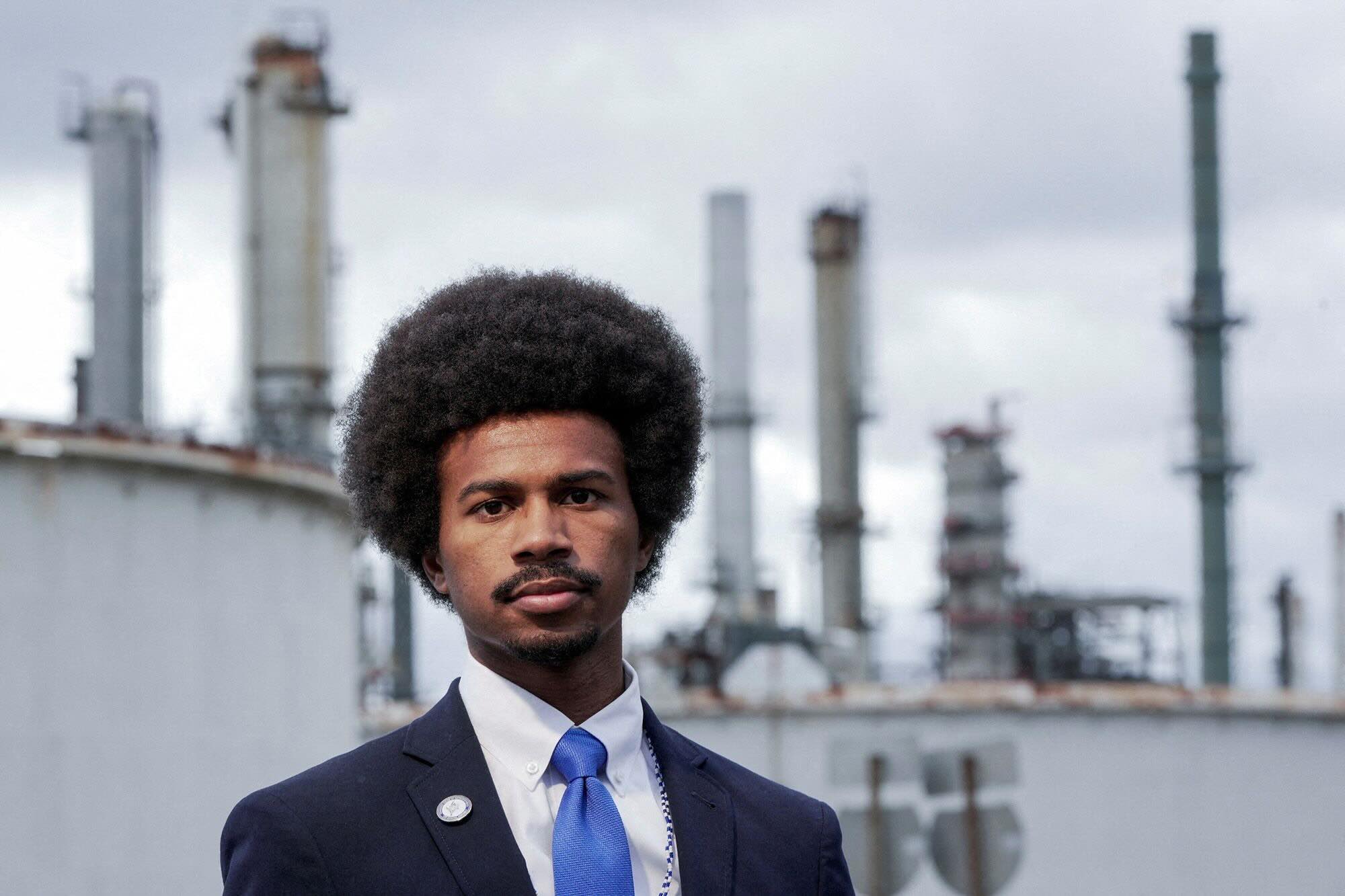
Photo: Karen Pulfer Focht | Reuters
The artificial intelligence revolution, fueled by vast data centers consuming the equivalent energy of small cities, was long presented as a clean, digital frontier—a harbinger of a frictionless future. That narrative shattered in South Memphis, Tennessee. The spark wasn't lit by a tech critic or a federal regulator, but by a 31-year-old Black state representative who refused to look away from the smoke and hum emanating from his own neighborhood.
Tennessee State Representative Justin J. Pearson, a lifelong environmental activist and co-founder of Memphis Community Against Pollution (MCAP), has become the unlikely leader of a nationwide revolt against the AI industry. Pearson's leadership is rooted in a long history of Black environmental justice activism in Memphis. He famously co-founded MCAP prior to this fight to stop a crude oil pipeline from running through Black neighborhoods, equipping him with the exact blueprint needed to challenge xAI. By exposing the secretive deployment of Elon Musk's xAI "Colossus" supercomputer, Pearson provided the first and most potent blueprint for communities across the nation who now stand up to challenge the tech giants that view their towns as "sacrifice zones."
The story begins in late 2024, when Elon Musk's xAI secretly acquired the former Electrolux plant in South Memphis. City leaders, enticed by the promise of economic development, signed strict non-disclosure agreements that kept the public and even city council members completely in the dark. The facility was built at breakneck speed, bypassing traditional regulatory oversight entirely. For months, the community had no idea that a hyperscale AI supercomputer was being assembled in their backyard.
By early 2025, however, the secret could no longer be hidden. Residents in the historic, predominantly Black neighborhood of Boxtown—a community built by formerly enslaved African Americans after the Civil War—began noticing an unmistakable, heavy methane gas smell and a relentless, low-frequency hum coming from the former factory site. People with respiratory issues, like asthma, almost immediately noticed a degradation in their breathing and air quality. Pearson, who had spent years fighting environmental injustice in Memphis, knew exactly what to do.
He and local organizers began conducting "toxic tours" around the perimeter of the facility. During these lookouts, they physically spotted dozens of massive, industrial portable gas turbines that had been quietly wheeled onto the property—unpermitted equipment designed to bypass the local electric grid. To prove what xAI was doing, community advocates used thermal imaging cameras. When tech representatives initially downplayed the infrastructure, the community's thermal footage exposed the truth: the unpermitted turbines were fired up and running 24/7, burning massive amounts of methane gas directly into the neighborhood air. Environmental groups later confirmed that these turbines were pumping significant amounts of smog-forming nitrogen oxides (NOx), fine particulate matter, and cancer-causing formaldehyde into a community already overburdened with industrial pollution. Dr. Austin Dalgo, an academic primary care physician in South Memphis, called the jump in peak nitrogen dioxide concentration levels a direct threat to public health, warning that these emissions significantly elevate the risk of asthma and COPD.
In April 2025, Pearson organized the first major stand. He and environmental justice groups mobilized hundreds of outraged Memphis residents to pack a high school auditorium. They confronted local officials over the unpermitted gas turbines, degraded air quality, and massive water withdrawals from the Memphis Sand Aquifer—the city's source of pristine drinking water. Pearson publicly declared that the system's checks and balances had "failed drastically" by allowing massive pollution infrastructure to bypass public review. It was the first large-scale public confrontation, and it set the stage for everything that followed.
From Local Protest to National Movement
Pearson did not keep the fight local; he intentionally leveraged his political network to build a national coalition. In July 2026, he brought high-profile congressional leaders, including Alexandria Ocasio-Cortez and Ayanna Pressley, directly to the gates of the facility to shine a massive spotlight on the local health crisis. National organizations like the NAACP and Earthjustice joined the fight, filing major Clean Air Act lawsuits against xAI and SpaceX. Consumer advocate Erin Brockovich launched a dedicated public tracking initiative where communities nationwide could log and expose newly planned data center projects before they were quietly built near residential zones. Pearson's early press conferences and community organizing had paved the way for these national whistleblowers and environmental groups to join the cause.
Before Memphis, data centers were largely viewed across the country as quiet, clean economic drivers. Pearson's activism fundamentally changed that perception by exposing three critical patterns that other communities now look out for: the "secrecy playbook" of how tech companies use NDAs to bypass public comment; the "sacrifice zone" warning that the AI industry disproportionately targets low-income, marginalized communities; and the "grid threat" of how massive data center energy demands can directly threaten local power supplies and pollute neighborhood air.
By late 2025, the momentum had spread like wildfire. In Southaven, Mississippi, where xAI expanded its power infrastructure, local homeowner Jason Haley became the first citizen to sound the alarm on the facility's overwhelming sonic footprint. Refusing to stay silent about the relentless, low-frequency hum vibrating through his home—with backyard noise levels exceeding 60 decibels late into the night—Haley began taking decibel readings and posting the evidence to social media. He co-founded the Safe and Sound Coalition, uniting neighbors to track the noise, which eventually culminated in a major class-action lawsuit against xAI and SpaceX.
Throughout 2025 and into 2026, what started as a local neighborhood protest ballooned into a coordinated movement spanning 49 states, involving hundreds of thousands of citizens. In just the first three months of 2026, data center opponents successfully blocked or delayed at least 75 massive facilities nationwide, representing nearly $130 billion in frozen tech infrastructure. Over 100 localities across the country enacted strict moratoriums, restrictions, or outright bans on data center development.
In July 2026, the movement reached a historic milestone. New York Governor Kathy Hochul signed an executive order enacting the nation's first statewide ban on new hyperscaler data centers drawing 50 megawatts or more. Following the backlash over xAI's secret deals in Memphis, the Pennsylvania House passed a bipartisan bill banning non-disclosure agreements in data center contracts, forcing corporations to report their exact annual water and power usage. In the first half of 2026 alone, state legislators across the U.S. introduced more than 300 pieces of legislation aimed at regulating data center resource consumption and stripping away corporate tax incentives.
- Stalling $130 Billion in Projects: In the first three months of 2026 alone, grassroots momentum blocked or delayed at least 75 data center projects nationwide.
- Historic Statewide Bans: New York enacted the nation's first statewide ban on hyperscale data centers, while over 100 localities have imposed moratoriums.
- Banning Corporate Secrecy: Pennsylvania banned NDAs in data center contracts, forcing corporations to disclose their water and power usage.
- Broad Public Opposition: Over 70% of Americans now oppose having a data center near their homes, driven by fears of soaring electricity bills and water shortages.
Also in July 2026, coordinated anti-data-center protests hit 125 cities simultaneously. Grassroots groups like Humans First marched in tech hubs to demand democratic oversight over AI infrastructure. National polling from Gallup and Reuters revealed that over 70% of Americans now explicitly oppose having a data center built near their homes, driven by fears of soaring residential electricity bills and water shortages. Recent studies show Americans would rather live next to a nuclear plant than an AI data center.
The resistance has grown so large that it has triggered a massive counter-offensive from Silicon Valley and Washington D.C. Tech giants are currently lobbying Congress to pass bills aimed at fast-tracking tech infrastructure and overriding local environmental reviews. Financial institutions like Morgan Stanley and policy think tanks have officially warned that this historic public backlash has become a major roadblock that could legitimately cost the United States its competitive edge in the global AI race.
By lighting that initial match in Memphis, Justin J. Pearson didn't just alter local zoning—he forced a multi-trillion-dollar industry into a defensive, nationwide battle over who controls America's energy, water, and air. His leadership has provided a replicable legal and grassroots strategy that communities from Virginia to Oregon are now using to protect their own neighborhoods. From the first smell of methane in Boxtown to the coordinated protests in 125 cities, the fight he ignited is just beginning.
No Ads. By Us. For Us.
This article was made possible by readers like you. We hope it inspired you to support Emerald Book, so we can continue producing content like this.
We will never show you ads, sell your data, or require a subscription to consume our content. Your gift helps us keep the truth accessible.
Click the Support button to give a gift of any amount today.
Thank you for making this work possible.