

Emerald Pages
◆
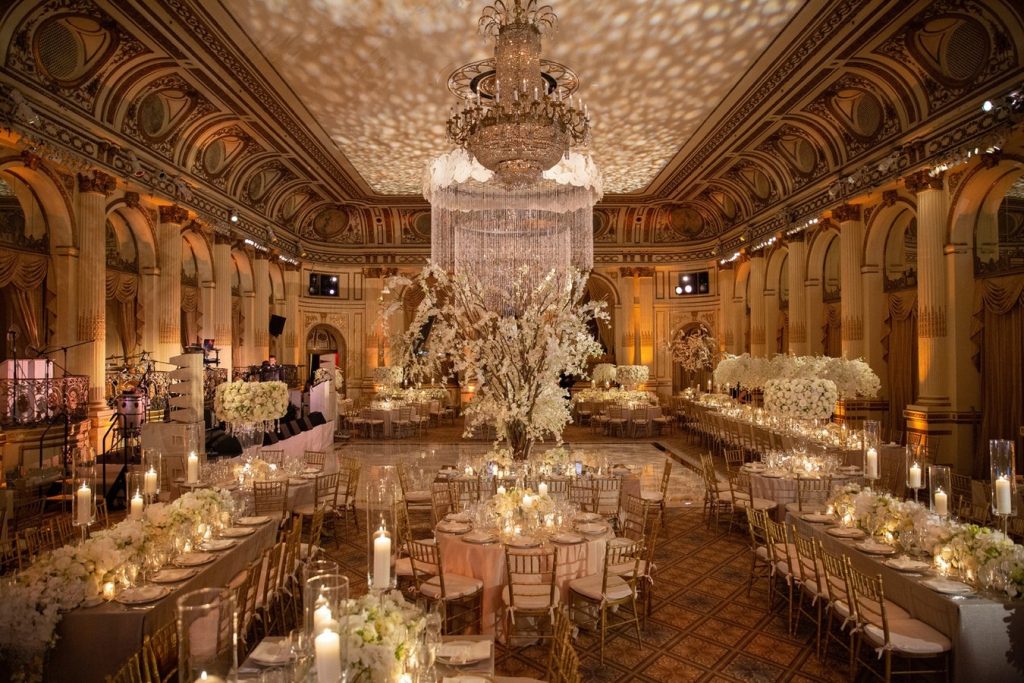
Photo: The Plaza Hotel, New York
Weddings have always been a significant life event, but in the modern era, they have transformed into a crushing financial milestone. What was once a modest community gathering has become a highly curated, multi-day production that now rivals the cost of a new car. With the average price of a U.S. wedding officially climbing to a baseline of $36,000 in 2025, the economics of saying "I do" have become a subject of intense financial scrutiny.
This staggering price tag—which roughly equates to the cost of a high-quality used vehicle—represents a decades-long evolution driven by economic shifts, changing consumer expectations, and a post-pandemic surge that has outpaced wage growth. To understand the crushing economics of the modern wedding, we must look at the historical trajectory of these costs, the macroeconomic forces at play, and the ingenious and sometimes dangerous ways couples are financing their big day.
A Historical Evolution: From Modest Gatherings to Financial Milestones
The cost of tying the knot has evolved through distinct economic eras, each leaving its mark on the tradition. In the 1930s, during the Great Depression, the average wedding cost roughly $392. While that sounds like a bargain, it equated to about $6,480 in today's money—an astonishing one-quarter of an average household's annual income. Couples sacrificed a huge chunk of their earnings for a simple, community-focused event.
The post-WWII boom of the 1950s brought a surge in disposable income and birthed the Western tradition of the large, extravagant "all-white" wedding affair. This set the stage for the arms race of bridal spending driven heavily by the cultural phenomenon of Princess Diana's royal wedding in the 1980s. By 1984, the average wedding cost $7,800 (~$17,000 adjusted), and by 1990, that number had ballooned to an inflation-adjusted $26,000. The 2010s saw costs hold relatively steady in the mid-to-high $20,000s before jumping to a then-record high of $31,213 in 2014.
The Post-Pandemic Price Spike: A New Baseline
However, the most extreme volatility has occurred in the last few years. According to The Knot's Annual Real Weddings Study, the pandemic caused a massive dip to $19,000 in 2020 due to micro-weddings, followed by a sharp rebound to $28,000 in 2021 as pent-up demand returned. Inflationary pressures then took a toll, pushing the average to $30,000 in 2022 and a peak of $35,000 in 2023. While 2024 saw a slight stabilization at $33,000 as couples cut guest counts, the 2025/2026 baseline is a new, permanent high of $36,000. This is driven by cumulative post-pandemic inflation, with wedding-related spending rising a staggering 8.5% year-over-year—double the pace of regular consumer inflation, according to a Bank of America Institute report.
The Economics of Escalation: Why Is It So Expensive?
The explosion in wedding costs isn't just a "wedding tax"—it's driven by a perfect storm of macroeconomic factors. The most obvious is cumulative raw inflation. Broad-based inflation since 2020 has driven up the cost of hard goods like food, flowers, and textiles by more than 20% to 26%. Simultaneously, rising labor costs and labor shortages have upended vendor pricing norms. Wedding vendors are not immune to Baumol's cost disease; a photographer cannot photograph a wedding any faster than they could 20 years ago, and as wages for skilled labor rise, so do their rates.
Furthermore, tariffs and global supply chain strains have directly inflated the cost of imported goods, from wholesale florals to specialty cake ingredients. The definition of a "standard" wedding has also shifted dramatically. We have entered the Experience Economy. Couples now demand highly curated, weekend-long experiences with custom farm-to-table menus, pop-up bars, and multi-day itineraries. This "premiumization" has driven the average cost per guest to an all-time high of $292, with couples spending more on fewer people to create an "Instagram-worthy" event.
- Venue & Catering: Over $15,000
- Photography & Video: Roughly $3,500
- Live Entertainment: Close to $4,000
- Flowers & Decor: Around $2,800
- The Rings & Dress: Near $7,000 combined
How Are People Paying for This?
With wages failing to keep pace with wedding inflation, the traditional model of the bride's parents writing a single check has largely vanished. Today, weddings are funded through a complex, multi-source financial strategy. The primary engine is multi-generational financial pooling. According to industry data, parents and extended family still foot about 51% to 52% of the total bill, but the couple now pays for the remaining 48%. To afford this, younger couples dip heavily into long-term personal savings, often delaying other major life milestones like buying a home.
For those without deep savings or parental backing, a booming market for wedding debt has emerged. Many couples turn to unsecured personal loans, carry high-interest credit card debt (often at 20%+ APR), or use "Buy Now, Pay Later" (BNPL) services like Klarna to split the costs of dresses and invitations into smaller payments. A popular, more strategic trend is credit card "churning," where couples open premium cards with massive sign-up bonuses, put large deposits on them, and use the accumulated points and miles to fund their honeymoon for free. Couples are also increasingly extending their engagements to 18 to 24 months to give themselves more time to save and spread out vendor payments.
As the costs continue to surge, couples are fighting back with two primary financial adjustments: The lab-grown shift (lab-grown diamonds now make up 61% of engagement ring purchases, costing up to 80% less than natural stones) and the guest list cut (over 40% of couples report shrinking their lists to control costs). In a new, high-baseline economy, couples are learning that the most powerful way to manage the crushing economics of a wedding is to challenge every assumption of what a wedding "should" be.
No Ads. By Us. For Us.
This article was made possible by readers like you. We hope it inspired you to support Emerald Book, so we can continue producing content like this.
We will never show you ads, sell your data, or require a subscription to consume our content. Your gift helps us keep the truth accessible.
Click the Support button to give a gift of any amount today.
Thank you for making this work possible.