

Emerald Pages
◆
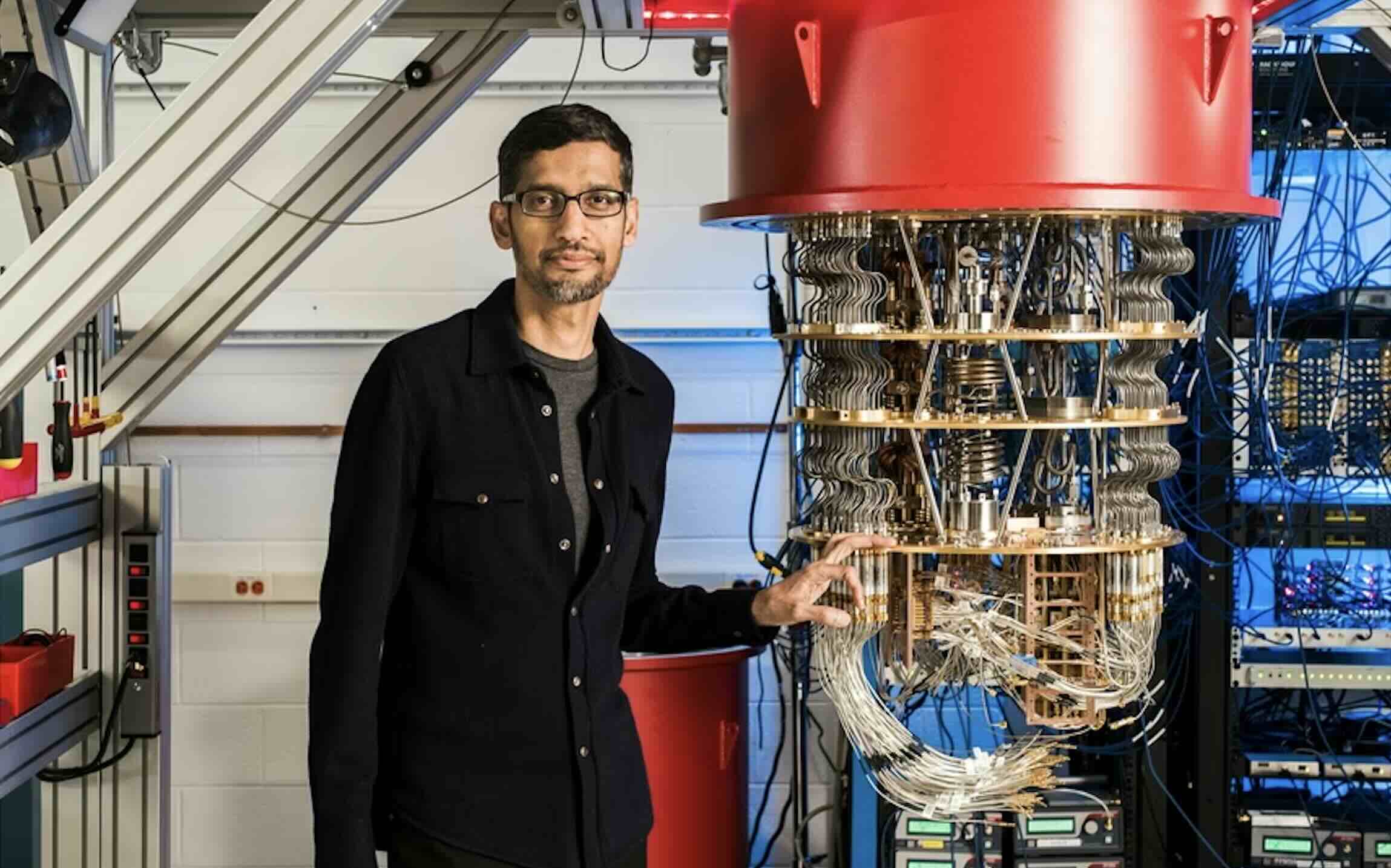
Photo: Google / Reuters
The science is real. The breakthroughs are historic. And that is precisely why the quantum computing industry is well positioned for the next great financial bubble. As of August 2026, the technology is at a critical inflection point, moving from the Noisy Intermediate-Scale Quantum (NISQ) era toward the dawn of early Fault-Tolerant Quantum Computing (FTQC). Yet, it is not physics that drives a bubble; it is human psychology—specifically, the fear of missing out (FOMO) and the intoxication of a magical narrative. Quantum computing offers the most powerful and incomprehensible narrative of our time, making it an irresistible target for speculation.
The comparison to Artificial Intelligence in 2015 is almost one-to-one. AI was a proven technology with immense potential, but it was seven years away from a mainstream "ChatGPT moment." However, its future promise allowed a massive investment bubble to form around infrastructure and hype, which is only now reaching a critical stage. Quantum computing is sitting in that exact same historical sweet spot. The fundamental error-correction problem—historically the greatest barrier to quantum computing due to decoherence—is being solved, as proven by Google's Willow chip and Quantinuum's Helios system. But a commercially viable, million-qubit fault-tolerant system is still a decade or more away. This gap between profound scientific reality and long-term commercial viability is the exact vacuum that bubbles fill with speculative hot air.
The setup is almost too perfect. First, there is the "Magic Box" factor. Because 99% of investors cannot explain how a qubit or quantum entanglement actually works, they cannot separate real milestones from clever marketing. When a startup promises to cure diseases or break global encryption using "subatomic particles existing in multiple universes," it sounds like science fiction, making it incredibly easy for hype artists to sell impossible promises. This total lack of public understanding is a prerequisite for a speculative frenzy. The industry's complexity allows companies to move goalposts indefinitely, legitimately replying to profit demands with, "This is deep physics; it takes a decade."
The Uncanny Parallel to AI
The parallel between quantum today and AI in 2015 is the structural blueprint. In 2015, AI had just experienced its "AlexNet moment." The fundamental math and hardware (GPUs) finally proved they could recognize objects better than humans. It was incredibly exciting to researchers and tech companies, but to the average consumer, it felt distant. ChatGPT was still seven years away. Quantum computing is sitting in that exact same historical sweet spot.
The Core Engineering Challenge is Solved: In 2015, neural networks didn't work well because computers were too slow. By 2015, researchers realized that plugging neural networks into modern Nvidia GPUs solved the speed bottleneck. Today, for decades, quantum computers didn't work because environmental noise caused too many errors. With recent breakthroughs in quantum error correction, we have finally proven that we can suppress these errors as the system scales. The underlying physics problem is solved; it is now strictly an industrial engineering race.
The Infrastructure is Transitioning to the Cloud: In 2015, tech giants began building out specialized AI cloud infrastructure so companies could rent GPU power. Today, we are entering the Quantum-as-a-Service (QaaS) era. Tech giants and cloud platforms—like IBM Quantum, AWS, Microsoft Azure, and Oracle Cloud—are actively integrating quantum processors (QPUs) directly into existing enterprise pipelines.
Early Use Cases are "Invisible" to the Public: In 2015, AI wasn't writing essays or creating video clips yet. Instead, it was working behind the scenes, silently improving Google Translate or flagging fraudulent credit card transactions. Today, quantum isn't doing anything consumer-facing. Instead, pioneering firms like Pfizer and HSBC are quietly running early hybrid quantum-classical calculations to test molecular drug designs or optimize financial risk models.
The Great Capital Migration
Wall Street is a giant pool of capital that needs to be fed high-growth stories. The current Generative AI boom will inevitably stabilize and consolidate into a few "boring" corporate utilities in the coming years. When billions in venture capital pulls out of AI, it will look for its next home. Quantum computing, with its world-changing potential and geopolitical importance, will be the obvious candidate. The same hype machine that drove the AI narrative will be copy-pasted onto quantum, promising returns even more astronomical than the last wave. Public government investments in quantum technology have already surpassed $10 billion, driven heavily by a tech and national security arms race between Washington and Beijing—a powerful signal that attracts FOMO-driven capital.
- Unlimited Funding: The geopolitical threat of a code-breaking machine ("Q-Day") ensures infinite funding. Startups can operate without revenue for years, artificially inflating their valuations.
- The Long Horizon: Because building a fault-tolerant quantum computer takes a decade, companies can move the goalposts without losing investor faith. "We're in deep physics" becomes a legitimate shield against profit demands.
- Quantum Washing: Just as we saw with ".com" in 1999 and "AI" in 2024, companies will add "quantum" to their names and pitch decks, often without a real product, to inflate their stock prices.
- Middleman Squeeze: The moment IBM, Google, or AWS roll out standardized, easy-to-use quantum software tools directly into the cloud, the consulting firms and small software startups charging high fees to "get ready for quantum" will evaporate.
The most fascinating aspect of this potential bubble is its "crash buffer." Unlike a pure software bubble, quantum computing is anchored by national defense. Because a working quantum computer can break encryption, governments cannot afford to let the technology stall. If private capital completely dries up, the U.S., China, and the European Union will step in to subsidize the surviving projects. This means the bubble might not burst as violently as the Dot-Com crash, but it will still wipe out a generation of weak startups.
The Generational Timeline of Tech Bubbles
The historical rhythm of tech bubbles is almost perfectly timed to a 10-to-12-year heartbeat. This regular cycle occurs because a decade is precisely how long it takes for the market to forget the pain of the last crash, for a new generation of investors to enter the room, and for engineering to produce a genuinely new computing platform.
- The 1980s: The Personal Computer & Biotech Bubble — The arrival of the microchip led investors to believe every home would have a PC immediately. The market crashed in 1987 because adoption took longer than predicted.
- The 1990s: The Dot-Com Bubble — The commercial internet arrived. Investors assumed traditional retail was dead and poured billions into any company with a ".com" in its name. The bubble burst in 2000 because high-speed internet infrastructure wasn't ready yet.
- The 2010s: The Easy-Money Tech & Crypto Bubble — A decade of near-zero interest rates fueled the explosive rise of smartphone apps, "unicorns," and the first massive wave of speculative cryptocurrency. The pop came in 2022 when interest rates rose.
- The 2020s: The Artificial Intelligence Bubble — The explosion of generative AI led to unprecedented corporate spending on data centers and microchips. As the market demands clear proof of profitability, capital is already beginning to look for the next macroeconomic wave.
The Bottom Line: Science vs. Speculation
The physics lab and the stock market are living in two different realities. The scientists are making slow, magnificent, decade-long progress. The marketers and financiers are taking those tiny breakthroughs and transforming them into a high-octane speculative narrative to capture early investment before the crowd wakes up.
Quantum computing is not just a candidate for the next bubble; it is perfectly positioned to be the defining bubble of the 2030s. It has the science, the narrative, the FOMO, and a unique safety net that makes it appear "crash-proof" to the average investor. When the bubble eventually pops, it won't mean the end of quantum computing. Like the internet after the Dot-Com crash, the surviving infrastructure will quietly change the foundation of human science. But between now and then, the speculation will be a wild ride.
It is easy to look at the massive headlines, billions of dollars in funding, and lack of consumer products and conclude that quantum computing is just another tech bubble like crypto or NFTs. However, the underlying technology is driven by verifiable physics, not speculation. The "Quantum Winter" of 2021–2022 has already filtered out the empty hype, and the money remaining in the field today is highly focused on hard engineering milestones. But as the technology moves from advanced prototyping to Quantum-as-a-Service (QaaS) cloud platforms, the business ecosystem around it remains a textbook setup for a major financial bubble. The science will survive. The infrastructure will change the world. But many investors will lose their shirts along the way.
No Ads. By Us. For Us.
This article was made possible by readers like you. We hope it inspired you to support Emerald Book, so we can continue producing content like this.
We will never show you ads, sell your data, or require a subscription to consume our content. Your gift helps us keep the truth accessible.
Click the Support button to give a gift of any amount today.
Thank you for making this work possible.