

Emerald Pages
◆
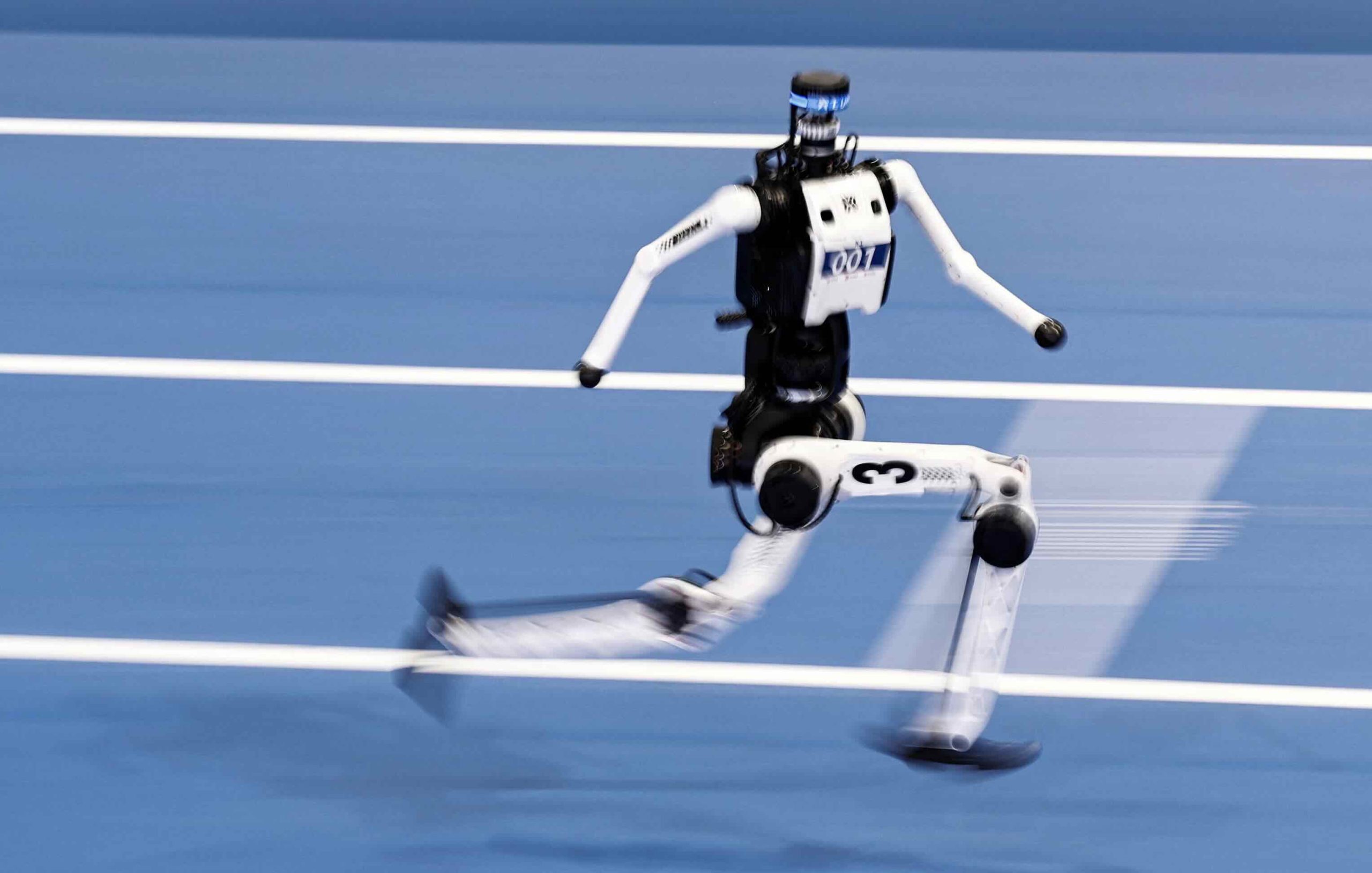
Photo: The 2026 World Humanoid Robot Games | Reuters
In Beijing, at the second annual World Humanoid Robot Games, a machine did the impossible. It ran 100 meters in 8.64 seconds, shattering Usain Bolt's legendary record. The headlines were triumphant: "Robots Beat Humans!" "The Future is Here!" It is a future that looks remarkably like a synthetic, perfectly efficient workforce. But to look closer at these metal sprinters, specifically at what they cannot do, is to see a path not to utopia, but to a profound and self-inflicted economic crisis.
These record-breaking robots are a marvel of hyper-optimization. They are built with custom-engineered legs, liquid cooling systems, and AI that allows them to run at 100% capacity from the starting gun. However, this incredible speed comes with a critical flaw: they cannot slow down. The robots are so hyper-focused on moving in a straight line as fast as possible that they lack the deceleration algorithms to stop safely, often crashing into padded barriers or bursting into flames at the finish line.
This inability to stop is a perfect metaphor for the industry itself. Tech companies, flush with cash from government initiatives and venture capital, are in a frantic race to build the "perfect worker"—a humanoid robot that can do everything a human can do, without the need for rest, pay, or rights. But they are so focused on raw acceleration that they are utterly blind to the catastrophic economic collision awaiting them at the end of the line.
The Hollow Victory: Beating a Human at a Robot's Game
The first thing to understand is that these record-breaking robots are not a triumph of general-purpose intelligence; they are a testament to specialized engineering. The robots that broke the 100m and 400m records are hyper-optimized for a single task: moving in a straight line on a perfectly flat track. They cannot navigate a cluttered warehouse, pick up a dropped bolt, or even safely come to a stop. The tech industry has chosen sports because it is a "solved problem" mathematically, unlike the chaos of the real world.
This distinction reveals a massive gap between marketing and reality. While these machines are built to mimic the human form, the human body is a terrible design for a machine. If you want the fastest machine, you use wheels. If you want the strongest, you use hydraulics. If you want the best jumper, you use springs. The humanoid form is only chosen because the world was built for humans, not because it is efficient. The human shape is the least efficient form a machine can take.
- The "Braking" Trade-off: Robots like Tiangong Ultra are so focused on forward velocity that they cannot decelerate safely, often crashing after crossing the finish line.
- Software Over Hardware: Humanoids are a "software shortcut" to avoid the trillions of dollars it would cost to redesign the world for specialized machines.
- The Publicity Stunt: Viral videos of robots running and doing backflips are marketing tools designed to attract investment, not indicators of real-world utility.
The goal of these companies is to create what is, in essence, a synthetic slave—an uncomplaining, unpaid, and infinitely reproducible workforce. The term "robot" itself comes from the Czech word robota, which literally means "forced labor" or "serfdom." By framing this as a solution to a "labor shortage," tech companies are rebranding an attempt to shift maximum economic power from human labor to corporate capital.
The Economic Suicide Paradox
The pursuit of a total synthetic workforce is not just a moral failing; it is a textbook example of economic suicide. The foundational rule of capitalism is a circular flow of money: businesses pay wages to workers, and workers spend those wages to buy goods and services. If you successfully replace the human workforce, you destroy the very consumer base that keeps corporations alive. This is a systemic failure known as the "Macroeconomic Consumption Trap."
Consider the simple fact: a humanoid robot can build a car, but it will never buy one. It will never eat groceries, pay rent, stream movies, or go on a vacation. If human wages are removed from the equation, consumer demand evaporates. Corporations will be left with hyper-efficient factories producing millions of products that no one has the money to buy. This is the ultimate dead end of full automation.
Furthermore, the collapse of the labor market would lead to a catastrophic concentration of wealth and the collapse of the tax base. If millions of humans lose their jobs, government tax revenues from income and payroll taxes plunge to zero. Without the infrastructure that governments provide—roads, power grids, courts, and police—corporations cannot operate safely or efficiently. The tech industry is racing to build the perfect worker, completely blind to the fact that they are destroying the customer and the very system that supports their business.
A Century-Old Lesson Ignored
This is not a new concept. Henry Ford famously understood this dynamic a century ago when he doubled his factory workers' wages to $5 a day. He didn't do this out of charity; he did it because he realized that if his own workers couldn't afford to buy a Model T, his business would fail. Ford understood that a healthy business requires a healthy consumer base. Today's tech barons, in their race for the "perfect worker," seem to have forgotten this fundamental truth.
The current reality is that true, generalized labor replacement is still decades away. The path to a humanoid that can navigate a messy, unstructured environment is blocked by thousands of microscopic problems: energy density, tactile feedback, environmental ruggedness, and the sheer cost of maintenance. The tech industry is trying to build a sci-fi future, but nature's blueprint for humanity remains entirely out of reach. They are betting billions on a vision that, even if successful, would lead to the collapse of the global economy.
So, the next time you see a robot break a world record, remember what it represents. It is not a victory for humanity; it is the hollow, explosive crash of a machine that could not slow down, a perfect symbol for an industry hurtling toward its own economic destruction.
No Ads. By Us. For Us.
This article was made possible by readers like you. We hope it inspired you to support Emerald Book, so we can continue producing content like this.
We will never show you ads, sell your data, or require a subscription to consume our content. Your gift helps us keep the truth accessible.
Click the Support button to give a gift of any amount today.
Thank you for making this work possible.