

Emerald Pages
◆
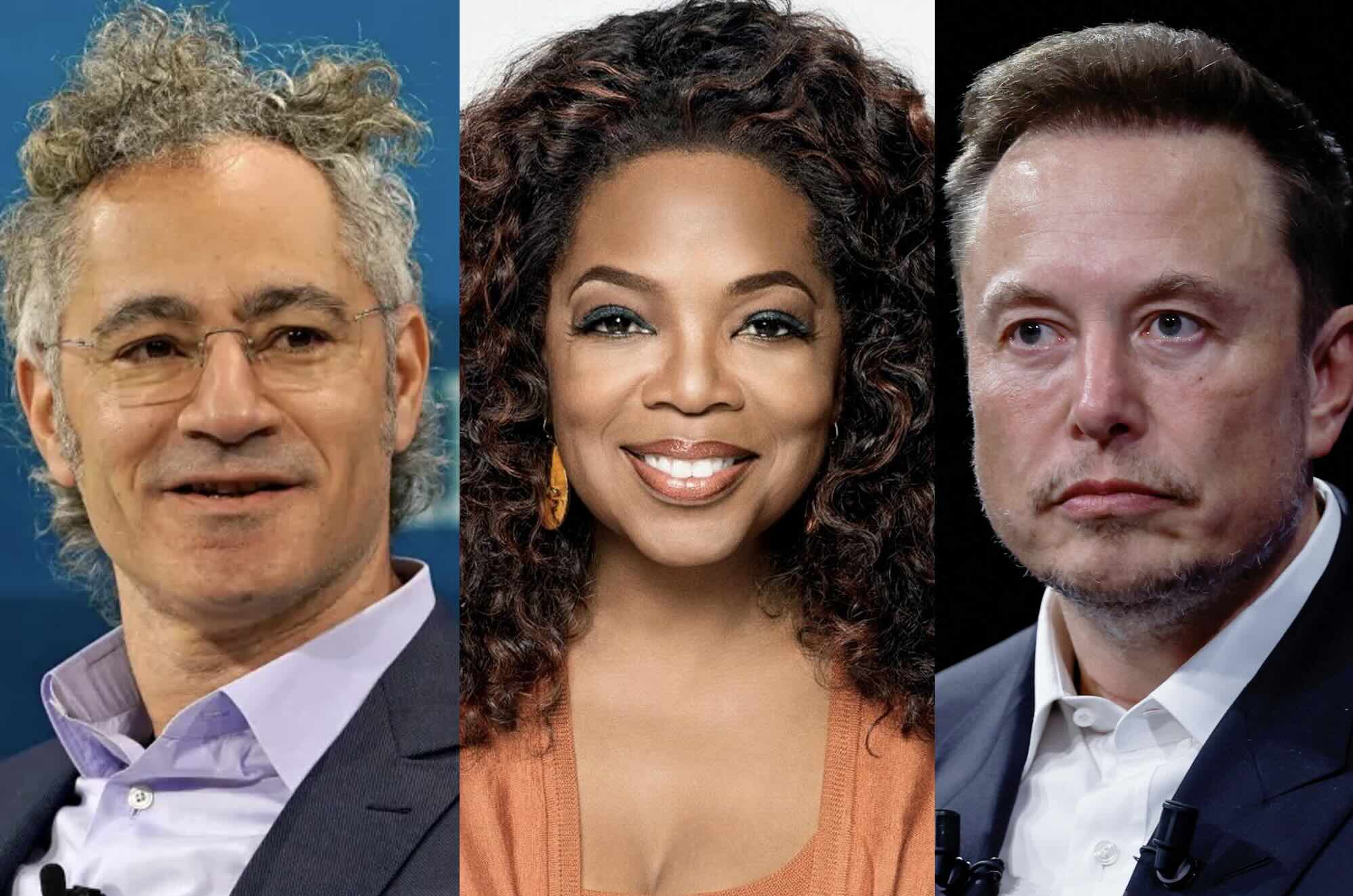
Forbes classifies Elon Musk (right), Oprah Winfrey (center), and Alex Karp (left) as "self-made" billionaires. | Photo: Emerald Book Image
TThe term "self-made" is one of the most celebrated titles in modern culture, conjuring images of figures like Oprah Winfrey, Jay-Z, or Elon Musk—individuals who seemingly pulled themselves from the brink of obscurity to the pinnacle of global wealth. It is a story we love to tell. It reinforces the belief in a pure meritocracy, where hard work and grit are the only currencies that matter. However, a rigorous examination of the data, history, and mathematical probabilities reveals a starkly different reality: the "self-made" label is, at best, a massive misnomer, and at worst, a deliberate illusion.
The myth begins with a misunderstanding of the term's history. The phrase "pull yourself up by your bootstraps" is famously used to describe overcoming adversity through sheer personal effort. However, when this phrase was coined in the early 19th century, it was intended as a joke—a literal description of an impossible physical feat. Over time, an intentional joke about an impossibility was repurposed as the baseline expectation for the working class. The modern "self-made" label operates on the same logical fallacy, attributing an outcome of immense statistical luck to personal moral virtue.
In the business world, the definition is highly debated, splitting into three distinct perspectives. Historically, it celebrated individuals who rose from poverty through diligence. In practice, it has become a technicality to differentiate those who inherited a company from those who built a new one. This allows the term to range from true "bootstrappers" to individuals with massive safety nets, family capital, and elite networks. This is why a label that sounds like a testament to pure individual grit is often used to describe what is, in reality, an upper-middle-class head start.
The Mathematical Impossibility
The most damning evidence against the "self-made" myth is the raw statistical improbability of moving from economic zero to elite wealth. Data from landmark economic studies, including Raj Chetty’s Opportunity Insights project, reveals exactly how sticky the wealth brackets are. If you are born into the bottom 20% of income earners, your chances of climbing to the top 20% are a mere 4% to 7.5%. The odds of reaching the top 10% fall to a staggering 1.5% to 3%, and reaching the top 1% is a near-impossible 0.1% to 0.5%.
To put this in perspective, only about 1 in 500 children born into poverty will ever enter the top 1%. When the media reports that "67% of billionaires are self-made," it creates the illusion that this is a common track. In reality, a massive chunk of that 67% includes people who started in the top 1% to 5% of earners. Their starting point was already at the finish line for most everyday people. This is a classic example of Survivorship Bias—looking only at the few who made it and ignoring the millions who started with the same grit but lacked the systemic advantages.
The "Silver Spoon" Self-Made
To fix the broken definition, Forbes created a Self-Made Score from 1 to 10. The score reveals the absurdity of the label. Roughly 70% of billionaires are labeled "self-made," but nearly 80% of that group were born into the top economic tiers of society. This means the media's "self-made" narrative is hiding the fact that most billionaires didn't start at zero; they were born on second or third base.
For instance, Elon Musk, Jeff Bezos, Bill Gates, and Alex Karp—all top-tier icons—score a 7 or 8 on the Forbes scale. They grew up in comfortable, educated households (often top 5% to 10% families). Their parents were doctors, lawyers, or executives, providing debt-free elite college educations and six-figure seed investments. Musk grew up in an upper-class South African family, Bezos's parents famously gave him a $245,000 investment for early Amazon, and Karp—whose father was a dentist and mother an artist—was raised in a wealthy Philadelphia suburb before co-founding Palantir. They all had a "golden trampoline" that allowed them to take massive risks without the fear of financial ruin, a luxury that is entirely absent for someone from the working class.
This is why, when we talk about "self-made," it often just means "wasn't rich before," a label that technically fits 95% to 99% of the human population. By this flawed standard, a person whose parents paid for their Ivy League tuition and early business capital gets the exact same label as someone who grew up on food stamps. It completely flattens the definition of "rich." To a billionaire, a family making $500,000 a year looks "normal," but to the other 98% of the world, that starting point is a fantasy.
The True Anomalies
In the rare cases where individuals do beat the 99.8% failure rate and start from absolute zero, the "self-made" label becomes a celebration of an anomaly, not a standard career path. Figures like Oprah Winfrey and George Soros are textbook examples of true bootstrappers. Oprah was born to an impoverished teenage single mother in rural Mississippi, survived severe childhood trauma, and built a global media empire from nothing. George Soros, a Jewish teenager in Nazi-occupied Hungary, adopted a false identity to survive the Holocaust, later working as a railway porter to put himself through the London School of Economics before building his hedge fund empire.
These individuals didn't just work hard; they possessed a rare combination of generational talent, relentless aggression, and immense situational luck. Their stories are awe-inspiring, but they are statistical miracles—not proof of a functioning meritocracy. Labeling these anomalies as "self-made" and holding them up as a blueprint creates a cruel illusion. It suggests that the 499 other people who failed just didn't try hard enough, attributing math to merit and translating a systemic lottery into a moral report card.
Ultimately, the data proves that while the "American Dream" trajectory is technically possible, it requires a perfect alignment of extreme personal effort and immense luck in a system with a 93% to 96% failure rate. The term "self-made" is, therefore, not a literal description of how wealth is built. It is a marketing phrase that erases collective infrastructure, ignores intergenerational momentum, and creates a false blueprint for success. It doesn't mean did it on their own; it just means they weren't rich before.
No Ads. By Us. For Us.
This article was made possible by readers like you. We hope it inspired you to support Emerald Book, so we can continue producing content like this.
We will never show you ads, sell your data, or require a subscription to consume our content. Your gift helps us keep the truth accessible.
Click the Support button to give a gift of any amount today.
Thank you for making this work possible.