

Emerald Pages
◆
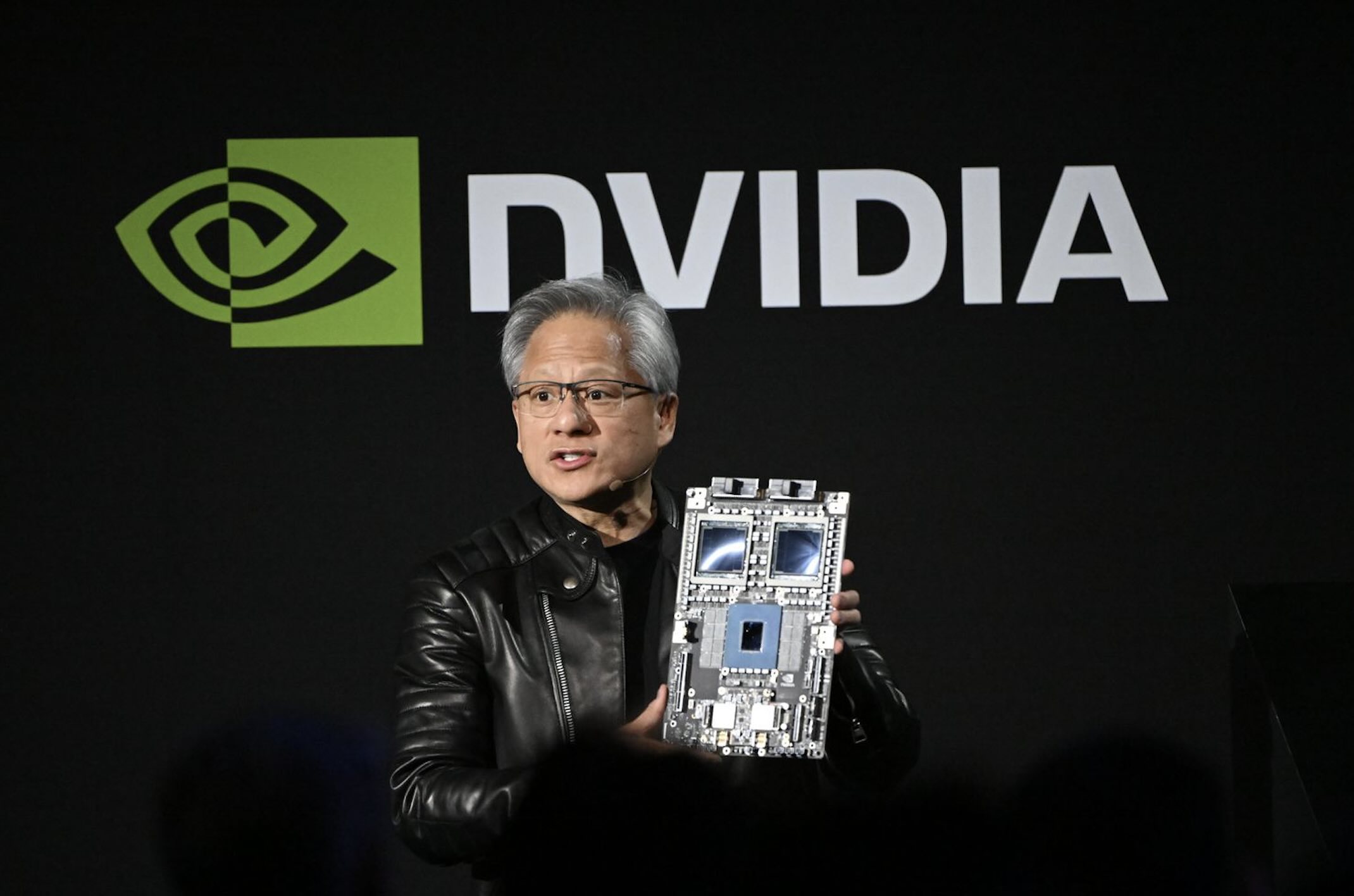
Photo: Bloomberg / Getty Images
In the span of just a few years, Nvidia has transformed from a niche video game graphics company into the most valuable publicly traded corporation on Earth, with a market capitalization of approximately $5.2 trillion. The company now generates over $253 billion in trailing twelve-month revenue and keeps nearly 63 cents of every dollar as pure profit—a margin that would make even the most successful software companies envious. But beneath the staggering financial numbers lies a troubling reality: Nvidia has effectively become the operating system for the global economy, and its unprecedented concentration of power has rendered the American economy dangerously fragile.
The company controls between 70% and 95% of the global AI chip market—the essential hardware required to train and run the artificial intelligence models that are rapidly becoming the backbone of modern commerce, defense, and communication. Every major technology company, from Microsoft and Google to Amazon and Meta, depends almost entirely on Nvidia's graphics processing units (GPUs) to power their AI ambitions. Nvidia's H100 and Blackwell chips have become the new gold standard, and owning them has become a competitive necessity.
The Chokehold: How Nvidia Controls the AI Supply Chain
Nvidia's dominance rests on a seemingly unassailable moat built around its proprietary CUDA software platform. Launched in 2006, CUDA has become the industry standard for AI programming. For two decades, researchers, engineers, and developers have learned to write code specifically optimized for Nvidia's architecture. This creates a massive barrier to entry for competitors: even if AMD or Intel produce cheaper or faster chips, customers would face the enormous cost and complexity of rewriting millions of lines of code to escape the Nvidia ecosystem.
The scale of Nvidia's market control is staggering. The company commands between 70% and 95% of the global AI chip market, making it the sole gatekeeper of AI infrastructure. Its CUDA software platform has become the industry standard, creating a lock-in effect that makes switching to competitors nearly impossible. Over 50% of Nvidia's data center revenue comes from just a few hyperscaler customers, and the company's 63% net profit margin means it keeps $63 of every $100 in revenue—far higher than typical hardware companies, which usually operate on margins of 10% to 25%.
This concentration of power has created what economists call a "single point of failure" in the global technology supply chain. Because Nvidia does not manufacture its own chips—relying instead on TSMC in Taiwan for fabrication—the entire AI industry is vulnerable to disruption from geopolitical conflict, natural disasters, or manufacturing defects. A military confrontation over Taiwan, a severe earthquake, or a catastrophic design flaw in Nvidia's next-generation Blackwell architecture could instantly bring the global AI industry to a standstill.
The Reverse Problem: Nvidia's Own Fragility
While the world relies on Nvidia, Nvidia itself relies almost entirely on a single company: TSMC. Nvidia designs the blueprints for its chips but does not own a single manufacturing facility. TSMC is the only company on Earth with the advanced lithography technology required to produce Nvidia's ultra-advanced Blackwell and Vera Rubin architectures. If production at TSMC's Taiwanese fabrication plants is disrupted, Nvidia has no backup plan—and neither does the global economy.
Nvidia's entire $5.2 trillion valuation rests on the continued operation of TSMC's factories in Taiwan, yet building a replacement advanced fabrication plant takes three to five years and costs hundreds of billions of dollars. A geopolitical conflict over Taiwan would cut off Nvidia's entire chip supply, leaving customers with nothing to buy for years. This creates a stunning paradox: the world's most valuable company is also one of the most structurally fragile. Nvidia's success is built on a foundation of concentrated risk, and a single geopolitical or manufacturing shock could bring its empire—and the global AI industry—crashing down.
The American Economic Dilemma
The fragility of Nvidia's position is amplified by its impact on the American economy. Because Nvidia's stock makes up such a massive percentage of major index funds like the S&P 500 and Nasdaq, a sharp correction in its share price would automatically drag down the entire U.S. stock market. Millions of Americans holding 401(k) and retirement accounts would see the value of their savings evaporate overnight, crushing consumer confidence and spending across the country.
Nvidia's 5.2% weighting in the S&P 500 means a stock correction would erase trillions in household wealth almost instantly. American businesses must pay exorbitant premiums for Nvidia hardware, costs that are passed directly to consumers in the form of higher digital subscription fees and tech-enabled service prices. Meanwhile, venture capital and private equity are disproportionately funneled into AI and Nvidia-related investments, starving other critical sectors like clean energy, manufacturing, and biotech of much-needed funding. Adding to the risk, billions in private credit loans have been issued using Nvidia GPUs as collateral, creating a shadow banking system that could unravel quickly if AI demand falters.
These structural vulnerabilities have led many analysts to draw parallels between Nvidia today and Cisco Systems during the dot-com bubble. Cisco briefly became the world's most valuable company in March 2000 by selling the routers that powered the internet boom. When the bubble burst, Cisco lost over 80% of its value, and the broader economy suffered years of stagnation. While Nvidia's profits are real and immediate—unlike many of the speculative dot-com startups—the structural concentration of risk remains dangerously similar. And the echoes of 2008 are also present: the shadow banking system built around GPU-collateralized loans mirrors the mortgage-backed securities that triggered the global financial crisis. The primary saving grace is that Nvidia's customers are cash-rich giants like Microsoft and Google, not subprime borrowers.
The Consumer Fallout
Ultimately, the fragility of Nvidia's chokehold will be tested by consumer demand for AI-powered products. Companies like Microsoft, Google, and Meta have spent hundreds of billions of dollars building AI infrastructure on Nvidia's chips, but consumer adoption of AI services has been slower than expected. If the AI monetization gap persists—if consumers and businesses do not adopt AI software at the pace required to justify the infrastructure spending—Big Tech may be forced to cut capital expenditures.
Big Tech is spending trillions on AI hardware but has yet to see consumer revenue match the investment. Microsoft, Google, Amazon, and Meta are all developing their own custom AI chips to reduce their reliance on Nvidia. At the same time, the UXL Foundation—backed by Intel, AMD, Google, and Samsung—is building an open-source alternative to CUDA to break Nvidia's software monopoly. Meanwhile, competitors like AMD and Google's TPUs are steadily approaching a "good enough" threshold at half the cost, which would collapse Nvidia's pricing power if reached.
Any of these scenarios could trigger a wave of cancellations on Nvidia's multi-year order book. Because Nvidia's factories are scheduled years in advance based on these massive orders, a sudden cancellation wave would cause revenues to plummet, triggering a financial crisis that could ripple through the private credit markets and into the broader American economy.
The situation is not hopeless, but it demands immediate attention. Policymakers must address the concentration of supply chain risk, regulators must examine Nvidia's anti-competitive practices, and investors must recognize the fragility built into the AI infrastructure boom. The United States cannot afford to have its economic future dependent on a single company's ability to execute flawlessly, year after year, in the face of overwhelming geopolitical and technical challenges.
Nvidia's dominance is a testament to the company's extraordinary engineering and strategic vision. But it is also a warning. When one company becomes the gatekeeper for the entire global economy, the consequences of failure are not limited to shareholders—they impact every American worker, retiree, and consumer. The AI boom has given Nvidia unprecedented power, but that power comes with unprecedented risk. The question is not whether Nvidia can maintain its lead—it is whether the American economy can survive the fall if it doesn't.
No Ads. By Us. For Us.
This article was made possible by readers like you. We hope it inspired you to support Emerald Book, so we can continue producing content like this.
We will never show you ads, sell your data, or require a subscription to consume our content. Your gift helps us keep the truth accessible.
Click the Support button to give a gift of any amount today.
Thank you for making this work possible.