

Emerald Pages
◆
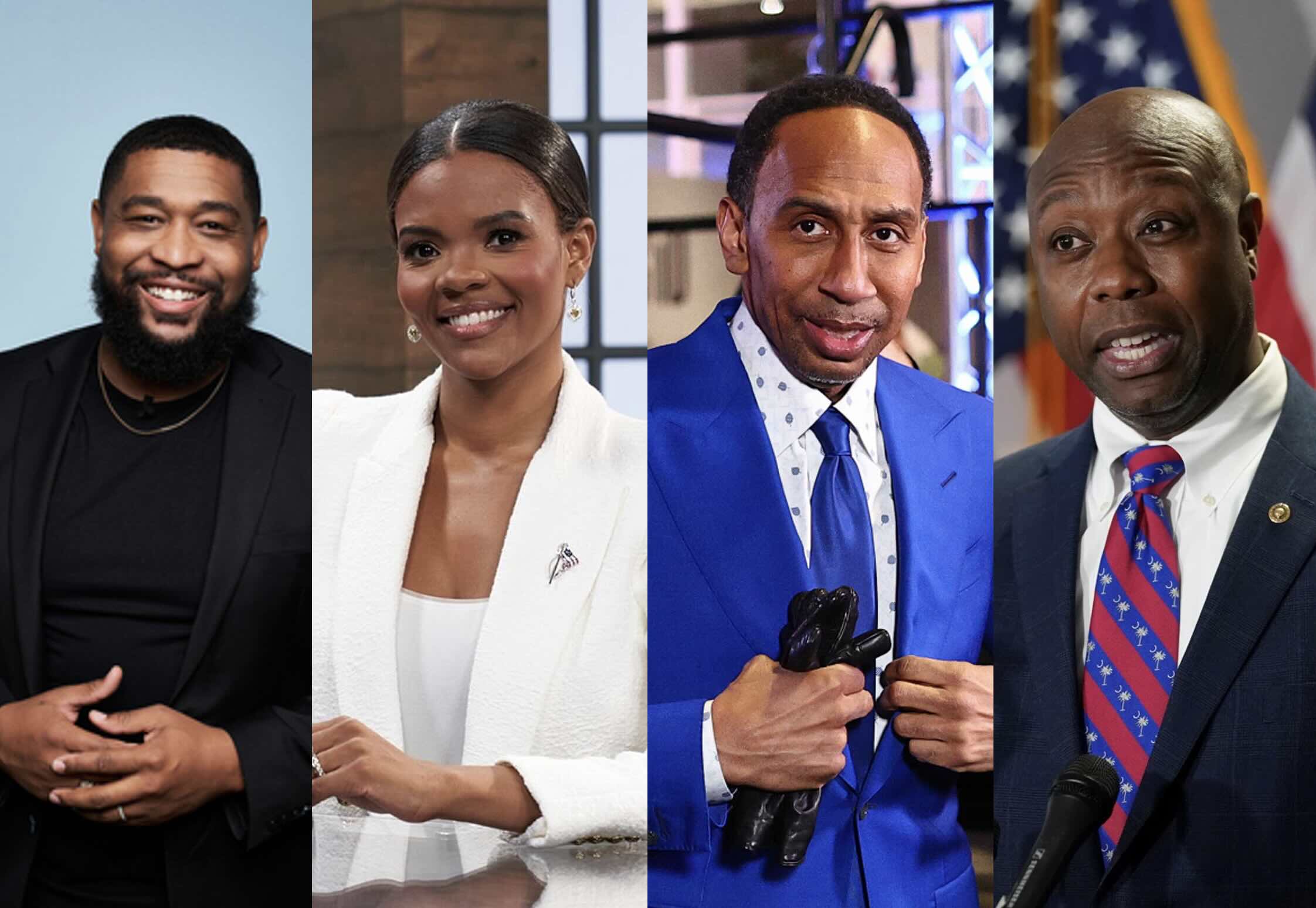
Public figures Candace Owens (center left), Brandon Tatum (left), Stephen A. Smith (center right), and Sen. Tim Scott (right) have been criticized for amplifying narratives that harm the Black community. | Emerald Book Image
The concept is deceptively simple—and devastatingly effective. Internalized racism is a subconscious phenomenon where individuals from racially marginalized groups absorb, believe, and apply negative societal stereotypes against their own racial or ethnic identity. It happens when the toxic messaging of structural and systemic racism becomes integrated into a person's core sense of self, leading them to treat the dominant culture as the universal standard of worth, capability, and beauty.
This is not a personal failing. According to mental health professionals and sociologists, internalized bias is a learned response to a systemic environment—which means it can be unlearned. But the damage it inflicts in the meantime is profound, extending far beyond individual psychology and into the very fabric of Black life in America.
And when that subconscious poison is amplified by influential public figures, it becomes something even more dangerous: a weapon that provides political cover for systemic injustice, shifts blame from oppressors to the oppressed, and actively stalls progress toward equality.
A Poison That Operates From Within
Internalized oppression distorts self-perception and shapes behavior in several distinct ways. It manifests as self-devaluation—the assumption that one's own racial group is inherently less intelligent, capable, or valuable. It shows up as altered beauty standards, with Eurocentric features prioritized and natural hair textures rejected. It drives cultural rejection, suppressing native accents, regional dialects, and ancestral traditions in favor of assimilation. And it creates lateral bias, where individuals distance themselves from their own community or reproduce mainstream prejudices within marginalized spaces.
These patterns play out across four major dimensions: internal and psychological manifestations (the "imposter" feeling, hyper-vigilance, self-doubt), interpersonal and lateral manifestations (colorism, distancing, gatekeeping), cultural and aesthetic manifestations (skin-bleaching, hair straightening, linguistic code-switching out of shame), and institutional reinforcement (blaming systemic disparities on cultural flaws rather than historical barriers). The habits feel like common sense—until they are examined under the harsh light of data.
A Public Health Crisis
The psychological toll of internalized racism is not abstract—it is measurable. Studies published in the National Institutes of Health's PubMed Central database show that internalized racism acts as what researchers call a "danger multiplier." Individuals who have absorbed anti-Black biases suffer statistically higher rates of severe anxiety and major depressive episodes when faced with discrimination, because they subconsciously believe the mistreatment is justified.
The biological consequences are equally stark. Epidemiological research tracking leukocyte telomeres—the protective caps on chromosomes that shorten with stress and age—found that Black men with high implicit anti-Black bias exhibit significantly shorter telomeres. This chronic, internalized stress causes premature cellular aging, increasing vulnerability to cardiovascular disease and early mortality.
Reproductive health is also affected. Public health researchers have linked internalized oppression to elevated glucose intolerance, high blood pressure, and chronic psychological distress in Black women—factors that contribute directly to disproportionately high rates of pregnancy-related complications.
And yet, the healthcare system itself is complicit. Black Americans are four times more likely to be diagnosed with schizophrenia than white peers presenting with the same symptoms, while being severely under-diagnosed with standard, treatable mood disorders. Only one in three Black adults who need mental health care actually receives it, often waiting until a crisis to seek help.
Colorism: The Internal Hierarchy
Colorism is one of the most visible byproducts of internalized racism—the valuation of lighter skin tones and Eurocentric features over darker skin within the same community. Its impact is quantifiable and devastating.
Harvard University researchers found that darker-skinned Black defendants face a steeper statistical penalty inside the judicial system. Even controlling for the exact same crime and criminal history, darker-skinned individuals receive longer, more punitive prison sentences than lighter-skinned defendants. The disparity is driven in part by internalized biases held by Black jurors, judges, and legal professionals.
For Black women, the damage is personal. As skin color becomes darker, perceived discrimination from other African Americans increases. This specific form of colorist rejection serves as a distinct predictor of severe clinical depression and low self-worth.
The Amplifiers: Public Figures Who Validate the Poison
Internalized racism is harmful enough when it operates in silence. But when it is validated, broadcast, and monetized by high-profile public figures, the damage becomes external and measurable. Sociologists point to a specific archetype: Black public figures who comfort the dominant culture by validating the idea that "racism is over" or that "the community is to blame." They are rewarded with lucrative platforms, corporate backing, and high-visibility status.
Candace Owens is perhaps the most recognizable example. With over 6 million YouTube subscribers and tens of millions of monthly impressions, her political commentary reaches a massive audience—and critics say she uses that platform to provide "racial cover" for anti-Black policies. She has labeled Black civil rights movements like Black Lives Matter as "black anarchy" and called victims of police brutality "thugs." Media observers note that Owens is elevated by right-wing media precisely because she reassures non-Black audiences that systemic racism is a myth.
Brandon Tatum, a former police officer turned conservative commentator, operates on a similar wavelength. His YouTube channel "The Officer Tatum" has over 3 million subscribers and has accumulated more than 571 million views—placing him in the top 0.13% of global creators. Tatum has explicitly defended the claim that systemic racism does not exist, arguing it is merely "used as an excuse to avoid personal accountability." He frequently uses his own life trajectory as proof that there are "no barriers" left for Black Americans. But his half-billion-view platform directly contradicts Bureau of Justice Statistics showing Black drivers are twice as likely to be searched—and he uses his police credentials to mask documented judicial inequalities.
Stephen A. Smith represents a different kind of harm. Unlike Owens and Tatum, Smith does not completely deny racism; he has spoken out on issues like white privilege in coaching hires. But his sports media persona frequently slides into respectability politics and what critics call "targeted asymmetrical vitriol"—intense criticism of Black athletes (like Kyrie Irving, LeBron James, and Kevin Durant) that he rarely applies to white athletes or executives. Smith's recent five-year, $100 million contract extension with ESPN is a study in incentives: the deal explicitly grants him corporate freedom to comment on politics, demonstrating that major media entities place immense value on a Black figure who soft-pedals institutional racism while policing the decorum of Black professionals.
The Legislative Bludgeon: Tim Scott
The harm extends beyond media personalities into the halls of Congress. U.S. Senator Tim Scott of South Carolina, the only Black Republican in the Senate (1 out of 100), wields legislative power that directly impacts Black lives—and critics say he uses his identity to shield policies that harm the community.
Following the murder of George Floyd, Scott was chosen as the lead Republican negotiator for federal policing legislation. Negotiations collapsed because Scott refused to alter qualified immunity, a legal doctrine that protects police officers from personal liability when they violate constitutional rights. By drawing a hard line against accountability, Scott provided the necessary political cover for Congress to block the George Floyd Justice in Policing Act. Today, Black Americans continue to be killed by police at more than double the rate of white Americans.
Scott has also used his personal success as an "extreme outlier"—a single Black senator among 100—to argue that systemic barriers no longer exist. He has publicly declared that "America is not a racist country," a statement that provides racial absolution to dominant political structures. As Chair of the National Republican Senatorial Committee, Scott is responsible for managing over $400 million in campaign funds, which he uses to elect politicians whose agendas include rolling back voting rights and defunding public schools in marginalized communities.
The Numbers Don't Lie
When public figures assert that systemic barriers are nonexistent, they directly contradict overwhelming empirical evidence. The data tells a stark story:
- Policing: According to the Bureau of Justice Statistics, Black drivers are more than twice as likely to be searched or arrested during traffic stops, and over three times as likely to experience the threat or use of force. In thousands of stops analyzed, Black drivers were searched more than twice as often as white drivers—but were actually 11% less likely to carry contraband.
- Wealth: White families hold 84.2% of all U.S. wealth despite making up only 66% of households. Black families account for 11.4% of households but own just 3.4% of total family wealth. The median Black family's net worth sits at roughly $44,100—just 15.5% of the $282,310 median wealth held by white families.
- Hiring: Large firms favor white applicants over Black applicants by an average margin of 9% to 24%, even when resumes list identical qualifications. AI resume-screening tools have been found to select white-associated names 85% of the time while Black-associated names are preferred only 9% of the time.
The Economic Incentive
Why do these figures continue to amplify harmful narratives? Simple—economic incentive. The media landscape creates a lucrative ecosystem for Black voices who tell the dominant culture exactly what it wants to hear—that systemic racism is an illusion, that equity initiatives are unnecessary, and that the struggles of marginalized people are entirely their own fault. By acting as gatekeepers of these ideas, figures like Owens, Tatum, and Smith secure massive platforms, corporate backing, and high-visibility status.
Stephen A. Smith's $100 million contract is perhaps the clearest example. Disney and ESPN are willing to pay $20 million annually for a Black commentator who subjects Black athletes to hyper-criticism while downplaying institutional racism. That is the market value of respectability politics.
As the psychologist and sociologist Hussein A. Bulhan observed, "The Manichean psychology permeates the prevailing values and beliefs. The oppressor identifies himself... and the oppressed internalizes the oppressor's image." In 2026, that process is highly profitable.
The Path Forward
Unlearning internalized bias is possible. Mental health professionals emphasize that because it is a learned response to a systemic environment, it can be intentionally unlearned over time. Strategies include confronting subconscious prejudices, fostering racial esteem by celebrating cultural heritage, and utilizing literature and sociological resources to untangle learned social patterns.
But the public amplification of internalized racism—by Owens, Tatum, Smith, Scott, and others—remains a powerful obstacle. When the message that "racism is over" or "the community is to blame" is repeated by influential voices and backed by millions of dollars, it becomes harder to see the truth: that systemic inequality is real, that it is measurable, and that it is actively harming Black communities every day.
No Ads. By Us. For Us.
This article was made possible by readers like you. We hope it inspired you to support Emerald Book, so we can continue producing content like this.
We will never show you ads, sell your data, or require a subscription to consume our content. Your gift helps us keep the truth accessible.
Click the Support button to give a gift of any amount today.
Thank you for making this work possible.