

Emerald Pages
◆
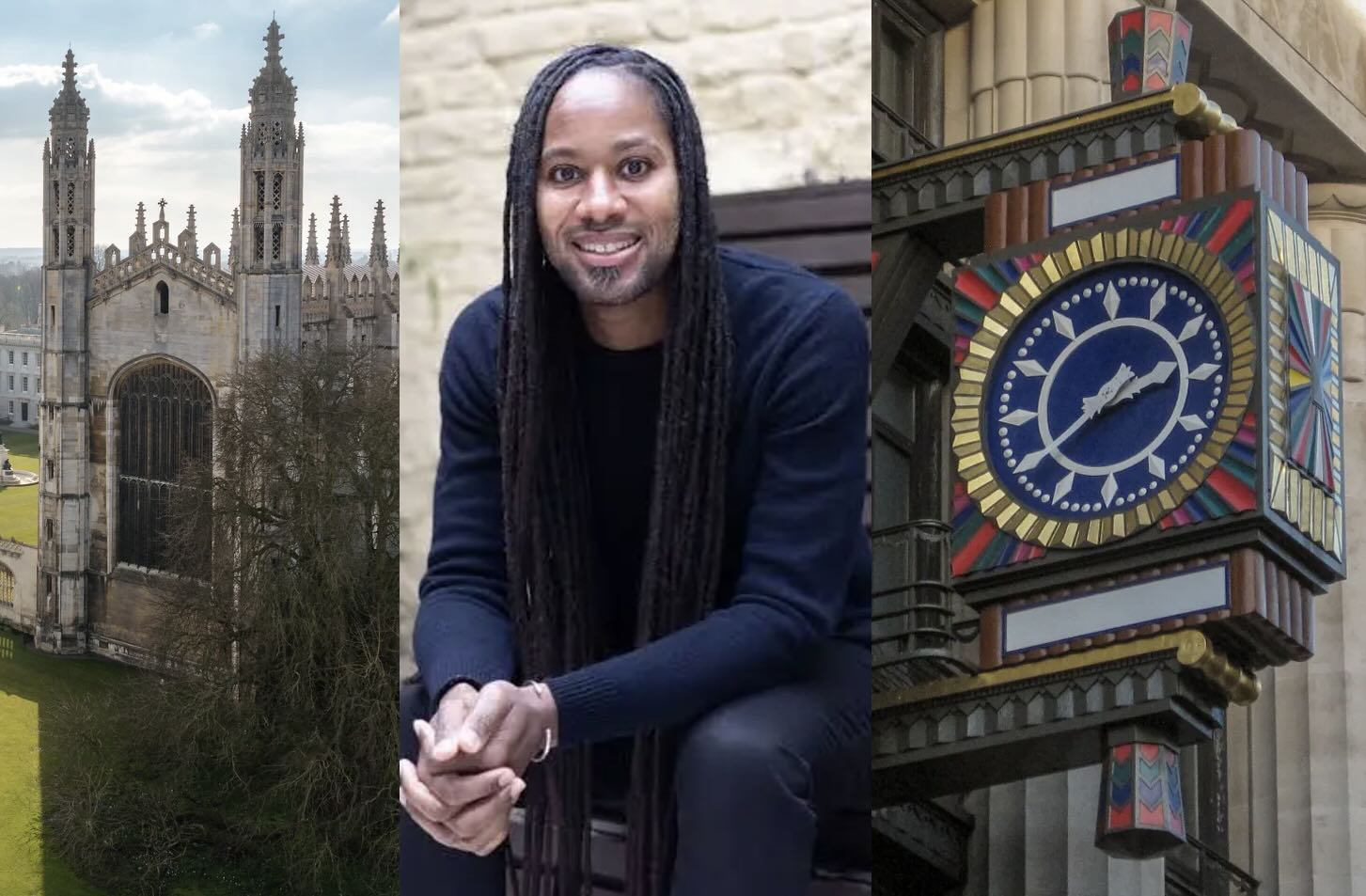
Photo: The University of Cambridge (left), Jason Arday (center), The Telegraph (right) | Emerald Book Image
The story of Jason Arday was never simply about one man. It was a tragedy written in two acts, a devastating play performed by two powerful actors: the University of Cambridge and the British media. The narrative is painfully simple and devastatingly clear—the university set him up to fail, and the press finished the job. The death of the 41-year-old sociologist, who was found dead at his home in Battersea, South London, on August 14, 2026, is not just a personal tragedy but a profound institutional failure that has sent shockwaves through British academia. The Metropolitan Police stated that his death is being treated as unexpected, but it is not believed to be suspicious.
In 2023, Cambridge University appointed Arday to a prestigious, senior professorship, making him the youngest Black professor in its history. It was a moment of celebration, a headline-grabbing milestone for a university often criticized for its lack of diversity. However, behind the scenes, the university appears to have bypassed the most basic administrative due diligence. Senior faculty members later admitted they had never read his work. The university failed to run standard software checks on his publications or independently verify details on his CV—including certain visiting professorships and specific fundraising numbers—before placing him into one of the most scrutinized positions in the world. They were so eager for the "historic" headline that they neglected the necessary vetting, leaving their new star hire completely exposed to the inevitable scrutiny.
When the inevitable accusations surfaced—ignited by Dr. Nathan Cofnas, a former Cambridge philosophy researcher with a well-documented history of promoting eugenics and race-realism theories (claiming Black people have lower average IQs)—the university panicked. Cofnas, who had recently been dismissed from his own Cambridge role following intense protests over his race-realism blogs, used his personal newsletter to publish the initial evidence of plagiarism in Arday's 2015 doctoral thesis. Instead of taking accountability for its own administrative negligence—having failed to conduct basic due diligence during the hiring process—Cambridge bowed to internal and external pressure and launched an investigation into Arday himself. This was a classic corporate maneuver: investigate the employee to deflect blame from the systemic failures of the employer. Dozens of Cambridge academics signed a letter demanding an independent inquiry into his background, with some expressing anger over how his senior appointment was handled. Over 100 senior faculty members revolted against their own leadership, arguing that the university was trying to investigate Arday to cover up its own negligence. On August 5, 2026, Arday resigned as a professor and fellow of Jesus College, noting that the "personal cost" of the relentless public commentary had become too great to bear. Even after his resignation, Cambridge confirmed that its investigation would continue regardless, intending to use the findings to audit and revamp its broader hiring processes—an admission that its own systems were broken from the start.
The Media: The Finishing Blow
The media took the baton from the university and ran with it, transforming a localized academic dispute into a national culture-war referendum. In the weeks leading up to his resignation and death, the press unleashed a "media pile-on" of staggering proportions. Investigative tracking indicates that nearly 250 articles were written about Jason Arday across dozens of major local and international news organizations before his death, with 188 of them appearing in the final nine days of his life.
This was not standard reporting. The coverage was led by dominant UK and international publications, including The Telegraph, The New York Times, The Times (UK), and independent academic watchdogs like Retraction Watch. Outlets like The Telegraph published at least a dozen separate front-page investigative features, explicitly branding Arday with headlines like "Cambridge's diversity poster boy." The press did not just focus on his thesis; they launched full-scale investigations into his life—auditing his charity running times, questioning his childhood medical records (including his autism diagnosis), investigating his claims of overcoming severe childhood developmental delays (being non-verbal until age 11 and illiterate until his late teens), and even contacting old acquaintances. Each detail became a new story, creating an endless, relentless cycle of torment.
A Double Standard Exposed
The disparity in coverage is the most damning piece of evidence. Other professors at Cambridge and across the UK have faced far worse accusations—some of which were upheld by internal investigations. Yet they did not have 250 articles written about them in a matter of weeks. Consider Professor Simon Goldhill, a high-profile Professor of Greek Literature, against whom an internal investigation upheld complaints of severe professional and sexual misconduct in early 2026. Despite the university upholding the misconduct findings, the case did not trigger the same immediate, front-page national media frenzy or massive public pile-on that Arday experienced.
The difference is clear: Arday was a high-profile, proud symbol of Diversity, Equity, and Inclusion (DEI). His downfall was a lucrative narrative for news organizations catering to an anti-DEI audience. He was not treated as an individual with potential academic errors; he was treated as a proxy in a culture war, his life dissected and humiliated for clicks. Defenders of Jason Arday, including the Runnymede Trust and the Good Law Project, argue that a distinct double standard exists. When white, tenured professors face allegations of sexual misconduct, financial fraud, or fringe racial theories, the standard response is often slow-moving internal bureaucracy and a shield of "academic freedom." In contrast, critics argue that because Arday was a highly visible symbol of DEI, his infractions were weaponized into an existential culture war, resulting in an unprecedented "total takedown."
The University's Shifting Stance
The University of Cambridge shifted its stance significantly over the course of the controversy. Initially, when the plagiarism allegations first emerged, Cambridge administration stood firmly by Arday, pointing out that Liverpool John Moores University (the institution that awarded his PhD) had already reviewed his thesis and cleared him of wrongdoing. At that stage, Cambridge officials privately described the situation as a "vile campaign to undermine his credibility." However, as the press and critics expanded their scrutiny to encompass his personal achievements, fundraising claims, and biographical background, the university reversed its initial defense. They announced an independent investigation into his qualifications, honorary appointments, and the circumstances surrounding his hiring by the Faculty of Education.
Following the news of his passing on August 14, 2026, University of Cambridge Vice-Chancellor Deborah Prentice issued an official statement saying the institution was "desperately saddened to hear this tragic news" and extended heartfelt sympathies to his family. Prentice also strongly defended the university's staff of color amid the wider political fallout, emphasizing that they are highly valued for their scholarship. She explicitly stated that Arday's case was an "aberration" and should not be used by critics to cast aspersions on the legitimacy of other minority academics at Cambridge.
- The Setup: Cambridge appointed Arday without running standard checks on his CV or publications, prioritizing a historic headline over administrative responsibility. Senior faculty members admitted they had never read his work prior to his hiring.
- The Abandonment: When scrutiny arrived, the university launched an investigation into Arday, shifting blame from its own failed HR processes to the person they had failed to protect. Over 100 senior Cambridge academics revolted against their own leadership.
- The Execution: The media weaponized the story, publishing nearly 250 articles that dissected his life—from his childhood medical records to his charity running times—creating an unendurable psychological siege he felt forced to resign from.
- The Disparity: Other professors at Cambridge who faced severe proven misconduct, including sexual harassment and promoting eugenics, faced far less external media pressure or institutional urgency.
The Human Cost
Following his passing, Arday's family released a statement via his publisher, Simon & Schuster, heavily criticizing what they described as a "campaign of sustained abuse" and "misinformation" over the past three years that proved to be "too much for Jason." In his August 2026 resignation letter, Arday specifically pointed to the staggering volume of public coverage, writing that he felt he was "living under a constant spotlight" and that the "relentless accusations, speculation and public commentary" had taken an unbearable toll.
The tragedy has sparked significant debate within UK academia. Prominent political figures, union leaders, and fellow academics have condemned the intense media coverage. UK Prime Minister Andy Burnham called Arday's death "a tragedy on so many levels" and called for reflection on "how things came to this." The University and College Union (UCU) and various civil rights groups have called the press coverage a "coordinated hounding" rather than legitimate journalism. Critics have pointed out that even for high-profile figures, receiving hundreds of highly critical, deeply personal articles in a matter of weeks creates an unendurable level of psychological pressure.
The tragedy of Jason Arday is a story of a system that created a vulnerability and then exploited it. The university set him up as a poster child without the necessary structural support, and when the structure failed, they abandoned him and then investigated him to cover up their own failures. The media, seeing a profitable target, finished the job with a relentless assault that focused not on impartial justice, but on tearing down a symbol. As his family and colleagues have stated, it was a "coordinated hounding." Cambridge and the press may claim they were upholding standards, but in reality, they were protecting their own institutions while destroying a human being.
No Ads. By Us. For Us.
This article was made possible by readers like you. We hope it inspired you to support Emerald Book, so we can continue producing content like this.
We will never show you ads, sell your data, or require a subscription to consume our content. Your gift helps us keep the truth accessible.
Click the Support button to give a gift of any amount today.
Thank you for making this work possible.