

Emerald Pages
◆
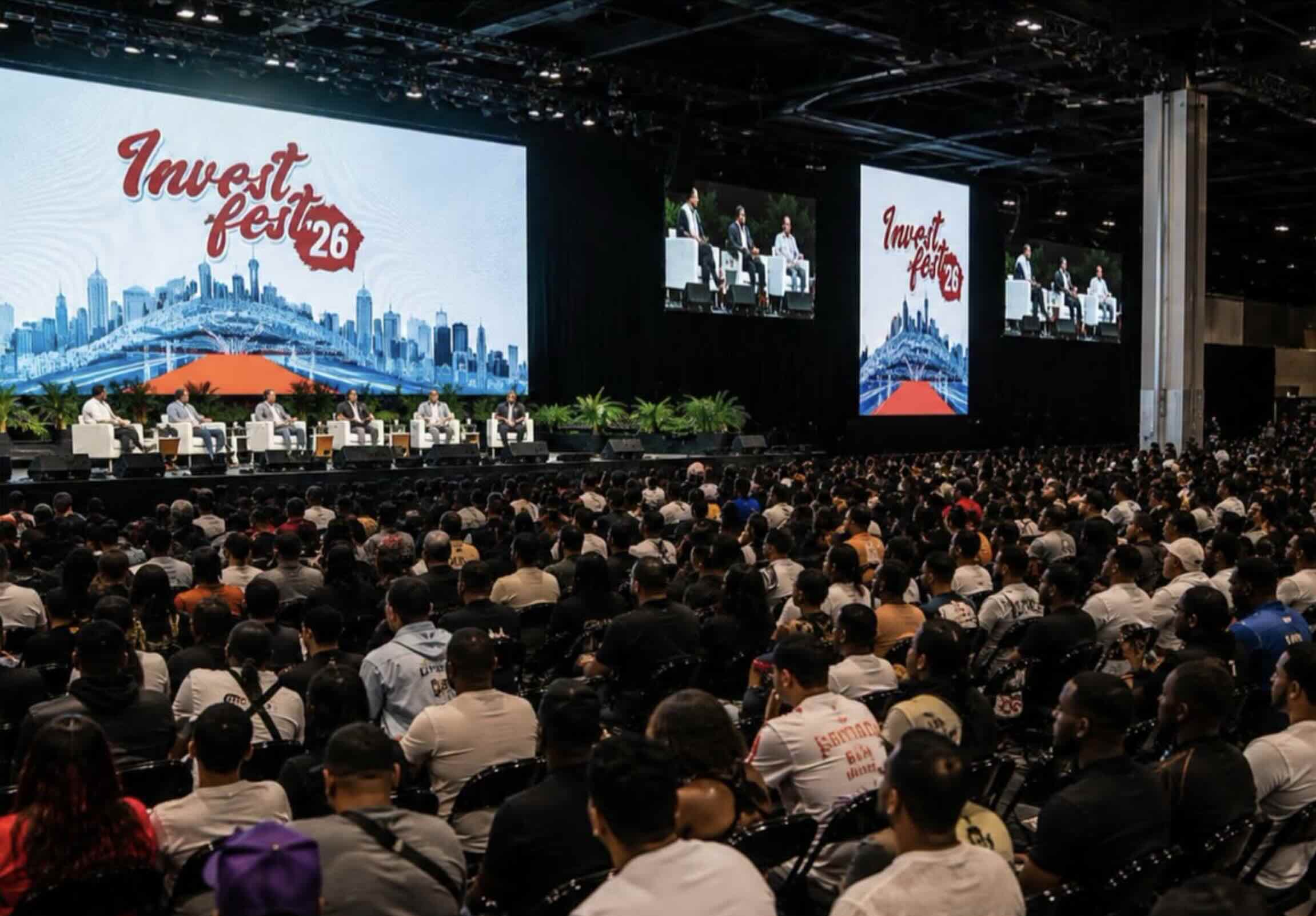
Photo: Earn Your Leisure | Facebook
On paper, Invest Fest appears to be a revolutionary step toward closing the racial wealth gap. Billed as the "biggest wealth festival on earth," the three-day event draws over 30,000 attendees to the Georgia World Congress Center in Atlanta, featuring celebrity speakers like Serena Williams, Steve Harvey, and Jack Dorsey. The festival promises actionable financial literacy, wealth-building strategies, and unprecedented networking opportunities. But beneath the high-energy production and motivational speeches lies a troubling economic reality: for the vast majority of participants, Invest Fest is a consumer expense — not an investment.
The festival, founded by Earn Your Leisure's Rashad Bilal and Troy Millings, operates on a brilliant but predatory business model. It sells the promise of wealth creation to an audience eager to escape financial struggle, yet delivers no tangible assets — no stocks, no real estate, no equity stakes — to the general ticket holder. Instead, capital flows in one direction: from the pockets of attendees into the bank accounts of organizers, corporate sponsors, and celebrity speakers. This is the gold rush reimagined for the digital age, where the shovels are $300 tickets and $2,500 VIP passes.
A closer examination of the festival's mechanics reveals a stark asymmetry. The organizers, who are neither hedge fund managers nor venture capitalists but rather media entrepreneurs and former educators, have constructed a commercial juggernaut. According to estimates based on public statements and industry benchmarks, the 2026 edition generated between $12 million and $15 million in gross revenue. The math is straightforward: 31,300 tickets sold at an average price of $275 equates to roughly $8.6 million; corporate sponsorships from institutional giants like Invesco QQQ and Block add another $3.5 to $5 million; and vendor booth fees from 400 small businesses contribute approximately $1 million.
This extraction model has a name in economic circles: it's called the "shovel seller" strategy, a reference to the 1849 California Gold Rush. During that historic frenzy, the miners risking their lives and capital rarely struck it rich. The entrepreneurs who profited most were those selling the tools, tents, and provisions. Invest Fest operates on the identical principle. The "miners" — attendees hoping to learn how to build wealth — spend thousands on flights, hotels, and tickets. The "shovel sellers" — the organizers, sponsors, and speakers — walk away with guaranteed profits, bearing none of the financial risk borne by the audience.
The Edutainment Exploitation Loop
Consumer advocates and financial analysts have identified this pattern as a form of "edutainment exploitation." The term describes a deliberate blending of legitimate education with high-octane entertainment — concerts, celebrity panels, influencer marketing — to create a psychological state where consumers confuse the feeling of being inspired with the actual action of building wealth. This confusion is the engine of the business model.
Attendees leave the arena energized, having absorbed motivational rhetoric and photographed themselves with celebrities. But their financial balance sheet has not improved. In fact, it has deteriorated. A general admission ticket costs $300; with travel and lodging, the total cost easily exceeds $1,500. For an attendee to achieve a positive return on that expenditure, they would need to implement a tax strategy saving $1,500, restructure a mortgage, or secure a business deal — a scenario that applies to a tiny fraction of participants. For the vast majority, the festival functions as an expensive entertainment expense, not a wealth-building event.
- Ticket revenue: ~$8.6 million from 31,300 attendees, with VIP packages reaching $2,500 each.
- Sponsorships: ~$3.5 to $5 million from corporations purchasing direct access to a concentrated minority consumer base.
- Vendor fees: ~$1 million from 400 businesses paying for booth space, creating a retail shopping mall dynamic.
The model relies heavily on "affinity marketing" — targeting a specific community by using shared cultural language and building intense trust. By positioning themselves as champions of Black financial empowerment, the founders lower their audience's natural defenses. This is not, in the legal sense, fraud. But it is a sophisticated funnel designed to extract maximum value from a demographic historically starved of financial resources.
What Participants Actually Receive
To understand the predatory nature of the festival, one must distinguish between what is marketed and what is delivered. The marketing promises wealth-building; the reality is access to a venue with speakers. For the standard ticket holder, there are no tangible assets exchanged — no shares of stock, no deeds to property, no equity in businesses. The only way an attendee leaves with a tangible asset is by using their own separate capital to purchase products from vendors, secure consulting services, or pitch their startup to venture capitalists through the festival's "Open Pitch" competition. This is not a wealth transfer from the event to the participant; it is a wealth transfer from the participant to the event.
The irony is inescapable. The festival is designed to educate people on how to build wealth, yet the primary economic activity taking place on the convention floor is retail shopping. Over 400 vendors sell books, clothing, beauty products, and consultations. Attendees, already depleted by ticket costs and travel expenses, are further encouraged to spend on consumer goods. Meanwhile, the only guaranteed financial winners are the organizers, who are selling a product with high margins and zero inventory risk.
This is a textbook case of what sociologists call "aspirational consumption." The audience is purchasing proximity to wealth, status, and success, rather than actual wealth itself. They are paying for the feeling of progress, not for progress itself. And because the human mind is susceptible to these emotional rewards, the loop repeats year after year. The organizers' counter-argument — that attendees fail to apply the information and that this is a failure of execution, not a flaw in the product — deflects accountability. But in economics, the burden of proof rests on the seller. If a product designed to teach wealth-building systematically fails to build wealth for its buyers, the product is at fault.
The Broader Ecosystem of Financial Hype
Invest Fest is not an anomaly; it is part of a broader ecosystem of financial influencers, courses, and conferences that have proliferated in the creator economy. The model follows a proven funnel: offer free content on social media to build an audience; sell low-cost books and digital products to establish trust; then upsell premium courses and live events for thousands of dollars. This is the "guru loop," a digital marketing strategy designed to maximize customer lifetime value.
The primary product being sold is the promise of learning how to sell the product to someone else. This dynamic mirrors multi-level marketing (MLM) structures, where participants are incentivized to recruit others, and the system blames individual failure rather than structural design. When a participant leaves Invest Fest feeling motivated but no richer, the narrative shifts: they didn't network hard enough, they didn't take notes diligently enough, they didn't implement quickly enough. The system is shielded from scrutiny by the very language of self-improvement it created.
The tragedy is that many attendees genuinely need financial literacy. They are seeking a way out of systemic inequality, predatory lending, and wage stagnation. But the commercialized version of financial education offered at events like Invest Fest too often extracts the very capital they need to build security. For every startup that secures a $250,000 investment on stage, thousands of others leave with only a lighter wallet and a brochure.
The alternative is mundane but effective: free institutional resources, low-cost index funds, and disciplined, automated saving. None of these require a $2,500 VIP pass. None of them come with celebrity endorsements. But they are backed by math, and math does not care about motivation.
In the end, Invest Fest is a monument to a fundamental paradox. It is, simultaneously, a legitimate business and a predatory funnel. It provides a service (access to curated content and networking) and charges a market rate. But it does so by exploiting the same desperation it claims to solve. The founders are building wealth, and they are doing so on the backs of those who have the least. That is not a community uplift. That is the gold rush, repackaged for the 21st century.
No Ads. By Us. For Us.
This article was made possible by readers like you. We hope it inspired you to support Emerald Book, so we can continue producing content like this.
We will never show you ads, sell your data, or require a subscription to consume our content. Your gift helps us keep the truth accessible.
Click the Support button to give a gift of any amount today.
Thank you for making this work possible.