

Emerald Pages
◆
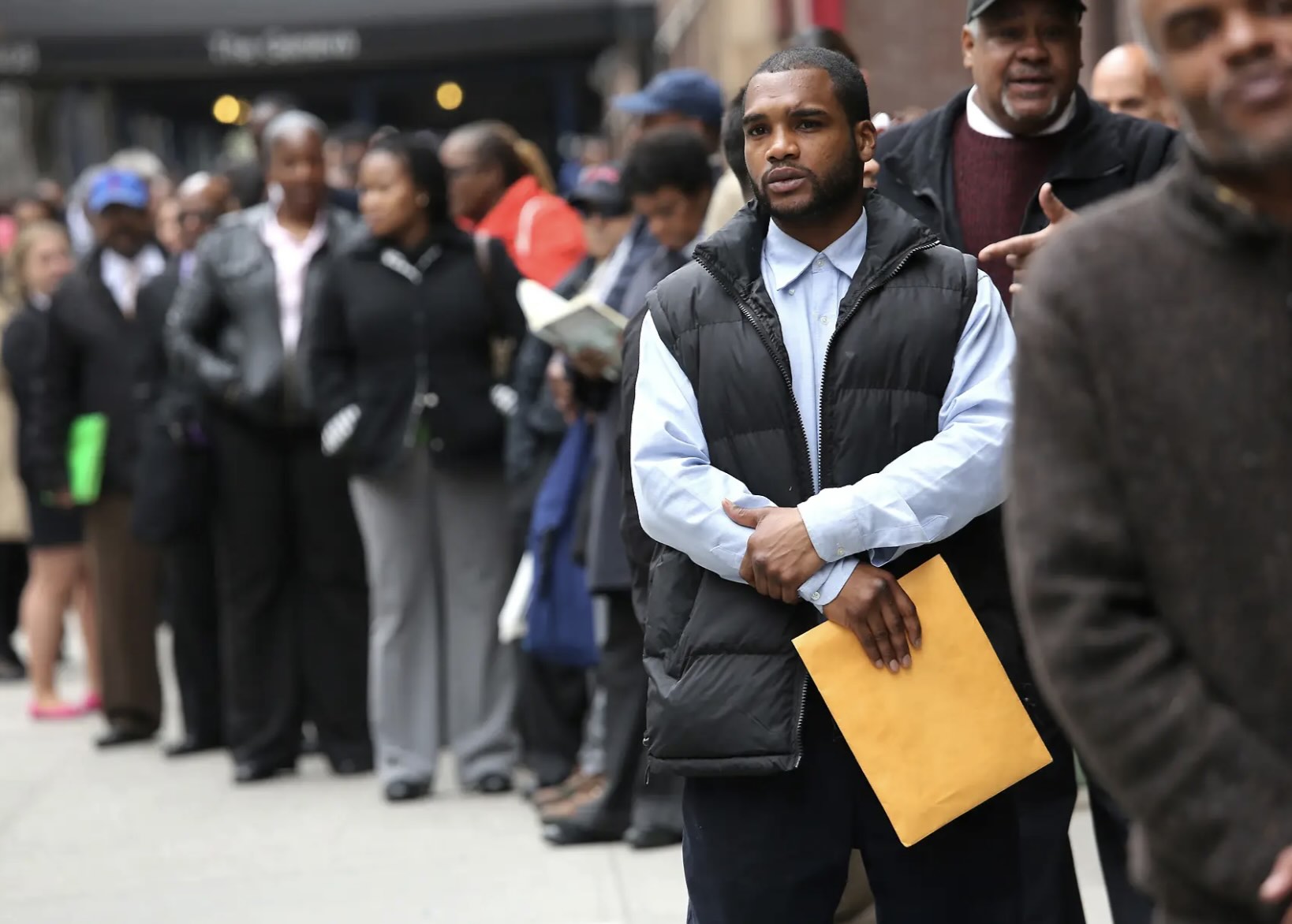
Photo: John Moore | Getty Images
On the surface, today's jobs report from the Bureau of Labor Statistics (BLS) appears to deliver a dose of good news. The national unemployment rate dipped to 4.1%, while the Black unemployment rate dropped by 0.3 percentage points from 6.6% to 6.3%. However, this headline figure is a classic example of a statistical phenomenon known as the "unemployment-rate mirage." While the percentage fell, the reality for Black workers—particularly Black women—has actually deteriorated.
The apparent contradiction of a falling unemployment rate amidst massive job losses is entirely driven by how the government defines "unemployed." To understand why the headline percentage drops even as the job market weakens, we must examine the mathematical formula and the economic exodus happening beneath the surface.
The Math Behind the Drop
The official unemployment rate is a simple fraction: the number of people actively looking for work divided by the total labor force (those working plus those actively looking). The BLS strictly enforces that if you do not have a job and have not searched for one in the last four weeks, you are completely removed from both the numerator and the denominator. You are no longer considered "unemployed"—instead, you are classified as "not in the labor force."
Today's report is the ultimate proof of this mechanical flaw. The U.S. economy did not add jobs; it actually lost 23,000 positions in July. Furthermore, the government sharply revised down May and June job data, revealing that the labor market had 103,000 fewer jobs than previously reported. In a healthy economy, a contraction of this magnitude would cause the unemployment rate to spike. Instead, it dropped from 6.6% to 6.3%. The reason? A staggering 264,000 Americans completely stopped searching for work and exited the labor force, which mathematically forced the official percentage down.
A Case Study: Black Women Pushed Out
The impact of this statistical distortion is most devastatingly illustrated by the experience of Black women. Data analyzed by Fortune revealed that between March and July 2026, the official unemployment rate for Black women fell from 7.07% to 5.73%. This sounds like a win. However, during that exact same period, actual employment among Black women fell by 212,000, and a massive 454,000 Black women exited the labor force entirely. Because they stopped searching for work due to widespread corporate downsizing, federal layoffs, and systemic barriers, the formula stopped counting them.
- Official Rate Drop: Black women's unemployment fell from 7.07% to 5.73% (March - July 2026).
- Actual Job Loss: Employment among Black women dropped by 212,000 during the same period.
- Mass Exodus: 454,000 Black women left the labor force entirely, removing themselves from the calculation.
- Federal Impact: Black Americans make up roughly 19% of the federal workforce, and massive downsizing has hit Black women the hardest.
The Persistent 2-to-1 Gap
Even with today's 0.3 percentage point drop, the Black unemployment rate remains alarmingly high and continues to hover at nearly double the rate of white workers. This 2-to-1 disparity is one of the most stubborn and persistent features of the American economy, holding steady across decades regardless of whether the economy is booming or in recession.
According to today's BLS report:
- Black Unemployment Rate: 6.3%
- White Unemployment Rate: 3.6%
- The Gap: Black workers are nearly twice as likely to be unemployed as their white counterparts.
Economists point to several systemic factors that keep the Black unemployment rate disproportionately elevated. The "last hired, first fired" phenomenon means Black workers are often the last to be hired during economic recoveries and the first to be laid off when corporations or the government downsize. Black workers are also heavily overrepresented in sectors currently facing massive contractions, such as local government, retail, and logistics. The widespread corporate rollback of Diversity, Equity, and Inclusion (DEI) hiring initiatives over the past year has sharply reduced targeted recruitment and advancement pipelines for minority workers. Even when the official numbers tick downward due to workers leaving the labor force, the massive gap proves that the underlying economic pressures are hitting Black households far harder than white ones.
The Real Picture: Employment-to-Population Ratio (EPOP)
When you look solely at the headline unemployment rate, you are looking at a statistic that can be manipulated by people giving up. Economists instead rely on the Employment-to-Population Ratio (EPOP)—which measures what percentage of the total population over age 16 actually has a paycheck. By this measure, the reality is stark.
The overall U.S. labor force participation rate fell to 61.4% today, a five-year low. For Black men, the actual percentage holding a job dropped to 58.8%, meaning over 41% are out of the workforce. For Black women, the EPOP hovers at 56.4%, meaning nearly 44% of all Black women are completely out of work—regardless of what the official BLS formula counts. If the government counted every person who wants a job but hasn't applied in the last month, economists estimate the "true" unemployment rate for Black workers would be nearly double the official headline, sitting in the 11% to 12% range.
Today's data is not a sign of recovery. It is a sign of surrender. The falling unemployment rate is a mathematical illusion built on the backs of discouraged workers who have been systematically pushed out of the job market. While the percentage falls, the number of paychecks in Black households continues to shrink, and the persistent gap between Black and white unemployment remains a stark reminder of the systemic inequities that continue to define the American labor market.
No Ads. By Us. For Us.
This article was made possible by readers like you. We hope it inspired you to support Emerald Book, so we can continue producing content like this.
We will never show you ads, sell your data, or require a subscription to consume our content. Your gift helps us keep the truth accessible.
Click the Support button to give a gift of any amount today.
Thank you for making this work possible.