

Emerald Pages
◆
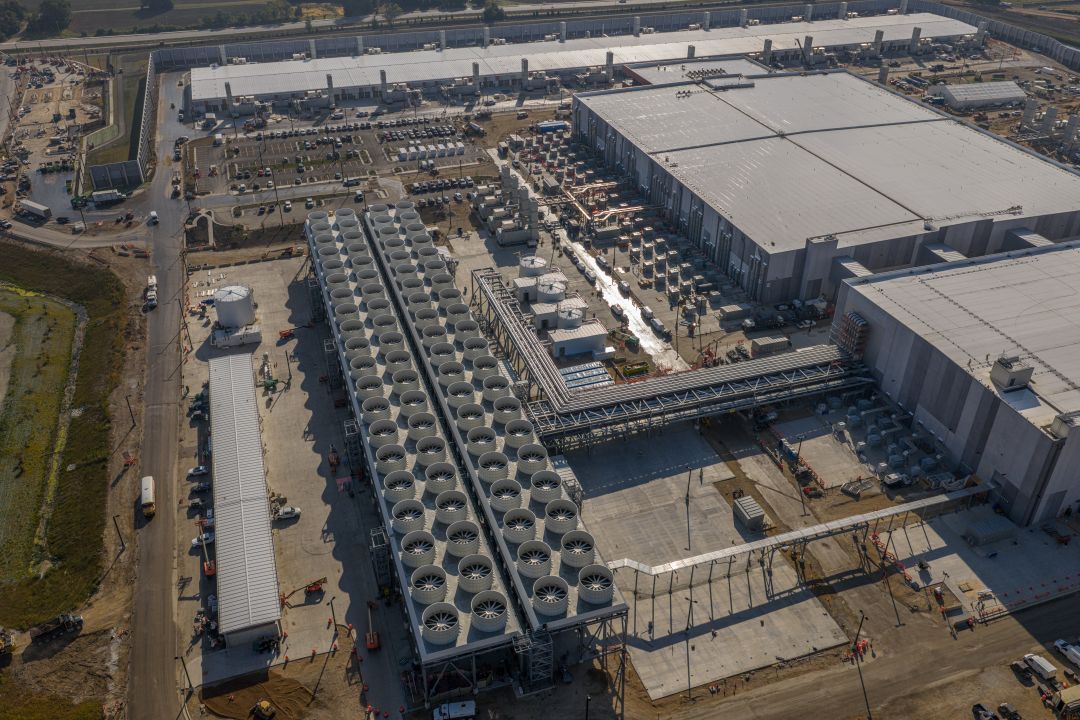
Photo: Microsoft’s AI datacenter campus in Mt Pleasant, Wisconsin.
The modern artificial intelligence boom is not just a story of clever algorithms or groundbreaking code; it is, at its core, a story of raw, unprecedented physical resources. When we marvel at the capabilities of models like GPT or Claude, we are often looking at the software tip of an immense hardware iceberg. The true cost and scale of this technology are almost incomprehensible, measured in petabytes of memory, gigawatts of power, and the physical footprint of entire city blocks dedicated solely to keeping the machines running.
To power a single frontier AI model, companies require massive amounts of memory, scaling from 256 GB to over 512 GB of system RAM per server node for orchestration, alongside terabytes of high-bandwidth specialized video memory (VRAM/HBM) across data center clusters. This demand is so immense that it has effectively consumed global supply chains, causing standard DRAM contract prices to spike by over 90%. We are witnessing a fundamental shift where the digital economy's growth is directly tied to the physical production of silicon and memory chips.
The memory itself is divided into two distinct categories: dedicated GPU memory (VRAM/HBM) and standard system memory (CPU RAM). The GPU memory is the ultra-fast embedded memory on AI chips like Nvidia's H100 or Blackwell architectures, used to hold active AI models and calculate parameters. A single high-end AI accelerator now features anywhere from 80 GB to over 192 GB of High Bandwidth Memory (HBM). The system RAM acts as the staging area, feeding data pipelines, managing training datasets, and handling orchestration.
The Pyramid of Scale: From Chip to Petabyte Cluster
The journey to building a world-class AI system begins at the chip level but quickly scales to unimaginable heights. A single server node, typically housing 8 GPUs, can contain anywhere from 256 GB to 512 GB of system RAM and over 640 GB of HBM. This is combined into server racks, which then form clusters. A standard air-cooled rack with 64 GPUs (like an H200 system) can hold up to 9.0 TB of HBM and 8 TB of system RAM. A high-density liquid-cooled rack, like the Nvidia GB200 NVL72, pushes that to a staggering 13.5 TB of unified HBM.
However, the real scale is revealed when you look at a frontier mega-cluster. Companies like OpenAI, Meta, and xAI are now building facilities with 100,000 to over 500,000 interconnected GPUs. At this scale, they are no longer dealing in gigabytes or even terabytes—they are managing petabytes of memory. A mid-size cluster of 10,000 GPUs represents roughly 560 Terabytes of system RAM and 1.4 Petabytes of VRAM. A frontier mega-cluster of 100,000 GPUs pushes that to 5.6 Petabytes of system RAM and over 14 Petabytes of VRAM, all active and processing data simultaneously.
The Memory Behind a Single Question
To understand why this scale is necessary, we have to look at the memory required to answer a single user question. The rule of thumb is that a model requires roughly 1 to 2 GB of VRAM per 1 billion parameters at 4-bit precision. A large enterprise model, like Llama 3.1 70B, will require about 45 GB of VRAM just to load its "brain." But a frontier model like GPT, with an estimated 1+ trillion parameters, can require over 1 Terabyte of memory for a single query.
- Your Shared Base: 10 GB to 14 GB per user for the model weights themselves (duplicated across GPUs).
- Your Private Cache (KV Cache): 1 GB to 5 GB per user, which scales linearly with the length of the conversation or uploaded documents.
- The Grand Math: When a million users query a model simultaneously, the data center must keep 15+ Petabytes of memory active to prevent lag or timeouts.
This is where the unfathomable nature of AI economics truly hits home. Every single byte of that memory is active, fully powered, and working at 100% capacity around the clock. If a data center turned off even a portion of that RAM, the AI would instantly lose its ability to function, suffering the digital equivalent of a lobotomy. This constant state of "hot" memory creates a massive power drain and generates extreme heat, requiring direct-to-chip liquid cooling to prevent the systems from melting.
Costs of a Digital Colossus
The financial architecture of building an AI company is as staggering as the physical one. It is no longer enough to be a software company; you must also be a massive industrial-scale hardware manufacturer and utility operator. The capital expenditure required to build a competitive AI infrastructure is now measured in the tens of billions of dollars.
- Single GPU (Nvidia H100/H200): $30,000 to $40,000.
- Next-Gen GPU (Nvidia Blackwell B200): $50,000 to $70,000+ per chip.
- Server Node (8 GPUs): $300,000 to $400,000, including CPUs, system RAM, and cooling.
- Server Rack (32-72 GPUs): $1.5 million to $4.5+ million.
- Mid-Scale Cluster (10,000 GPUs): Upwards of $750 Million.
- Frontier Mega-Cluster (555,000 GPUs, e.g., xAI's Colossus 2): The GPU purchase alone cost approximately $18 Billion. The total infrastructure cost scales past $25 to $30 Billion.
- Future Multi-Campus Super-Cluster (Millions of GPUs, e.g., Microsoft/OpenAI's "Stargate"): Total estimated cost is set to surpass $100 Billion.
The costs don't stop at construction. The operational expenses (OpEx) to keep these facilities alive are equally immense. A 1-Gigawatt facility, which is the scale of a modern AI mega-campus, burns through roughly $900 million per year in electricity bills alone, not to mention the massive costs for water treatment for cooling loops and an army of engineers.
The Walmart Metric
To put this all into perspective, we can use a uniquely American unit of measurement: the Walmart Supercenter. A standard Supercenter averages 178,000 square feet. The Colossus 2 data center campus, which houses 555,000 GPUs, spans roughly 1 million square feet—the equivalent of over 5 Supercenters.
But the real jaw-dropping comparison is in power consumption. A standard Walmart Supercenter uses an estimated 1.5 to 2 Megawatts (MW) of power. A 555,000-GPU AI cluster draws an astonishing 1 to 2 Gigawatts (1,000 to 2,000 MW). This means a single AI mega-cluster consumes more electricity than 500 to 1,000 Walmart Supercenters combined. If you were to fill 8 Walmart Supercenters exclusively with GPU server racks, you would be looking at a computing entity housing nearly 4.5 million GPUs, requiring over 4 Gigawatts of power—a feat that would require the output of several dedicated nuclear power plants just to turn it on.
Ultimately, the scale of AI data centers reveals a profound truth about the future of technology. The most advanced software on Earth is now being built on a foundation of physical infrastructure that rivals the most ambitious industrial projects in history. It is no longer just about writing code; it is about building, powering, and cooling small cities dedicated to the pursuit of artificial intelligence.
No Ads. By Us. For Us.
This article was made possible by readers like you. We hope it inspired you to support Emerald Book, so we can continue producing content like this.
We will never show you ads, sell your data, or require a subscription to consume our content. Your gift helps us keep the truth accessible.
Click the Support button to give a gift of any amount today.
Thank you for making this work possible.