

Emerald Pages
◆
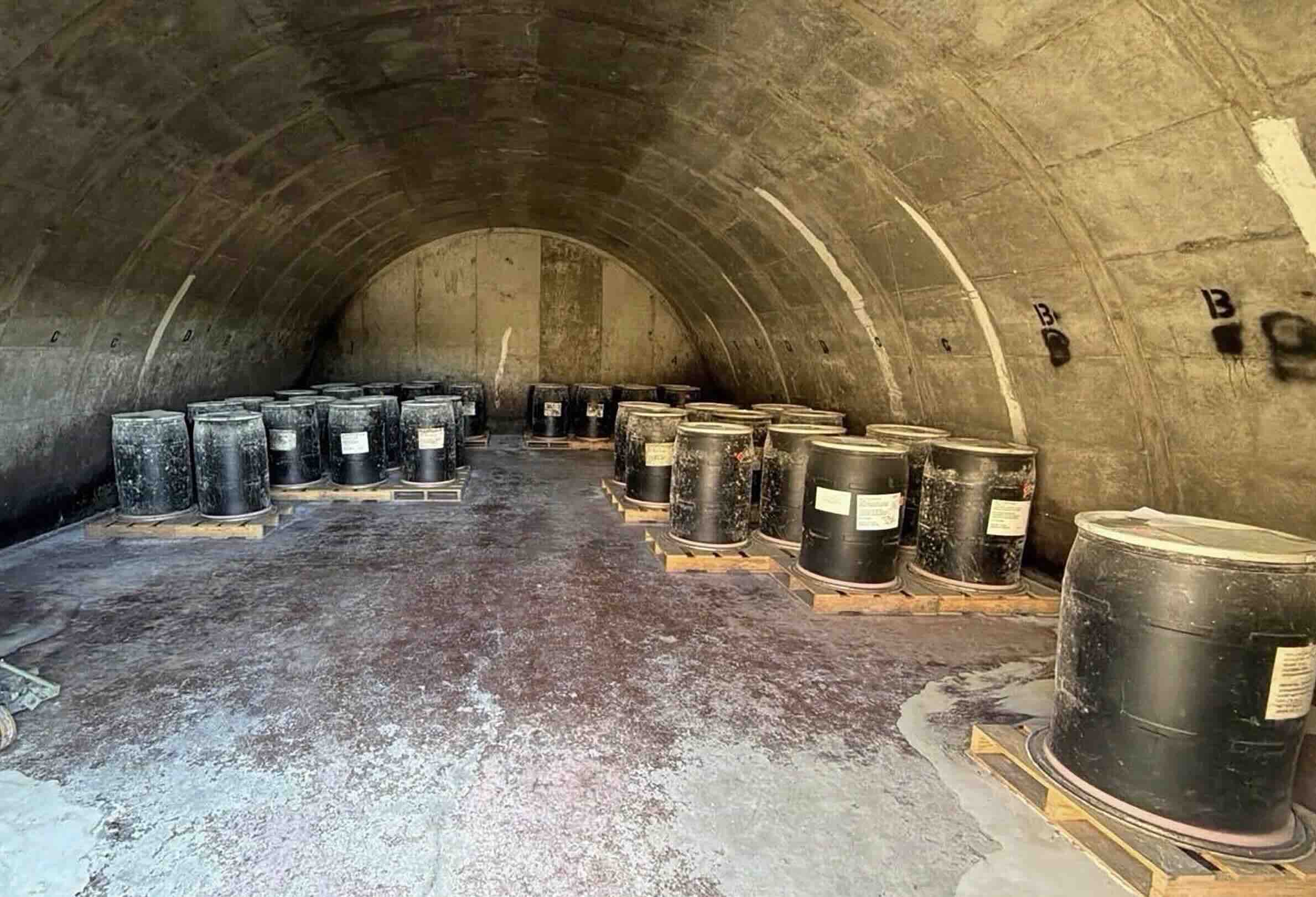
Photo: Iowa Army Ammunition Plant | CNN
At 9:00 a.m. Central Time on November 25, 2026, two simultaneous booms rolled across the farmland of Des Moines County, Iowa, loud enough to be heard miles from the Iowa Army Ammunition Plant. A white and gray plume climbed hundreds of feet into the air and then dissolved. Inside the containment walls, crews had just destroyed more than 60 barrels—roughly five tons—of degraded, World War I-era lead azide. Maj. Gen. Eric Shirley confirmed there were no secondary explosions and no flying debris outside the walls.
It was, by the Army's account, a successful operation. More than two hours after the blast, FEMA Administrator Cameron Hamilton reported a 0.0 detection level of lead in the atmosphere; five hours after, monitors still read zero. Officials noted the particulate matter released was roughly one-tenth that of a major fireworks show, and that the visible cloud was largely steam and mist from the 3,600 gallons of aqueous foam used to suppress toxic dust.
But the detonation was not the story. The story is why it had to happen at all. The United States had spent $1.05 trillion on national defense in fiscal year 2026. It could not, or would not, keep a stabilizing liquid topped off in 68 plastic barrels. And the records show the problem was visible as far back as 2004.
A 40-Year-Old Stockpile and a 2004 Warning
Lead azide is a primary explosive, sensitive enough that it is normally stored submerged in a water-and-ethanol mixture. That liquid is not decorative—it is the safety system. Remove it, and the chemical can detonate from slight friction, static, or a minor bump.
According to a 2014 U.S. Army report, the Defense Department launched a project in 2004 to find safer alternatives to lead azide specifically because a 40-year-old stockpile was already deteriorating at the Middletown facility. In other words, the military recognized the hazard two decades before the detonation. It did not dispose of it.
In 2009, during a military base reorganization, the Army moved lead azide from other installations across the country to the Iowa plant, consolidating the nation's remaining barrels in one place. Because some of the original metal drums were corroding, workers transferred the explosive into plastic barrels filled with a stabilizing water-and-ethanol bath. Some of those drums were already over 60 years old.
Then the stockpile sat. The plant's private operator, American Ordnance—a subsidiary of Day & Zimmermann—was responsible for checking the bunkers monthly and opening the barrels every September to replenish the stabilizing liquid. The barrels were kept inside 80-year-old, earth-covered concrete bunkers that were not climate-controlled. Over the years, seasonal temperature swings caused the lead azide to repeatedly dissolve and recrystallize into larger, needle-shaped crystals, acutely sensitive to friction and shock.
The Check That Never Happened
Records obtained by The Washington Post and Iowa Public Radio fill in the gap between routine maintenance and emergency. In September 2025, American Ordnance quietly asked a disposal contractor for a quote to neutralize the 68 barrels—six months before the Army officially notified the EPA, in March 2026, that the drums had crystallized and become too dangerous to open or refill. That timing suggests signs of trouble were likely visible during the September 2025 annual check.
By September 2026, Army officials judged that even unscrewing the barrel lids to add more stabilizing liquid had become too dangerous. Skipping that refill accelerated evaporation and left detonation as the only option officials deemed safe for workers. Col. Aaron Teller, commander of the 71st Explosive Ordnance Disposal Group, noted that crystallized lead azide had built up on the outside of the barrels and lids. The Army, FBI, and ATF concluded that sending workers inside to open, spray, or move 68 barrels over a three-week period posed an unacceptable risk of an accidental blast.
- 2004: The Defense Department begins work on lead azide alternatives because a 40-year-old stockpile at Middletown is already deteriorating.
- 2009: The Army consolidates the nation's remaining lead azide at the Iowa plant, transferring it into plastic barrels with a stabilizing bath.
- September 2025: American Ordnance quietly seeks a disposal quote for the 68 barrels.
- March 2026: The Army notifies the EPA that the drums have crystallized and are too dangerous to open.
- September 2026: Officials judge even unscrewing the lids to refill the liquid too dangerous. Detonation becomes the only remaining option.
The Safer Option That Was Canceled
Cleaner alternatives existed. Companies like MuniRem Environmental use a sulfur-based liquid solution to break down explosive compounds and chemically lock up toxic heavy metals like lead—eliminating the explosive hazard without blowing up the material or sending dust into the air. In March 2026, an expert panel recommended chemical neutralization, and the Army awarded MuniRem a contract. Just days after the company submitted its detailed proposal in May, the Army canceled the contract and opted for a controlled blast instead.
In documents clearing the way for the detonation, the Army said chemical alternatives "offered environmental protections" but were ruled out on worker-safety grounds. Officials also warned that dropping winter temperatures could cause the remaining liquid inside the drums to freeze, triggering a spontaneous, uncontained explosion. The Army framed the choice as a trade-off between environmental safety and immediate worker safety—and chose the workers.
Critics argue that trade-off was manufactured. Environmental groups including Earthjustice and the Iowa Environmental Council sued to stop the blast, arguing the crisis was entirely avoidable. Federal records show the military knew the stockpile was deteriorating as early as 2004 and 2009. Had the Army maintained the stabilizing liquid or disposed of the barrels years earlier—before the crystals formed—chemical neutralization could have been used safely without putting the surrounding community at risk.
What the Detonation Cost the Neighbors
The blast may have been contained, but the disruption was not. Ahead of the detonation, local schools canceled classes and nearby businesses closed temporarily. Vulnerable residents—young children, pregnant women, and people with chronic illnesses—were advised to evacuate, while others sheltered in place with sealed windows. Roughly 350 farms in Iowa and Missouri sit within the initial caution zone.
State and federal agencies are still collecting soil and water samples across Iowa, Illinois, and Missouri to evaluate potential environmental fallout. EPA crews are testing local water, soil, and surfaces, including in areas near the neighboring states, and officials noted it could take several days of lab analysis to complete ground contamination assessments. Public health officials advised residents to wash outdoor surfaces—cars, window sills, playground equipment—with soap and water as a precaution. Residents can track live data through the U.S. EPA OSC Response Profile or view regional updates via Iowa Homeland Security.
Where the $1.05 Trillion Went
The financial breakdown of the defense budget explains how this happens. According to Congressional Budget Office and Defense Department figures, FY 2026 defense funds divided into a few massive buckets: roughly $313 billion for weapons procurement and R&D—fighter jets, naval ships, AI systems, hypersonic missiles; about $294 billion for operations and maintenance, including fuel, global deployments, training, and day-to-day contractor operations; roughly $236 billion for military personnel and health; and more than $85 billion for nuclear and missile defense.
An August 2026 Government Accountability Office report found that the Pentagon manages over 736,000 buildings—about a third of which are over 50 years old, like the World War II-era bunkers in Iowa—yet consistently requests only about 80% of the money needed to maintain them. The department faces a $285 billion maintenance backlog. Roughly half of the entire defense budget goes straight to private corporations, and because the military relies heavily on contractors for both building and maintaining sites, oversight often breaks down when a contractor cuts corners or misses routine checks. The Pentagon has also failed seven consecutive annual financial audits, meaning top leaders often lack accurate, real-time tracking of inventory, property conditions, and contractor work orders.
Buying new ships and bombers wins political support and defense-industry lobbying. Cleaning up obsolete hazardous waste at a rural depot has no powerful constituency. So it gets pushed to the bottom of the list—until an emergency forces action.
Negligence, Mismanagement, or Both?
Whether the handling of the stockpile constitutes legal negligence or misappropriation involves distinct legal questions now being debated. Under the Federal Tort Claims Act, citizens can sue the government for negligence, though the military often invokes the "discretionary function exception," arguing that decisions about munitions management and resource allocation involve policy judgment rather than simple carelessness. Private contractors like American Ordnance can face separate scrutiny or contract penalties if investigators find they failed to perform paid maintenance duties.
Legally, "misappropriation" under federal law—such as the Antideficiency Act—specifically means spending money on something Congress did not authorize. Deferring hazardous waste cleanup in favor of other authorized defense priorities is generally classified by oversight bodies like the GAO as mismanagement or poor resource allocation rather than illegal misappropriation—unless an investigation proves a contractor billed the government for maintenance checks it never actually performed.
The investigations are already underway. Acting Army Secretary Adam Telle acknowledged the systemic failure and ordered a nationwide audit of every U.S. Army weapons storage facility to ensure aging munitions do not reach a similar crisis point elsewhere. Lawmakers from both parties—including Iowa Rep. Mariannette Miller-Meeks and State Sen. Janice Weiner—have called for congressional hearings into why the Army and its contractor allowed the stockpile to sit unaddressed for over 20 years and failed to notify local communities until days before the blast. The EPA and state agencies continue testing soil, water, and surfaces around Middletown, results that could become central evidence if residents or environmental groups pursue legal claims.
The detonation in Middletown was safe, but it was not a solution—it was a symptom. For a military with a trillion-dollar budget, the inability to maintain a few dozen barrels of known toxic material is not a matter of resources. It is a matter of priorities, oversight, and accountability. Until those change, the next environmental crisis is already ticking away in another forgotten bunker—and the only maintenance it will get is a visual check from outside the drum.
No Ads. By Us. For Us.
This article was made possible by readers like you. We hope it inspired you to support Emerald Book, so we can continue producing content like this.
We will never show you ads, sell your data, or require a subscription to consume our content. Your gift helps us keep the truth accessible.
Click the Support button to give a gift of any amount today.
Thank you for making this work possible.