

Emerald Pages
◆
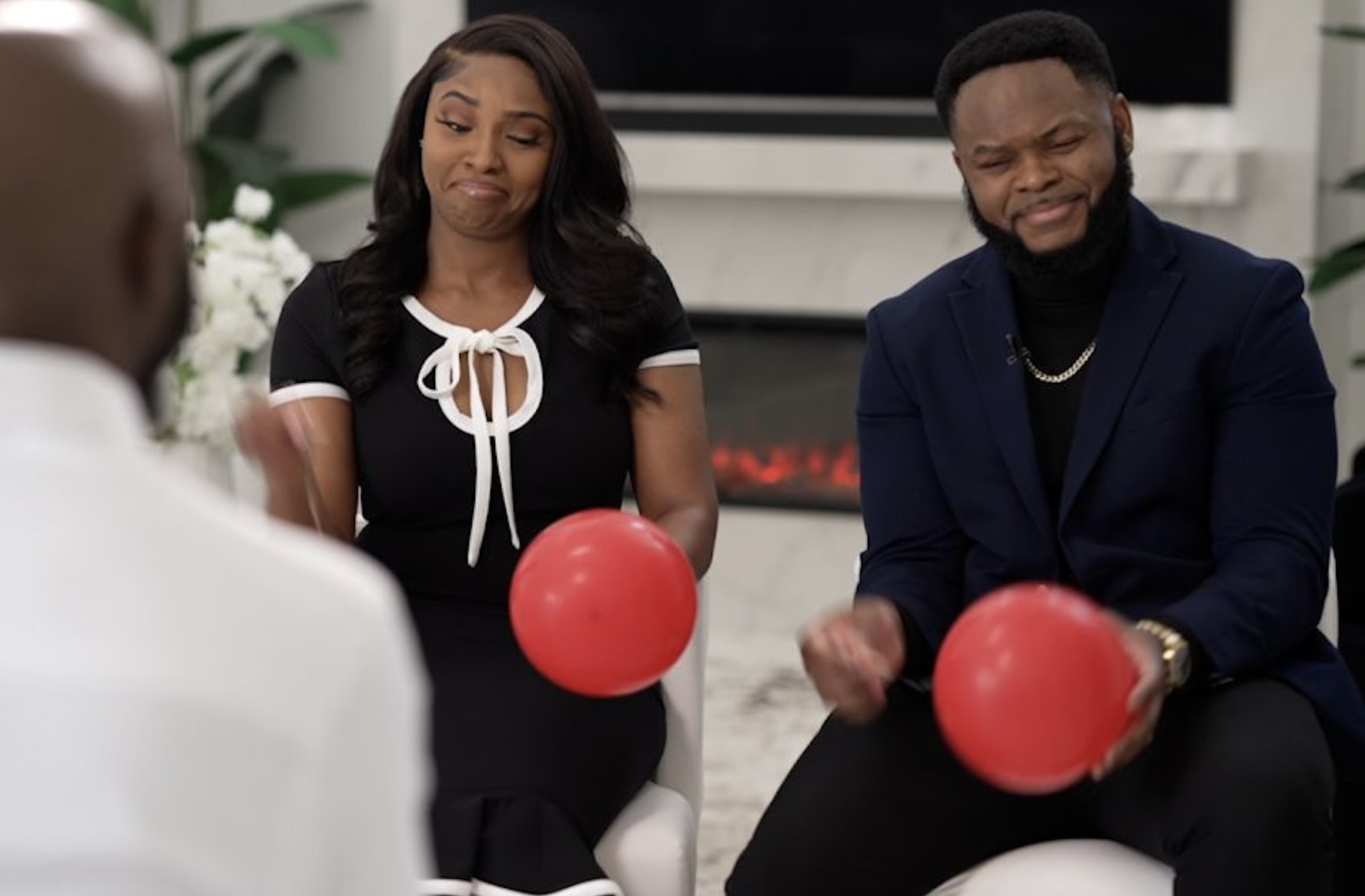
Arlette Amuli and BM | Photo: CNN
Across 131 episodes of the flagship YouTube series, roughly 2,000 contestants have stood on a soundstage in Phoenix holding red balloons. They came with the disposable income to pay for their own flights and hotels, the flexibility to take a day off work, and the willingness to be judged on camera in a ten-minute speed elimination. By the creators' own accounting, that pool of 2,000 has produced just four marriages—eight individual people out of nearly 2,100—a strict marriage rate of roughly 0.38% to 0.44%. The broader relationship outcome, including engagements and ongoing dating, sits at 2.5% to 3.0%. That means the format fails to produce any lasting romantic connection for roughly 97% of the people who appear on it. These numbers are not a quirk of a young show finding its footing. They are the direct, predictable output of a format engineered for virality rather than romance.
The problem is not that a dating show has a low success rate. The problem is that this particular show—one of the most visible Black-led dating platforms on the internet, with clips routinely pulling hundreds of thousands to millions of views—presents itself, and is consumed by millions, as a window into Black dating culture. Creators Arlette Amuli and Bolia "BM" Matundu have framed the series as holding a mirror up to modern superficiality, arguing that you cannot fix a problem you refuse to see. But a mirror that filters out 99.6% of the population and then broadcasts the remaining sliver as a cultural portrait is not a mirror. It is a funhouse distortion.
To understand why the show cannot represent the broader Black dating market, you have to start with who actually makes it onto the stage. Contestants pay their own way—flights, lodging, wardrobe—with past participants reporting out-of-pocket costs from $600 to over $1,500 for a single day of filming. Even the Netflix spinoff offered only a roughly $200 stipend. That casting filter is enormous. It screens out the nurse working back-to-back shifts, the teacher who cannot take a random Wednesday off, the single parent without childcare, and the everyday dater who would never spend a thousand dollars for a ten-minute conversation with strangers. What remains is disproportionately entrepreneurs, aspiring influencers, models, and brand-builders who view the trip as a marketing investment rather than a sincere search for a spouse.
The Economics Should Predict the Opposite
Here is where the show's numbers become truly paradoxical. In the real world, financial stability and education are the strongest predictors of lasting marriage among Black Americans. Census and Pew Research data show marriage rates among Black Americans exceed 55% among college graduates and reach over 80% among Black men earning six figures. The show's self-selected pool—people with the means, time, and confidence to fly out and be filmed—should, on paper, be one of the most marriage-prone demographics in the country. Instead, it produces a 0.4% marriage rate.
The explanation is not that these people are unlovable or incapable of commitment. It is that the environment overrides the demographic. On a viral soundstage, financial success and good looks become shields rather than bridges. Contestants weaponize their standards—rejecting people over shoes, sock choices, height, or a single awkward sentence—to protect their ego and produce a memorable soundbite. People with abundant options in their own cities are not flying to Phoenix because they lack dates. They are flying out for visibility, and that incentive removes any urgency to compromise, be patient, or build chemistry.
- The 0.4% marriage rate: Four marriages from an estimated 2,000 contestants (roughly eight individuals), or 0.38% to 0.44%.
- The 97% failure rate: Even counting marriages, engagements, and ongoing dating, roughly 97% of contestants leave with no lasting connection.
- The economic paradox: A pool selected for disposable income and flexibility—traits that predict higher real-world marriage rates—produces one of the lowest conversion rates in dating television.
- The real-world baseline: Roughly 52% of Black American adults have been married at least once, and about 30% to 32% are currently married—figures the show does not come close to reflecting.
Why the Comparison Fails on Every Level
Measured against traditional dating franchises, the gap is stark. Married at First Sight converts roughly 17% of its cast into lasting marriages, Love Is Blind about 6%, and The Bachelor and Bachelorette roughly 1.4%. Even those comparisons are generous to Pop the Balloon, because franchises like The Bachelor and Married at First Sight contractually force engagements and weddings at the finale, artificially inflating their numbers. When you compare Pop the Balloon instead to non-marriage dating shows—where couples simply leave dating on their own terms—the show sits at 2.5% to 3.0%, roughly on par with Too Hot to Handle but far below Love Island USA (~9.5%) and Are You the One? (~6.0%). The difference is time. Villa shows isolate contestants together for four to six weeks without phones. Pop the Balloon gives them ten to fifteen minutes.
None of this is accidental. The format is a viral machine by design. The sound of a balloon popping, followed by an immediate and unfiltered explanation of why someone is not attractive, creates instant conflict with zero backstory required. Cycling roughly fifteen contestants through a single episode generates dozens of standalone mini-interactions—petty rejections, savage comebacks, awkward standoffs—giving editors a week's worth of clips from one shoot. Viewers do not tune in to root for a marriage. They tune in to argue in the comments about whether a contestant's standards are delusional. In that sense, the 97% failure rate is not a bug. It is the product.
The reputational cost is where the numbers turn from trivia into something more serious. Because algorithms prioritize conflict over compatibility, the show's shallowest moments are broadcast as a blanket reflection of Black dating culture to millions of viewers, both inside and outside the community. Viral clips are routinely stripped of context and reposted across X, TikTok, and YouTube to fuel "Black men versus Black women" rage-bait, painting Black daters as uniquely materialistic, combative, or unlovable. Meanwhile, millions of ordinary Black marriages, partnerships, and families thrive quietly offline, generating no shares and no angry comments. The calm reality is algorithmically invisible. The chaotic outlier is not.
The Actual Landscape of Black Love
So what does the real Black dating market look like? The data tells a story that is nothing like the balloon stage. According to the U.S. Census Bureau and Pew Research Center, roughly 52% of Black American adults have been married at least once, and about 30% to 32% are currently married—compared with roughly 48% of all U.S. adults. Broken down by gender, approximately 36% of Black men and 29% of Black women are currently married—a gap that is driven in significant part by widowhood, since Black women are considerably more likely to outlive their spouses and thus appear as not currently married despite having been married before. The National Center for Family & Marriage Research puts the annual first-marriage rate for unmarried Black adults at roughly 1.7% per year, peaking around 3.5% annually for Black women ages 25–34—a real-world conversion rate that is still several times higher than the balloon show's 0.4% lifetime marriage rate.
The show also misses who is actually looking. A November 2026 Pew Research Center study found that 42% of Black adults are completely single, yet single Black adults are significantly more likely than White singles to be actively looking for a relationship or dates—53% versus 36%. That is a community that wants partnership and pursues it, not one that rejects strangers over footwear. And the real-world gains cluster exactly where the show's casting pool should be strongest: marriage rates among Black Americans exceed 55% among college graduates and reach over 80% among Black men earning six figures. The population the show filters for is, in the aggregate, the most marriage-prone slice of Black America.
Real Black love also forms in places cameras never reach. It grows through churches, workplaces, mutual friends, community organizations, and months of shared routine—not ten-minute judgments on a soundstage. Those relationships generate no clips, no shares, and no angry comments, which is precisely why the algorithm never shows them. The healthy majority is quiet; the viral outlier is loud. And that gap between the quiet majority and the loud outlier is the entire distortion.
- Ever married: Roughly 52% of Black American adults have been married at least once.
- Currently married: About 30% to 32% of Black adults (36% of Black men, 29% of Black women)—the gender gap is driven in large part by widowhood, as Black women are more likely to outlive their spouses.
- Annual marriage rate: Roughly 1.7% of unmarried Black adults marry each year, peaking near 3.5% for women ages 25–34.
- Intent to partner: 53% of single Black adults are actively looking for a relationship or dates, versus 36% of White singles.
- Income and education: Marriage rates exceed 55% among Black college graduates and 80% among Black men earning six figures.
The creators have acknowledged parts of this. Matundu has argued the selection bias is a modern human problem rather than a racial one, and after roughly ten episodes he told Amuli they needed to pivot toward highlighting genuine love stories, later launching the dating app Luv or Pop to give serious daters a space outside the camera-heavy stage. Amuli has pointed out that algorithms amplify petty rejections while full episodes include hours of humor and vulnerability. These are fair points about individual clips. They do not change the underlying arithmetic. A show where roughly 97% of participants leave with nothing is not a representative sample of anything except the incentives of viral entertainment.
The distinction that matters is between individual agency and collective optics. Every adult on that stage volunteers, pays their own way, and signs a release. No one is coerced. But consent is individual, while the narrative is collective. A few thousand people choose to compete for attention in a high-pressure arena, and millions of others inherit the stereotype afterward. Calling a 0.4% marriage rate a reflection of Black love is like treating a food fight in a school cafeteria as a restaurant review. It shows chaos that really happened, but it says almost nothing about what a real meal looks like—and it leaves the wrong impression on everyone who never sees the dining room.
The real Black dating market is not a soundstage in Phoenix. It is churches and workplaces and mutual friends and quiet months of getting to know someone without a camera rolling. It marries at rates the balloon show will never touch—roughly half of Black adults have walked down the aisle at least once, and the most educated and stable among them marry at rates above 55% and 80%. The numbers do not lie: a format built on ten-minute judgments and viral rejection cannot represent a community that builds love over years. Viewers deserve to know the difference.
No Ads. By Us. For Us.
This article was made possible by readers like you. We hope it inspired you to support Emerald Book, so we can continue producing content like this.
We will never show you ads, sell your data, or require a subscription to consume our content. Your gift helps us keep the truth accessible.
Click the Support button to give a gift of any amount today.
Thank you for making this work possible.