

Emerald Pages
◆
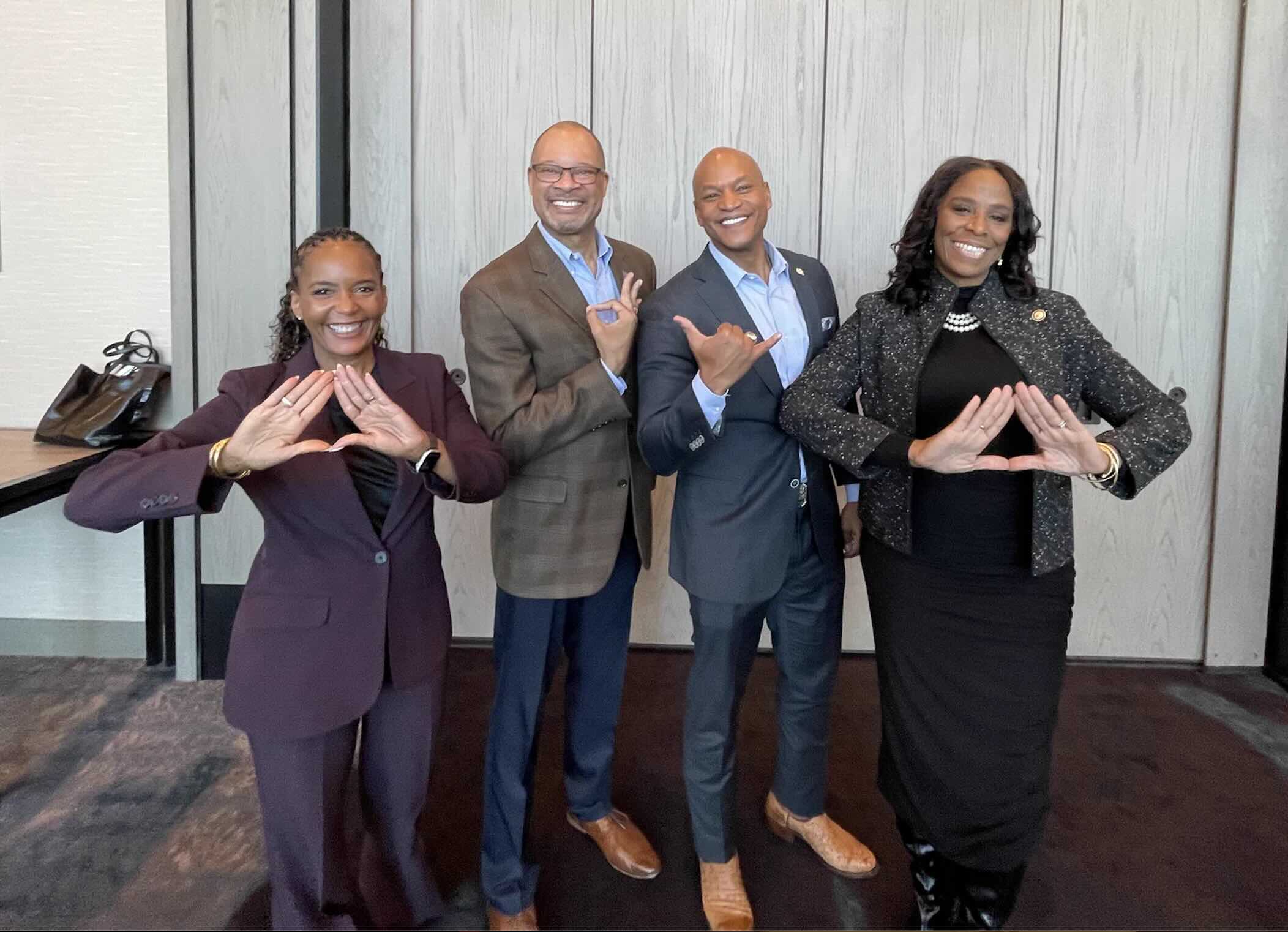
Photo: Gov Wes Moore | X
On a November evening in Park City, Utah, five of the most powerful Black elected officials in America stood shoulder to shoulder for a photograph. Aaron Ford of Nevada. Keisha Lance Bottoms of Georgia. Wes Moore of Maryland. David Crowley of Wisconsin. Stacey Plaskett of the U.S. Virgin Islands. Between them, they represented a milestone that had never before existed in the history of the republic: six Black governors set to serve simultaneously, beginning in January 2027. The photo, taken at the National Governors Association's New Governors Leadership Forum, was widely shared as a symbol of a new era. Less widely discussed was the quieter fact embedded in the frame: four of the five belonged to the same nine organizations.
That overlap is not incidental. Across the seven Black U.S. senators serving in the 120th Congress, five are Divine Nine members. Both of the first Black Supreme Court justices—Thurgood Marshall and Ketanji Brown Jackson—are D9. The architects of the NAACP's legal strategy, the leaders of the Civil Rights Movement, and a striking share of Black Fortune 500 CEOs all trace back to the same fraternities and sororities founded between 1906 and 1963. The Divine Nine—the National Pan-Hellenic Council's five fraternities and four sororities—are routinely described as college social clubs. That description misses the point entirely. They are, and have been for over a century, the foundational infrastructure of Black American leadership, operating at every tier of the Black elite, from local community boards to the United States Senate.
A Network Built by Exclusion
When Alpha Phi Alpha was founded at Cornell in 1906—followed by Alpha Kappa Alpha at Howard in 1908—Black students were barred from white fraternities, campus housing, and professional societies. The exclusion was not subtle. It was structural, written into campus rules and enforced by custom. Less than 1% of Black Americans attended college at the time. Those who did almost universally joined these new organizations, instantly concentrating the nation's future doctors, lawyers, educators, and judges inside a single interlocking network. The founders understood what they were building: not a social club, but a mutual-aid society for a population locked out of every mainstream institution.
That structural advantage never disappeared. It compounded. Membership became multi-generational, and unlike predominantly white Greek organizations, where active involvement typically ends at graduation, D9 membership is designed as a lifelong commitment. Alumni join active graduate chapters in virtually every major U.S. city. These chapters meet monthly to organize community service, award scholarships, and fundraise—meaning a young attorney or aspiring politician is regularly sitting in the same room as federal judges, corporate executives, and elected officials. The mentorship is not abstract. It is a sponsorship pipeline, operating in person, year after year, in hundreds of cities at once.
The result is a network that functions less like a club and more like an institution—with its own fundraising capacity, its own voter mobilization infrastructure, and its own informal system of vetting and trust. In high-stakes politics and corporate governance, D9 affiliation serves as an immediate credential of shared values, community service, and accountability. It signals to donors, party gatekeepers, and board nominating committees that a candidate has been vetted through years of local civic leadership. That signal is worth a great deal in rooms where access is scarce.
Politics: The Campaign Machine
The group photo taken November 18 at the NGA forum in Park City captured five of them: Aaron Ford (Nevada, Kappa Alpha Psi), Keisha Lance Bottoms (Georgia, Delta Sigma Theta), Wes Moore (Maryland, Alpha Phi Alpha), David Crowley (Wisconsin, not D9), and Stacey Plaskett (U.S. Virgin Islands, Delta Sigma Theta).
The Senate tells a similar story. Of the seven Black senators set to serve in the 120th Congress, five are D9 members: Raphael Warnock (Alpha Phi Alpha), Scott Colom (Alpha Phi Alpha), Angela Alsobrooks (Delta Sigma Theta), Lisa Blunt Rochester (honorary Alpha Kappa Alpha), and Juliana Stratton (Alpha Kappa Alpha). Only Cory Booker and Tim Scott sit outside the network. Combined with the governors, nine of the thirteen Black governors and senators serving in 2027 will be Divine Nine members—nearly 70%, concentrated in just three organizations.
- Governors: 4 of 6 are verified D9 members (Moore, Bottoms, Plaskett, Ford); Crowley is a Prince Hall Mason, not D9
- U.S. Senate: 5 of 7 Black senators belong to D9 organizations—Warnock and Colom (Alpha Phi Alpha), Alsobrooks and Stratton (Delta Sigma Theta), Blunt Rochester (honorary AKA)
- Combined: 9 of the 13 Black governors and senators serving in 2027 are Divine Nine members
The mechanics are straightforward. Running for governor or Senate requires millions of dollars and massive volunteer networks. While non-D9 candidates build a donor base from scratch, D9 candidates step into a national network of graduate chapters ready to bundle donations, host fundraisers, and organize "Stroll to the Polls" voter drives. The chapters are already organized. The relationships are already built. The trust is already established. In a political system where access to capital and organized labor is everything, that head start is decisive.
The network also shapes who runs in the first place. Because graduate chapters function as local civic hubs—running scholarship funds, food drives, and voter registration—they are where rising professionals first build visibility and prove their commitment to service. A city council member who has spent a decade organizing through her chapter has a track record that party recruiters can read. The pipeline from local chapter to statehouse to Congress is well-worn, and it runs through the D9.
Industry: The Gatekeeper Economy
The same pattern exists in corporate America, though the pipeline works slightly differently. D9 members are well-represented among Black Fortune 500 CEOs and board members—Rosalind Brewer (Alpha Kappa Alpha), Marvin Ellison (Omega Psi Phi), René Jones (Kappa Alpha Psi), and Cathy Hughes (Alpha Kappa Alpha) among them. Because corporate board seats are heavily filled through personal referrals, D9 alumni networks act as trusted vetting channels when companies look for Black directors and senior executives. A recommendation that travels through a graduate chapter carries weight that a cold resume never will.
In industry and finance, D9 membership is often the undergraduate starting point that feeds into even more exclusive, invitation-only adult societies. Sigma Pi Phi—"The Boulé"—was founded in 1904, making it the oldest Black Greek-letter organization, and it has no college chapters. Men are invited only after reaching the pinnacle of business, medicine, law, or finance; most Boulé members are also D9 alumni. The Links, Incorporated, founded in 1946, is the invitation-only women's service organization for high-achieving Black women in corporate leadership, philanthropy, and politics—the vast majority of whom also belong to D9 sororities like AKA and Delta Sigma Theta. And the Executive Leadership Council serves as the premier membership organization specifically for Black C-suite executives and corporate board directors at Fortune 500 companies.
The distinction matters. Winning elections requires turning out tens of thousands of voters and bundling small-dollar donations, which makes D9 graduate chapters uniquely powerful in politics. Climbing the corporate ladder depends instead on executive sponsorship, MBA networks, and private capital—areas where smaller, invitation-only groups like The Boulé and the ELC carry the most direct weight alongside D9 ties. But the two systems interlock. The same person who organized a voter drive through her chapter in her twenties may, two decades later, be nominated to a Fortune 500 board by a fellow alumna. The network does not switch off; it changes arenas.
Culture: The Credibility Bridge
D9 membership is deeply embedded in Black entertainment, media, and sports, though the relationship works differently than in politics or business. Many prominent figures pledged in college long before achieving fame: Angela Bassett and Kerry Washington (Delta Sigma Theta), Spike Lee and Omari Hardwick (Alpha Phi Alpha), Lionel Richie (Kappa Alpha Psi), Michael Jordan and Shaquille O'Neal (Omega Psi Phi), Robin Roberts (Delta Sigma Theta). For them, membership was part of campus life, not a career strategy—and that authenticity is precisely what gives the network its cultural credibility.
Others were inducted as honorary members later in their careers to recognize cultural impact and philanthropy—Alicia Keys, Ava DuVernay, and Maya Angelou (Alpha Kappa Alpha); Aretha Franklin, Cicely Tyson, and Ruby Dee (Delta Sigma Theta); Dwayne "The Rock" Johnson and Al Roker (Phi Beta Sigma). D9 traditions—stepping, strolling, calls, signature colors—are regularly woven into Black television, film, and live events, from School Daze and A Different World to Beyoncé's Homecoming. The organizations rarely make someone a star. But they lend star power a badge of community credibility, and they give the organizations a cultural visibility that no amount of fundraising could buy.
Behind the scenes, the network is even more concentrated. D9 alumni are heavily represented among network executives, talent managers, entertainment lawyers, and journalists—the gatekeepers who decide which stories get told and which talent gets promoted. Fame in music or sports still relies primarily on talent and commercial appeal. But the infrastructure that surrounds fame—the deals, the contracts, the coverage—runs through rooms where D9 ties are common currency.
The Civil Rights Engine
Long before today's governors and senators took office, D9 organizations served as the institutional backbone of the Civil Rights Movement. Thurgood Marshall and Charles Hamilton Houston, both Alpha Phi Alpha, dismantled Jim Crow segregation through the courts while relying on D9 legal networks for research and funding. Dr. Martin Luther King Jr. (Alpha Phi Alpha), Dorothy Height (Delta Sigma Theta), Whitney Young (Alpha Phi Alpha), and A. Philip Randolph (Phi Beta Sigma) used their organizations' national chapters to coordinate marches, bail funds, and voter registration drives. The movement was not an ad hoc eruption of protest. It was organized, chapter by chapter, through the D9.
Just months after its founding, Delta Sigma Theta made its first public act marching in the historic 1913 Women's Suffrage Parade in Washington, D.C.—establishing civic activism as a permanent D9 mandate. After the Voting Rights Act of 1965 opened the ballot box across the South, D9 graduate chapters seamlessly pivoted from protest organizing to electing Black mayors, state legislators, and members of Congress—including Shirley Chisholm (Delta Sigma Theta), the first Black woman elected to Congress in 1968, and Barbara Jordan (Delta Sigma Theta). The same chapters that had coordinated bail funds and marches now coordinated campaigns and get-out-the-vote operations.
Those pioneers mentored the next wave of Black leaders—who in turn mentored today's governors, senators, and executives. The pipeline became self-sustaining across generations. When Wes Moore took the oath as Maryland's governor, he was standing on a foundation built by people who had been organized by the same organizations a century earlier. The continuity is the point.
The Limits of the Network
None of this is uncontested. Critics within the Black community sometimes point out that the D9's centrality reinforces a specific professional, college-educated class as the default political voice for Black America. Black candidates outside these organizations—non-Greek leaders, working-class organizers without college degrees, or Black Republicans—often face a steeper climb to access the same fundraising and institutional backing. The network that opens doors for some inevitably functions, at least in part, as a gate for others.
There is also generational friction. Younger voters and grassroots movements sometimes feel disconnected from legacy institutions, and the D9's emphasis on propriety, service, and institutional respectability can read as out of step with the more confrontational politics of a newer generation. The organizations are aware of the critique. Many chapters have launched explicit efforts to recruit younger members and to engage with movements that operate outside traditional civil rights channels. Whether those efforts will keep the network as central in the next century as it was in the last is an open question.
The photo from Park City is a useful artifact. It captures a historic first but it also captures something older and less visible: the network that helped make the moment possible.
No Ads. By Us. For Us.
This article was made possible by readers like you. We hope it inspired you to support Emerald Book, so we can continue producing content like this.
We will never show you ads, sell your data, or require a subscription to consume our content. Your gift helps us keep the truth accessible.
Click the Support button to give a gift of any amount today.
Thank you for making this work possible.