

Emerald Pages
◆
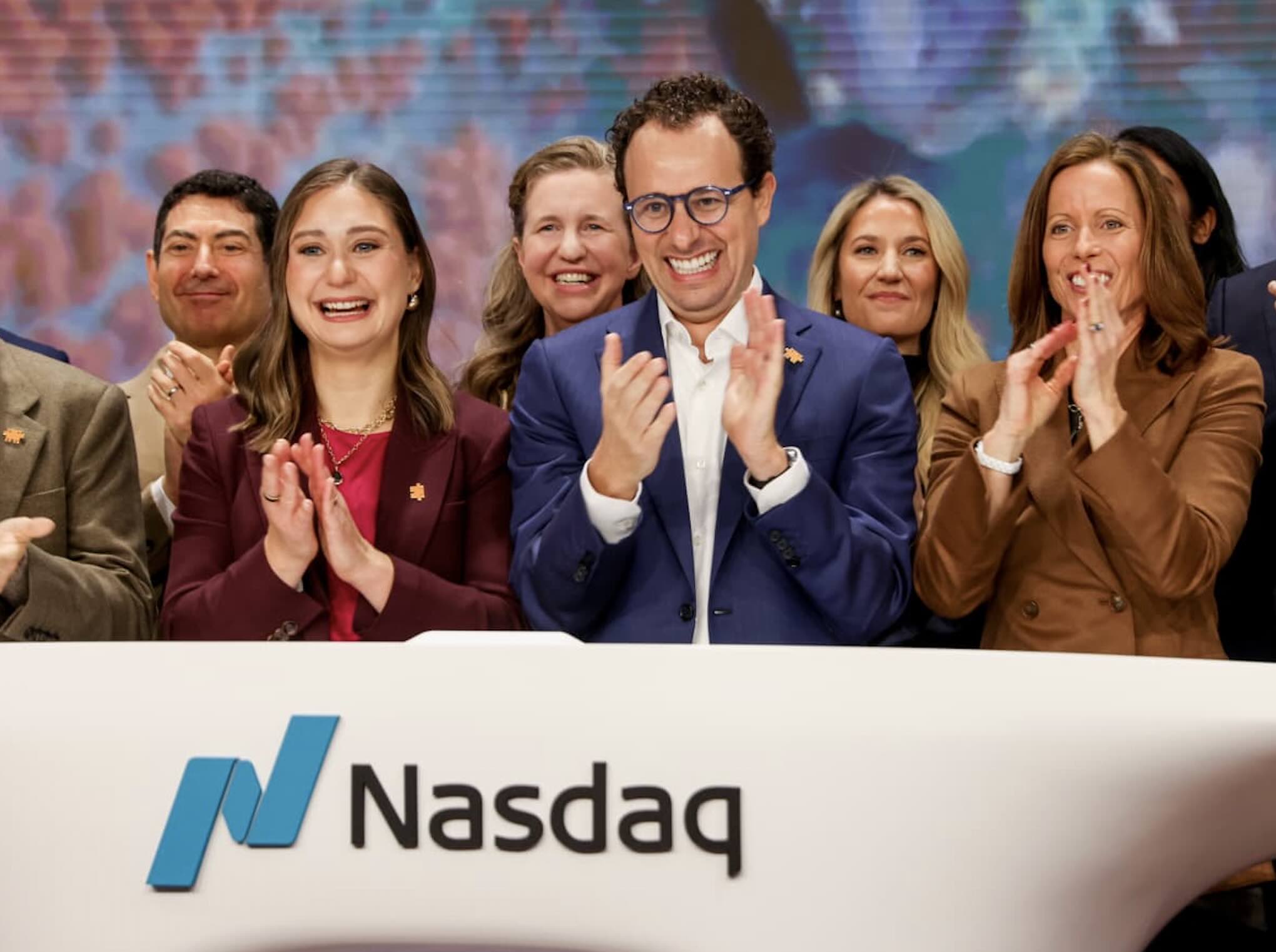
Photo: AP
When Anthropic officially went public on November 19, 2026, under the ticker ANT, it became the largest offering in stock-market history — surpassing SpaceX's $75 billion debut earlier in the year. Shares priced at $83, opened at $111.50, and briefly valued the maker of Claude at nearly $2 trillion. It raised $81.3 billion in the public offering, plus another $26 billion from tech partners including Nvidia, Google, Microsoft, AMD, Broadcom, Micron, and TSMC.
And yet, by afternoon, roughly nine out of every ten stocks in the S&P 500 were trading in the red. The Nasdaq Composite, which had rallied more than 1.5% at the opening bell, reversed sharply the moment ANT began trading and closed the session down about 1.4%. The Dow fell more than 800 points. The S&P 500 shed 1.3%, marking its sixth consecutive daily loss — its longest losing streak since April 2024. The VIX spiked above 27.
The divergence is not a coincidence. It is a signal. While Anthropic soared, the rest of the market voted with its feet — and the message was not about enthusiasm for artificial intelligence. It was about doubt.
The mechanics of the sell-off are instructive. Because Anthropic raised a record $81.3 billion and debuted at a $1.5 trillion to $2 trillion valuation, institutional and retail investors had to free up cash by selling existing tech, chip, and blue-chip holdings. Fund managers with finite capital were forced to rebalance — dumping Nvidia, Broadcom, Micron, and even SpaceX, which fell over 5%, to make room for the new giant. AMD dropped roughly 8% after a short-seller report raised export-control questions.
A Balance Sheet That Tests Belief
If investors truly believed in the AI future, the Anthropic debut should have lifted the entire sector. Instead, the prospectus gave them reasons to pause. The company reported $33.2 billion in revenue for the first nine months of 2026 — up more than 1,200% year-over-year — alongside a staggering $901 billion in long-term compute commitments extending through 2045, with nearly $70 billion due over the next 12 months alone.
The headline numbers look even worse up close. Anthropic posted a GAAP operating loss of $1.3 billion for the first nine months, and a headline net loss of $104 billion — driven largely by $94.3 billion in non-cash accounting charges tied to the rising fair value of convertible notes and derivative liabilities ahead of the IPO. Even with $131.8 billion in cash on hand, rising to roughly $232.4 billion after IPO proceeds, the scale of future obligations dwarfs what the company has actually earned.
- Nine-month revenue of $33.2 billion — against $901 billion in long-term compute commitments.
- A $104 billion headline net loss, including $94.3 billion in non-cash accounting charges.
- Roughly 11,900 enterprise customers spending $100,000+ annually, generating about 74% of revenue.
- Nearly 90% of S&P 500 stocks in the red on debut day — the market's answer to the AI narrative.
The sell-off also reflected a classic "sell-the-news" reaction. For months, Wall Street had treated Anthropic's IPO and Nvidia's quarterly earnings as the twin catalysts that would reignite the bull market. Once both events passed without fixing the market's underlying issues, traders sold into the quiet. Nvidia slipped despite beating estimates, amid leadership uncertainty and ongoing SEC and export-control scrutiny. The "peak catalyst" had come and gone.
The Macro Backdrop: Rates, Debt, and Fatigue
Beneath the IPO rotation lies a more fundamental problem. Minutes from the Federal Reserve's October meeting signaled that most officials expect further interest rate hikes, keeping the 10-year Treasury yield hovering near 5.05%. With the S&P 500's cyclically adjusted price-to-earnings ratio near 41 — a level rarely seen in market history — higher borrowing costs are forcing institutions to reduce exposure to expensive equities.
And then there is the AI spending question itself. As Bloomberg noted, Anthropic's successful listing did not ease investor anxiety over whether the AI industry's massive borrowing and data center spending will generate enough near-term profit to justify sky-high valuations. Where bullish institutions see a $901 billion compute commitment as a moat, skeptics see a liability — locked-in capacity that smaller rivals cannot match, but that also requires returns the company has yet to demonstrate at scale.
The broader market was already fragile. The Nasdaq is down more than 12% from its October peak, and more than 3% for November. Today's session added fresh shocks: JPMorgan Chase, Visa, and Mastercard slid after confirming customer data was accessed in a third-party vendor cyberattack; managed care stocks dragged healthcare down nearly 1.8%, led by a 6% drop in Cigna; Williams-Sonoma plunged 13% on missed comparable sales. Bitcoin eased to near $62,700. Gold fell 1.4%.
What the Divergence Really Says
A single IPO cannot crash the stock market, and today's drop is best understood as a liquidity rotation rather than a systemic collapse. Treasury and corporate bond markets are functioning normally. Many companies continue to beat revenue and profit forecasts. Once major funds finish adjusting their weightings over the next few trading sessions, that forced selling pressure typically subsides — as it did after Alibaba's 2014 debut and Facebook's 2012 listing, both of which saw the broader market pull back before stabilizing.
But the pattern is telling. When the largest, most anticipated AI company in history goes public at a $2 trillion valuation and the market's response is to sell everything else, that is not a vote of confidence. It is a market saying that the AI trade has become too concentrated, too expensive, and too dependent on future promises rather than present profits. Anthropic's stock may hold above its $83 IPO price in the days ahead. The question investors are really asking is not whether Anthropic can grow — it clearly can. It is whether the rest of the AI ecosystem can justify the capital it is consuming.
For now, the answer from the broader market is a resounding red screen. And until the AI industry can show that its enormous spending translates into durable earnings, the divergence between a soaring Anthropic and a falling market may prove to be less a glitch than a verdict.
No Ads. By Us. For Us.
This article was made possible by readers like you. We hope it inspired you to support Emerald Book, so we can continue producing content like this.
We will never show you ads, sell your data, or require a subscription to consume our content. Your gift helps us keep the truth accessible.
Click the Support button to give a gift of any amount today.
Thank you for making this work possible.