

Emerald Pages
◆
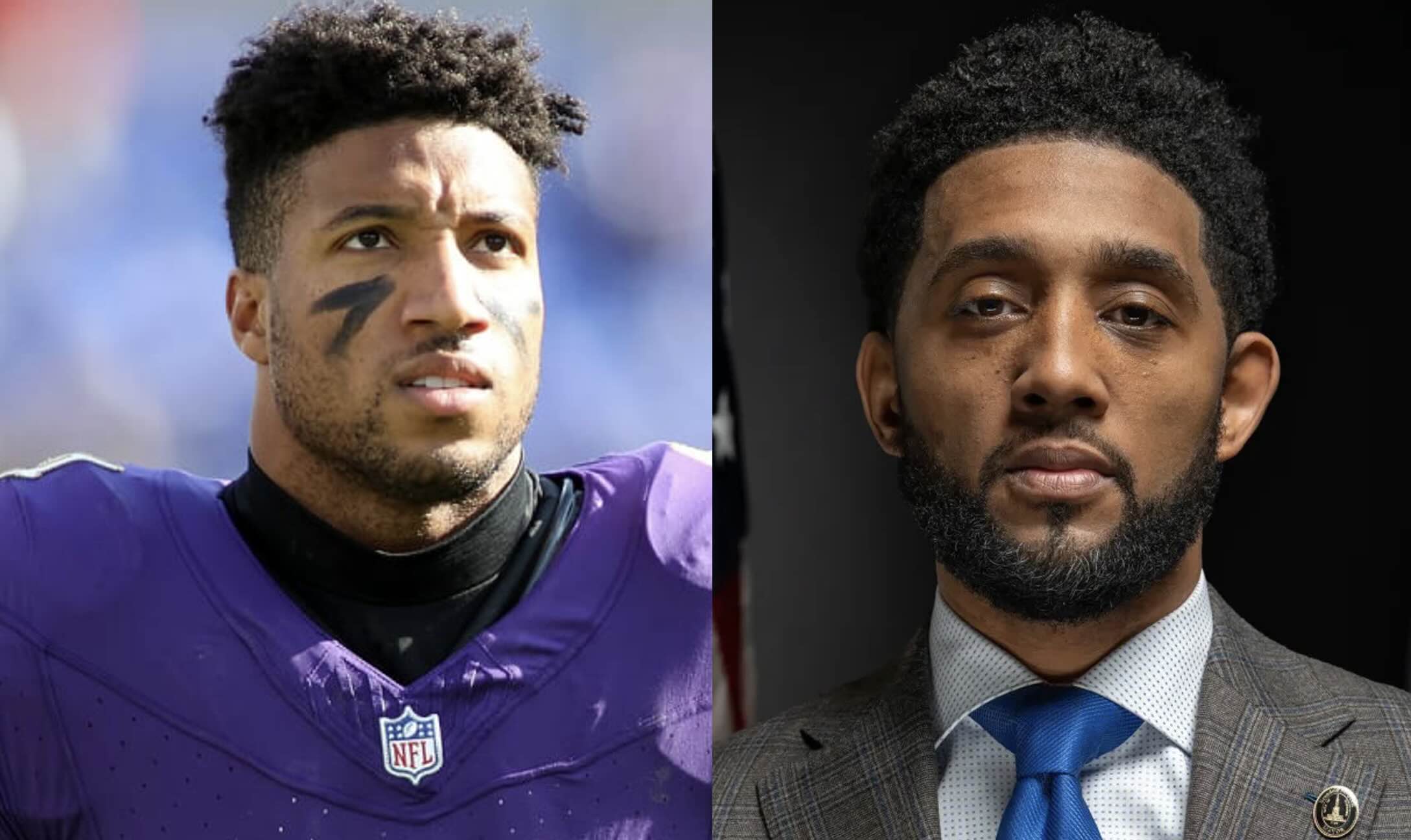
Baltimore Ravens defensive back Marlon Humphrey (left) and Baltimore Mayor Brandon Scott (right) | Photo: Emerald Book Image
Marlon Humphrey stepped to his locker on Wednesday afternoon and apologized. By Thursday morning, the Ravens had sent him home from their facility in Owings Mills and deactivated him for Sunday's Week 11 game in Charlotte. In roughly 24 hours, a ten-year career built in Baltimore—and nearly $100 million earned from its franchise—collided with a single sentence delivered for podcast laughs. The sentence was wrong on the facts. It was wrong on the timing. And most of all, it was wrong for the person who said it.
The remark came during a Wednesday episode of The Marlon Humphrey Show. Co-host Jeremiah Pittman asked what Baltimore is best at making. Humphrey listed The Star-Spangled Banner, National Bohemian beer, and H&S Bakery—all genuine Baltimore exports—before landing on the line that would cost him his game check: "They're best at making criminals." Humphrey and Pittman laughed. Humphrey noted the comment would likely be edited out. It wasn't. The clip remained in the episode, went viral on social media, and was subsequently deleted. By then, the damage was done.
What followed was a compressed cascade of consequences. Humphrey apologized to reporters at his locker after Wednesday's practice, noting he has spent his entire ten-year career in Baltimore, welcomed a son there, and invests in the local community. Mayor Brandon Scott issued a statement calling a verbal apology "not enough," emphasizing that young Black boys in the city look up to Ravens players as role models, and invited Humphrey to sit down with local community members. On Thursday morning, head coach Jesse Minter announced Humphrey had been sent home and would be inactive for Sunday's road game against the Carolina Panthers. The team, mired in a five-game losing streak, wasted little time containing the distraction.
The Numbers Do Not Support the Joke
The central problem with Humphrey's remark is not just that it was offensive. It is that it was empirically false—and demonstrably so at the very moment he said it. Baltimore is in the middle of a historic, multi-year decline in violent crime, and the data is unambiguous.
According to the Baltimore Mayor's Office, the city recorded 133 homicides in 2025—its lowest total in nearly 50 years. That marked a 31% drop from 2024 and a nearly 60% decrease since 2021. It was the third consecutive year homicides fell by double digits. The downward trend carried into 2026: Baltimore Police Department data showed homicides fell another 23% in the first half of the year compared to the same period in 2025, with nonfatal shootings down 2.5%. By October 1, 2026, homicides were down 15.3% year-over-year (83 in 2026 versus 98 at the same point in 2025), alongside a 4.2% drop in nonfatal shootings (226 versus previous totals).
The national comparison is even more striking. A Council on Criminal Justice analysis found that Baltimore's homicide rate in the first half of 2026 was 68% lower than in 2019—more than double the average decline across other major U.S. cities. In other words, Baltimore is not just improving. It is improving faster than almost any comparable city in America.
- 133 homicides in 2025: the fewest in nearly 50 years, down 31% from 2024 and nearly 60% since 2021.
- Down 23% in the first half of 2026: 50 homicides versus 65 in the same period of 2025.
- Down 15.3% year-over-year as of October 1, 2026: 83 homicides versus 98 at the same point in 2025.
- 68% lower than 2019: more than double the average decline across other major U.S. cities, per the Council on Criminal Justice.
There is context worth acknowledging. Even with steep drops, FBI crime data for 2025 still ranked Baltimore fifth among the 50 largest U.S. cities for violent crime, with a rate roughly four times the national average. Certain non-violent offenses, such as motor vehicle thefts, have remained elevated compared to pre-2020 levels. The city still faces serious public safety challenges. But that is precisely the point: Baltimore is a city making measurable, documented progress against the exact stereotype Humphrey reinforced—and it is doing so while community programs and law enforcement drive significant improvements. His joke leaned on an outdated reputation at the precise moment the numbers were proving it wrong.
Where Humphrey Comes From
The second problem is who said it. Humphrey grew up in Hoover, Alabama—an affluent suburb just south of Birmingham, where the median household income is more than double that of Baltimore City. He was born and raised there, attending Hoover High School, a nationally renowned athletic powerhouse, before playing college football at the University of Alabama.
His family background is one of comfort and athletic pedigree. His father, Bobby Humphrey, was a first-round NFL draft pick who played running back for the Denver Broncos and Miami Dolphins, earning Pro Bowl honors before transitioning into a business career. His mother, Barbara Humphrey, was an All-American track athlete at UAB. Humphrey himself signed a five-year, $98.75 million contract extension with the Ravens in 2020, making him one of the highest-paid cornerbacks in the NFL.
That background matters because it explains the disconnect. Like many NFL players, Humphrey spends most of his time at the Ravens' training facility in Owings Mills—a wealthy suburb in Baltimore County—and travels frequently, rather than experiencing daily life in the city's neighborhoods. To people living and working in Baltimore, the joke felt like punching down. Community leaders and residents have spent years trying to shake off the exact stereotype Humphrey reinforced. Hearing a wealthy athlete from a comfortable suburb reduce the entire city to "making criminals" for podcast laughs felt dismissive and out of touch.
Humphrey grew up in a wealthy suburb outside Birmingham, Alabama—a city that regularly posts a higher per-capita homicide rate than Baltimore itself. The person making the joke came from a place with worse crime numbers than the place he was mocking.
The Stats That Actually Are Declining: His Own
If Humphrey wanted to talk about decline, he might have looked at his own stat sheet. The 30-year-old cornerback is in the final year of that five-year, $98.75 million deal, carrying a league-high cornerback cap hit of $26.3 million. His on-field play has drawn heavy criticism this season, and the numbers are brutal.
Humphrey has struggled statistically through the 2026 season, ranking among the league's worst in fourth-quarter receiving yards allowed (313). He trails near the top in man-coverage yards surrendered since 2025 and has yielded career-high marks with 9.5 yards per target and a 94.4 passer rating. Fans exiting M&T Bank Stadium during Monday night's loss to the Los Angeles Chargers could be heard directing profanity at him—audible criticism that underscored how thin the goodwill had already become.
Mayor Scott turned that dynamic back on Humphrey in his Wednesday evening statement, noting that city leaders avoid such public criticism because of a shared "Baltimore versus the world" ethos—but wondering aloud how Humphrey would feel if prominent Baltimoreans implied the city "once produced great defensive backs but we have recently lost our way." The jab landed because it was true. A player whose own performance is declining, on a team riding a five-game losing streak, chose to mock a city whose crime rates are declining faster than almost any other major U.S. city.
A City That Expects Better From Its Own
The final problem is the relationship Humphrey has benefited from and, in one sentence, disrespected. Baltimore is a blue-collar, fiercely loyal sports town where residents take deep pride in their identity and expect the athletes representing the city to understand and respect it. The Ravens' standard was set by icons who did exactly that: Ray Lewis, Ed Reed, and Torrey Smith actively embraced the city, spent time in its neighborhoods, and defended Baltimore against national critics.
Humphrey, by contrast, has spent his entire ten-year NFL career in a Ravens uniform. He built his career and wealth in Baltimore. Many fans didn't view his remark as an outsider taking a cheap shot—they felt it was someone who profited from the city casually disrespecting the people who support him every Sunday. Because Humphrey has been drafted, developed, and paid nearly $100 million by Baltimore's franchise over the past decade, his joke echoed the exact outside stereotypes the city constantly fights against. Feeling betrayed by one of their own cut deeper than any national criticism could.
The Apology and What Comes Next
Humphrey did apologize. Speaking to reporters at his locker after Wednesday's practice, he expressed love for the city where he has spent his career, welcomed a son, and invested. He acknowledged the impact of his words and said the issue "won't really happen again," confirming he plans to continue his podcast. But the apology was brief, and critics and local commentators felt it was dismissive—noting Humphrey appeared more focused on defending his local business ties than the community impact.
Mayor Scott acknowledged the apology via Instagram while stating that "a verbal apology is not enough," inviting Humphrey to meet with him and local residents working to steer youth away from crime. That invitation remains open. Whether Humphrey accepts it will say more about him than any podcast joke ever could.
The data is clear. Baltimore is not "best at making criminals." It is a city making real, measurable progress against violent crime—progress that a wealthy, suburban-raised athlete with declining stats and a $26.3 million cap hit should have understood before he opened his mouth. The numbers never supported the joke. The city never deserved it. And the player who told it is now the one whose season, and whose standing in the city he calls home, are the ones in decline.
No Ads. By Us. For Us.
This article was made possible by readers like you. We hope it inspired you to support Emerald Book, so we can continue producing content like this.
We will never show you ads, sell your data, or require a subscription to consume our content. Your gift helps us keep the truth accessible.
Click the Support button to give a gift of any amount today.
Thank you for making this work possible.