

Emerald Pages
◆
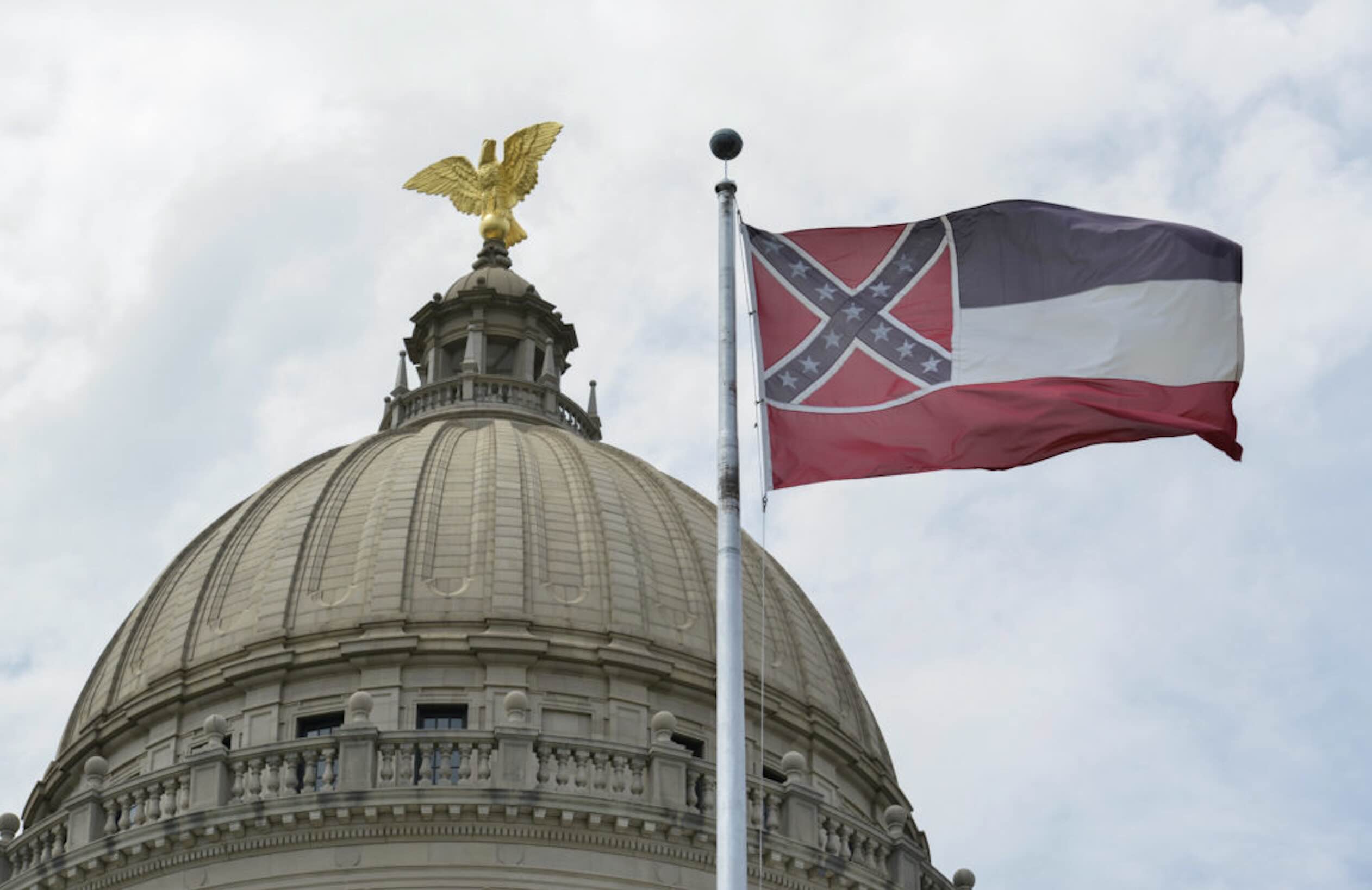
Old state flag that includes a Confederate emblem, in Jackson, Mississippi, U.S. at the State Capitol | Photo: Reuters
Mississippi consistently ranks among the states with the highest poverty rates and lowest median household incomes in the United States. But the numbers tell a deeper story: a state that receives roughly $2.20 to $2.50 in federal funding for every $1.00 its residents pay in federal taxes, ranks 50th in per-capita GDP, and sits at or near the bottom in healthcare, infrastructure, and income—all while its Republican leadership has held a government trifecta since January 2012.
The question of why Mississippi remains America's poorest state is not just academic. It is a question about how a state with a nearly 37% Black population—the highest share in the nation—came to be governed by policies that disproportionately harm its Black residents, and why a state that takes more than it gives has become a net drain on the American economy in virtually every measurable way.
Last Place, Almost Everywhere
Across major national benchmarks, Mississippi consistently ranks near the bottom of all 50 states—typically between 44th and 50th—in poverty, income, healthcare, and fiscal independence. The state's overall poverty rate hovers around 18% to 19%, while child poverty is significantly higher at roughly 24% to 28%. Median household income sits around $45,000 to $55,000 depending on the Census benchmark—frequently the lowest or near-lowest in the country.
- Poverty Rate: 49th or 50th nationally (~18.0%–19.4%), trailing only Louisiana in some years.
- Median Household Income: 50th (lowest) at roughly $59,127, compared to Massachusetts at over $104,000.
- Federal Dependency: 4th most dependent, receiving over $2.20 back per $1.00 paid in federal taxes.
- Per-Capita GDP: 50th among all states, generating significantly less economic output per resident than the national average.
- Healthcare: 49th or 50th, with high rates of uninsured residents, chronic illness, and limited rural hospital access.
- Infrastructure: 49th or 50th, with poor road and bridge conditions and lower broadband access in rural areas.
The state's strongest metric—affordability—is itself a byproduct of its weak economy. Mississippi ranks 6th in cost of living, roughly 13% below the national average, but that is driven by low wages, low demand, and inexpensive housing rather than prosperity. According to United For ALICE, 48% of Mississippi households still struggle to afford basic necessities, ranking the state 50th nationally on that measure.
The Fiscal Drain: Taking More Than It Produces
On a strict dollar-for-dollar basis, Mississippi operates at a large net deficit relative to the U.S. Treasury. According to fiscal analyses, Mississippi residents and businesses consistently pay billions less in federal income, payroll, and corporate taxes than the state receives back in federal spending. Data compiled by USAFacts shows Mississippi generates the second-lowest amount of federal tax revenue per resident in the nation, yet receives over $11,000 more per person in federal spending than it contributes—ranking fourth highest nationally for per capita federal inflows.
Federal transfers account for roughly 33% to over 40% of Mississippi's combined state and local government revenue—significantly higher than the national average. About 60% of federal transfers to Mississippi's state and local governments go toward public welfare, including Medicaid, food assistance (SNAP), and cash assistance for low-income families. A large share also goes directly to residents through Social Security and Medicare, while defense contracts and agricultural subsidies make up much of the rest.
Economists note that in any large country, rural and agricultural regions almost always consume more public funding than they generate in tax revenue, while dense urban and financial centers generate massive tax surpluses. States like Mississippi supply physical goods—warships, poultry, timber, automobiles, and energy logistics—that are essential to the broader economy, even though those industries generate lower wages and lower tax receipts than tech, finance, or corporate headquarters located in wealthier states. But the scale of Mississippi's dependence, combined with its bottom-tier outcomes, makes it an outlier even among rural states.
The Racial Wealth Gap: A Policy Choice, Not an Accident
The question of how race, public policy, and poverty intersect in Mississippi is one of the most heavily studied topics in American sociology and political science. Data consistently shows a sharp racial wealth and poverty gap: the poverty rate for Black Mississippians typically hovers between 26% and 29%, compared to roughly 11% to 12% for White Mississippians. Because Black residents make up nearly 37% of Mississippi's population—the highest share in the nation—and experience poverty at more than double the rate of White residents, this disparity significantly pulls down the state's overall median income and pushes up its statewide poverty rate.
Sociologists, civil rights organizations, and progressive policy analysts argue that a continuous line of policies—both historic and modern—disproportionately harms Black residents and depresses the broader state economy. Slavery, Jim Crow laws, sharecropping, redlining, and unequal funding of Black schools during segregation prevented generations of Black families from accumulating land, home equity, and capital. Because wealth is passed down across generations, those historical barriers continue to affect economic outcomes today.
Even when modern laws are written in race-neutral language, they have a racially disparate impact. Refusing to expand Medicaid disproportionately leaves low-income Black adults uninsured. Relying heavily on sales taxes—including one of the highest state grocery taxes in the country—while moving to phase out the state income tax shifts a larger share of the overall tax burden onto lower-income households, who spend a greater portion of their earnings on basic goods. A $7.25 minimum wage places a heavier burden on Black workers who are overrepresented in service and hourly jobs. And chronic underinvestment in majority-Black cities and regions—such as the water infrastructure crisis in Jackson and underfunded school districts in the Mississippi Delta—limits economic opportunity for the state's Black population.
Republican Leadership: A Decade of Trifecta Control
The Republican Party has held full, uninterrupted control of Mississippi's state government—the governorship and both legislative chambers—since January 2012. Prior to that, Democrats held continuous control of the Mississippi State Legislature from 1876 until 2007, when Republicans briefly controlled the Senate after two Democratic senators switched parties. Republicans secured durable majorities in both chambers in the 2011 elections, taking control in early 2012.
Since then, the state's Republican leadership has pursued a distinct policy agenda: cutting income taxes, keeping labor costs competitive, rejecting Medicaid expansion under the Affordable Care Act, enforcing strict safety-net eligibility rules, and maintaining a $7.25 minimum wage by defaulting to the federal rate. State leaders, including Governor Tate Reeves, argue that cutting income taxes and reducing regulations are long-term strategies designed to attract private sector investment and eventually reduce the state's reliance on federal aid. Supporters of tax cuts and deregulation—such as the Mississippi Center for Public Policy—argue that lowering income taxes and keeping labor costs competitive makes the state attractive to major manufacturers and tech companies, creating jobs that lift families out of poverty.
However, state leaders reject specific federal initiatives, such as expanding Medicaid, while still relying on federal funds for over 40% of the state's annual budget. They argue that Mississippi's Republican leadership maintains low state taxes and cuts income taxes while relying on federal transfers—largely funded by taxpayers in wealthier, often Democratic-leaning states—to keep state schools, healthcare, and infrastructure running. A widely publicized state audit also revealed that millions of federal TANF dollars intended for poor families were misspent or diverted to non-needy projects, limiting direct cash aid to those in poverty.
Why Republican Control Persists
Political scientists, historians, and election analysts point to a mix of demographic, cultural, and structural factors to explain why Republican leadership has remained entrenched despite the state's economic challenges. Many Mississippi voters prioritize social, religious, and cultural issues over state-level economic indicators. Alignment with conservative evangelical values, opposition to abortion, and support for Second Amendment rights strongly anchor voter loyalty. Mississippi also exhibits some of the most racially polarized voting patterns in the United States: White voters consistently support Republicans by wide margins, while Black voters—who make up roughly one-third of the population—overwhelmingly support Democrats, creating a structural ceiling for Democratic candidates in standard-turnout elections. Legislative district boundaries drawn by Republican majorities, combined with stronger fundraising networks and national party support, give GOP candidates a built-in advantage in state House and Senate races.
Many voters in the state also hold a deep-seated distrust of federal regulations and government-run programs. Consequently, they often view conservative policies like tax cuts and deregulation as protective measures against government overreach, rather than as causes of economic hardship.
A Cycle That Reinforces Itself
Because metrics like income, education, healthcare, and infrastructure are closely linked, struggles in one area often reinforce challenges in others. Ranking at or near the bottom in healthcare access, life expectancy, and chronic illness means a larger share of the working-age population faces health barriers that limit full-time employment and suppress household income. Lower rates of college degree attainment and technical training make it harder to attract high-paying industries, keeping median wages at the bottom of national rankings. Low household incomes and high poverty rates generate a smaller state tax base, and with less local revenue, the state struggles to fund road repairs, water systems, and rural broadband without relying heavily on federal grants.
The result is a state that, in strictly fiscal terms, takes in tens of billions of dollars more in federal funding than it pays in federal taxes—a net negative on the federal balance sheet—while producing critical goods, energy, agriculture, and military defense assets for the rest of the country. Both things are true at once. But the scale of the imbalance, and the persistence of bottom-tier outcomes across nearly every measurable category, raises a question that neither party has answered: whether a state can continue to rely on federal transfers funded by taxpayers in wealthier states while pursuing policies that suppress wages, limit healthcare access, and disproportionately harm its Black residents.
Mississippi's defenders argue that deep-rooted poverty cannot be reversed within a single decade of Republican trifecta control, and that low taxes and deregulation are long-term strategies designed to attract private sector investment. But a decade is long enough to measure outcomes, and that the outcomes—last or near-last in poverty, income, healthcare, infrastructure, and fiscal independence—speak for themselves. What the data makes clear is that Mississippi is not just a poor state. It is a state whose poverty is structural, racial, political, and fiscal all at once—and one whose costs are borne, in part, by the rest of the country.
No Ads. By Us. For Us.
This article was made possible by readers like you. We hope it inspired you to support Emerald Book, so we can continue producing content like this.
We will never show you ads, sell your data, or require a subscription to consume our content. Your gift helps us keep the truth accessible.
Click the Support button to give a gift of any amount today.
Thank you for making this work possible.