

Emerald Pages
◆
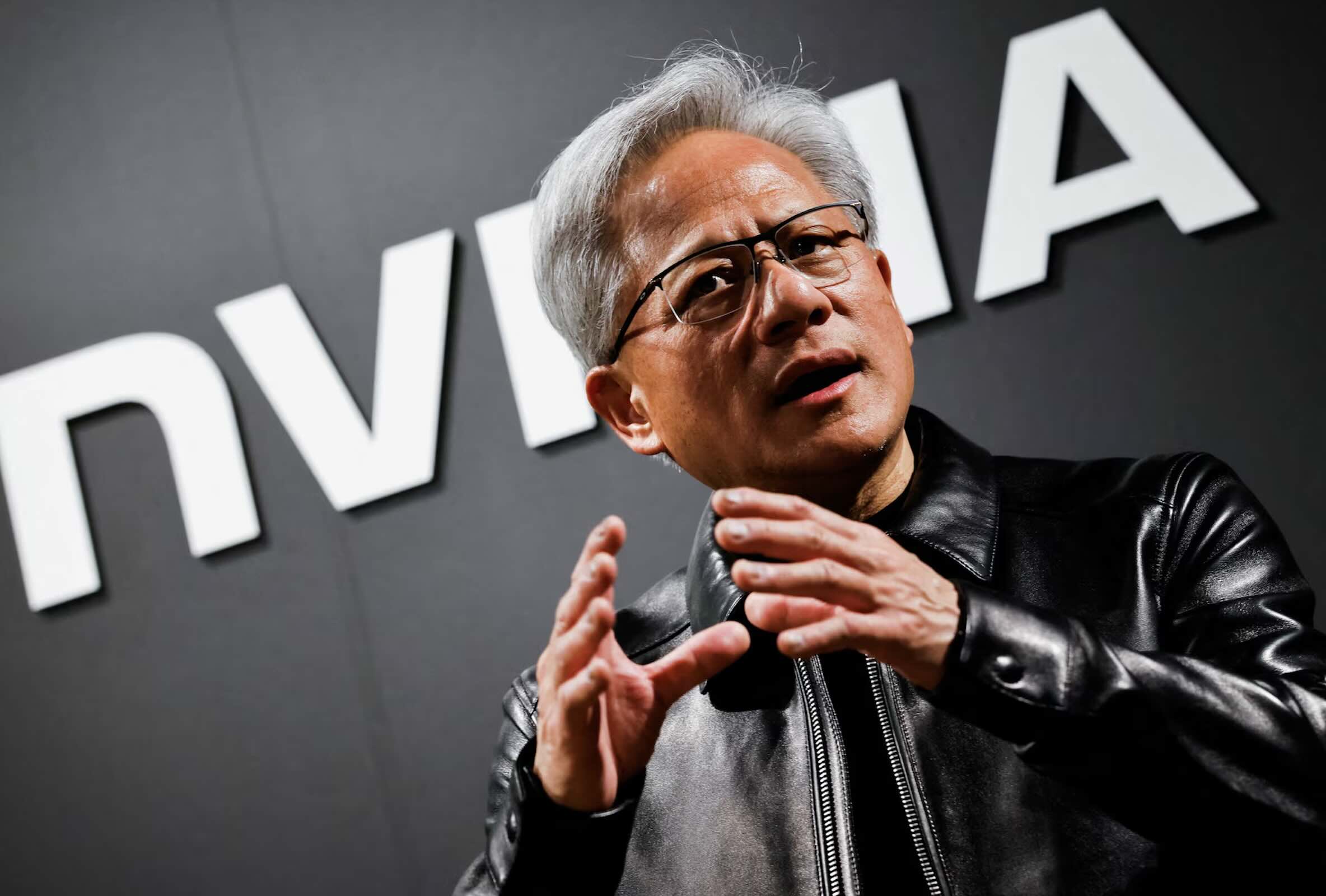
Photo: Reuters
When the first New York Times report landed on October 29, 2026—alleging that Jensen Huang had conducted an extramarital affair with Alice Huang, a Singapore-based executive suspected of ties to Chinese intelligence—the story initially read as a lurid corporate scandal. A second report on November 11, detailing a relationship with Kimberly Powell, Nvidia's VP of Healthcare who reported directly to him, made his position untenable. By November 12, Huang had resigned as CEO and director. A third affair, with an unidentified Nvidia employee, surfaced hours later via Reuters.
But the personal scandal was never the real story. What Huang's ouster actually revealed was something far more consequential: the degree to which a single company—and a single man—had become the load-bearing wall of the entire American economy. And the mechanisms Huang built to sustain Nvidia's growth, now being unwound by interim CEO Colette Kress, are precisely the mechanisms that threaten to bring the whole AI bubble down.
The Hidden Architecture of the Boom
Beneath the headlines about affairs and espionage lay a financial structure that regulators had been quietly warning about for months. Nvidia, under Huang, had ceased to be just a chip supplier. It had become what analysts now call the "central bank of AI"—extending roughly $100 billion in direct equity investments and over $530 billion in off-balance-sheet guarantees and lease backstops to customers who then used that capital to buy Nvidia's own products.
The mechanics were elaborate. Nvidia poured $30 billion into OpenAI, $10 billion into Anthropic's IPO, and $2 billion into cloud operator CoreWeave—companies that promptly turned around and purchased tens of billions in Nvidia hardware. It guaranteed up to $105 billion in 20-year rent obligations to SoftBank's SB Energy for an OpenAI data center in Ohio, enabling construction loans to fill the facility with Nvidia chips. For smaller "neoclouds" like CoreWeave, Nvidia pledged roughly $65 billion across the ecosystem, promising to rent back unused cloud capacity—a revenue floor that allowed CoreWeave to take on $24.9 billion in high-interest debt to buy more GPUs.
Meanwhile, Huang locked Nvidia into massive prepaid supply commitments with TSMC and memory makers just as major cloud providers began shifting toward custom in-house chips. By July 31, 2026, Nvidia's reported inventory had surged to $31.58 billion—more than double its $14.96 billion level a year earlier. In a tense August 2026 internal meeting, Huang admitted to his finance team that a mountain of prepaid silicon was coming at Nvidia like an "avalanche" with no immediate buyers.
Rather than cut prices, he doubled down on the circular financing loop. CFO Colette Kress pushed back hard, arguing to rein in the company's financial exposure and eventually slashing a proposed $250 billion compute guarantee for OpenAI down to $125 billion. It was a preview of the conflict that would define her interim tenure.
The Singapore Pipeline and the Export Loophole
Parallel to the circular financing ran a second, more politically explosive channel. Between mid-2024 and early 2026, Singapore-based data center operator Megaspeed—run by Alice Huang—purchased at least $4.8 billion worth of Nvidia AI equipment. During that period, Nvidia's revenue billed to Singapore jumped to 22% of total sales, even though less than 1% of those chips physically stayed in the city-state.
When U.S. officials inspected a Megaspeed facility in Malaysia in 2024, they found Nvidia equipment still sitting in shipping boxes. Nvidia auditors later could only locate a few thousand of the roughly 136,000 GPUs the company had imported. Beyond physical rerouting, Megaspeed built data centers across Malaysia, Indonesia, and Thailand specifically to rent computing power to Chinese tech giants like Alibaba—exploiting a legal loophole that allowed remote cloud access to restricted chips hosted outside China.
Critics and lawmakers accused Nvidia of "willful negligence" for continuing to treat Megaspeed as a preferred partner despite glaring red flags. According to The New York Times, a U.S. Commerce Department inquiry into Megaspeed was previously halted after Nvidia intervened—and Huang continued meeting with Alice Huang even after investigations began. Nvidia denies violating export laws and notes it voluntarily cut off all shipments to Megaspeed in June 2025. But the Justice Department has taken over the investigation, and the Trump administration moved on November 16 to tighten export rules closing the remote cloud-access loophole.
The Market Begins to Price In the Risk
The market's verdict has been swift and brutal. Since October 16, Nvidia's stock has shed more than 30% of its value—roughly $1.76 trillion in market capitalization—closing at $156.14 on November 16. The contagion has spread across the entire semiconductor ecosystem: Micron and Intel both fell over 7% on Monday, AMD dropped 5%, and AI cloud providers CoreWeave and Nebius slid 6.1% and 7.6% respectively.
The broader indexes have not been spared. The Nasdaq Composite closed Monday at 24,509.76, down 2.49% on the day and roughly 11% below its October 6 record peak. The S&P 500 fell 1.92% to 7,416.59—its biggest single-day drop since November 5—while the Dow Jones Industrial Average dropped 739.38 points to 51,608.17. All three logged their third consecutive losing session.
- Nvidia stock: $156.14, down more than 30% from its October 16 peak, wiping out roughly $1.76 trillion in market value
- Nasdaq Composite: 24,509.76, down 2.49% Monday and roughly 11% below its October 6 record
- S&P 500: 7,416.59, down 1.92% Monday—its biggest single-day drop since November 5
- Dow Jones: 51,608.17, down 739.38 points (1.41%) Monday
The concentration risk is extreme. Since late 2022, just 10 AI-linked companies have accounted for more than half of the S&P 500's $32 trillion in market gains. Roughly 44% of U.S. pension fund holdings are tied up in tech stocks. Federal Reserve Bank of St. Louis data showed AI accounted for roughly 39% of real U.S. GDP growth in late 2025, while Morningstar estimates tech investment drove nearly half of GDP growth in the first three quarters of 2026.
The Debt Beneath the Surface
What makes the unwind so dangerous is that the AI boom has increasingly shifted from being funded by tech giants' cash reserves to relying on corporate bonds, private credit, and off-balance-sheet debt. In its November 13 Financial Stability Report, the Federal Reserve flagged AI leverage as a top systemic risk for the first time.
Companies issued more than $680 billion in debt tied to advanced computing in the first ten months of 2026—a fivefold jump from $130 billion in all of 2023—bringing total outstanding public AI debt to over $1.1 trillion. Aggregate hyperscaler debt has pushed above $700 billion as capital expenditures grew faster than operating cash flow. Beyond reported bonds, the Fed estimates hyperscalers hold roughly $3 trillion in off-balance-sheet leases, backstop guarantees, and special-purpose vehicles, with major U.S. banks carrying close to $1 trillion in exposure to AI developers and private credit vehicles.
The most fragile link is the "neocloud" sector. CoreWeave alone carries $35 billion in debt, with some credit facilities charging 11% to 15% interest. Over $20 billion in neocloud loans are backed directly by Nvidia GPUs as collateral—lenders assumed those chips would hold value for five to six years, but rapid upgrades and falling rental rates are eroding that collateral. Following Huang's resignation and fears that Nvidia will stop guaranteeing partner debt, borrowing costs for below-investment-grade AI firms have spiked.
Why Nvidia Is the Trigger
Market analysts and financial historians widely view Nvidia as the single most likely trigger to pop the AI bubble. Because Nvidia acts as both the primary supplier of AI hardware and the financial backstop for much of the ecosystem, a slowdown or retrenchment at the company directly threatens the entire chain.
The math is stark. UBS analyst Tim Arcuri estimates that if Kress pulls back Nvidia's customer financing, it could immediately remove $50 billion or more in hardware demand from the market. The Bank for International Settlements—the "central bank for central banks"—has warned that tech giants are over-investing by 1.5 to 3 times the economically efficient level, and that 55.2% of incoming investments into AI firms came from other AI companies, with 46.4% of AI-to-AI deal value involving circular supply-chain agreements.
NYU professor Aswath Damodaran estimates that $3 trillion has been invested into AI infrastructure while combined annual AI software revenues sit at only $250 billion. Unlike the 1990s dot-com boom, which left behind long-lasting fiber-optic cables, AI data centers are filled with GPUs that have an effective shelf life of about three years. If the bubble pops, companies could be left holding billions in debt on rapidly depreciating hardware.
The Moment of Truth
Colette Kress will face investors on Tuesday, November 17, during Nvidia's quarterly earnings call, where she is expected to clarify how much financial exposure Nvidia still carries and what her conservative playbook means for future revenue guidance. The same week, Anthropic's high-stakes IPO will serve as a second stress test for whether the AI boom holds together or unravels.
The irony is sharp. Huang was ousted over personal conduct—undisclosed relationships with subordinates that gave Nvidia's board undeniable governance grounds for removal. But the financial architecture he built, and the circular financing that inflated Nvidia's sales figures, may prove far more damaging than any affair. The scandal did not create the bubble's fragility. It simply pulled back the curtain at the worst possible moment.
No Ads. By Us. For Us.
This article was made possible by readers like you. We hope it inspired you to support Emerald Book, so we can continue producing content like this.
We will never show you ads, sell your data, or require a subscription to consume our content. Your gift helps us keep the truth accessible.
Click the Support button to give a gift of any amount today.
Thank you for making this work possible.