

Emerald Pages
◆
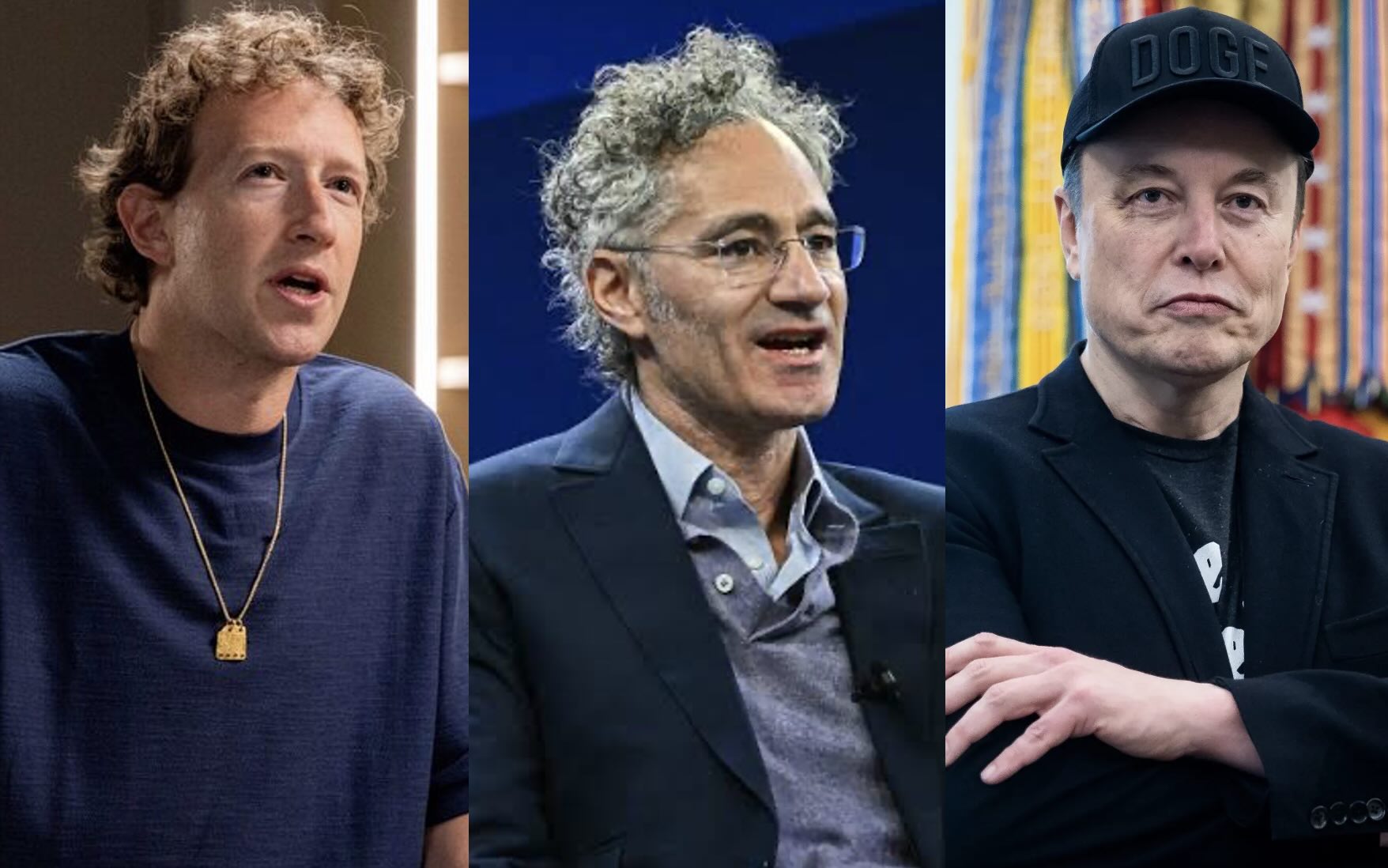
Meta CEO Mark Zuckerberg (left), Palantir CEO Alex Karp (center), and SpaceX CEO Elon Musk (right) | Photo: Emerald Book Image
In the span of a single week, the same tech executives who spent the last two years dismantling diversity programs, gutting content moderation teams, and lavishing donations on Donald Trump's inauguration have discovered a sudden, burning passion for progressive values. The speed of the transformation would be comical if it weren't so transparently transactional. And the policies that drew Democratic fury—the algorithms, the layoffs, the contracts—remain entirely untouched.
Following the November 2026 midterm elections, in which Democrats won control of both the House and Senate, Silicon Valley has launched what lobbyists are calling an "un-MAGA makeover." Palantir CEO Alex Karp has become the unlikely face of this rebranding effort, using the word "progressive" eight times in a single Politico interview to describe a company that holds roughly $2 billion in active federal contracts and a U.S. Army agreement worth up to $10 billion over a decade.
Karp, who donated $1 million to MAGA Inc. and $1 million to Trump's inauguration while Palantir contributed $10 million to the White House East Wing ballroom project, now claims he has been a Democrat his whole life and that Palantir's products are "essentially progressive." He also reframed the midterm results as a "referendum" on "economic justice" and warned that the AI boom cannot simply make the rich 20 times wealthier without helping average workers.
The company has brought on former Democratic Senator Jon Tester of Montana as a senior adviser—a clear signal that Palantir is bracing for the subpoenas Democratic committee chairs are already preparing. Senator Ron Wyden has signaled that Palantir's data-tracking contracts with the Department of Homeland Security and ICE will be top targets for congressional probes in January 2027.
But Karp is hardly alone. Meta has parted ways with Joel Kaplan, the Republican operative who served as Mark Zuckerberg's key liaison to the Trump administration after the 2024 election. The company is now forming a bipartisan influence team to repair relationships with Democrats. Kalshi, the prediction market platform, ended its advisory role with Donald Trump Jr. just one week after the midterms, citing a mutual agreement following his firm's investment in a competitor—though observers noted the move came ahead of promised Democratic congressional investigations into corruption. Companies including Kalshi and Paramount Skydance have rushed to hire former Democratic aides to bolster their government relations efforts.
OpenAI's Sam Altman, who spent two years meeting frequently with Trump to advance the company's interests, has suddenly pivoted to "human-first" AI safety messaging. In a November 5 post, he distanced himself from the administration's hands-off approach, writing that people should not cede control to superintelligence and inviting human-first regulation. The company has also launched a public relations effort to rebrand data centers as "AI compute campuses" and pledged to be more collaborative with local communities. Google and Microsoft are making similar concessions to address voter backlash over the environmental and local impacts of data center expansion.
The Policies They're Not Reversing
While executives are now speaking the language of economic justice and bipartisanship, the actual policies that drew Democratic ire remain firmly in place. Meta has not restored the third-party fact-checking system it eliminated in the United States. The trust and safety teams that were dismantled have not been rebuilt. X and YouTube have not reinstated the election-related claim restrictions they loosened. The algorithms that critics say actively amplified racist, xenophobic, and MAGA-aligned content during the 2025–2026 period remain untouched.
Civil rights organizations, digital researchers, and users widely documented a surge in racist and extremist rhetoric across major social networks after guardrails were removed and moderation teams were downsized. Many critics argued that algorithms actively amplified divisive content during this period. None of those moderation systems have been restored as part of the current pivot. No company has announced plans to bring back the fact-checkers, rehire the safety teams, or change the algorithmic amplification that researchers flagged.
- DEI programs: Rolled back across major firms in 2025 to align with conservative priorities. No announcements of restoration.
- Fact-checking: Eliminated at Meta in the United States. No plans to reinstate. X and YouTube loosened election-related claim restrictions; no reversal announced.
- Trust and safety teams: Downsized or dismantled. No rehiring announced despite documented surges in hate speech and harassment.
- Data center practices: Google and Microsoft are offering concessions on energy use, but the environmental and utility cost issues that drove voter backlash remain unaddressed at the federal level.
- Federal contracts: Palantir's ICE and DHS contracts, Amazon's defense and cloud deals, and Microsoft's government work all remain in place. No company has canceled or renegotiated a contract as part of the pivot.
Why Both Parties Are Skeptical
The skepticism is not limited to Democrats. On the right, conservative commentators have accused Big Tech of abandoning the administration at the first sign of political trouble. A November 7 report by The Asia Business Daily noted that some Republicans have criticized the industry following the midterm losses, arguing that the industry's support was never genuine. Populist conservatives who long viewed Silicon Valley with suspicion over perceived censorship and market dominance now see their doubts confirmed: the industry's loyalty was to power, not to any party or principle.
Political analysts note that by swinging so visibly toward the Republican Party after 2024 and then rushing back toward Democrats after the 2026 midterms, tech companies have damaged their credibility with both parties. Rather than winning allies, the rapid pivot has left Silicon Valley isolated as it prepares for divided government and heightened scrutiny in 2027.
The incoming Democratic Congress has promised an "investigative blitz" targeting firms like Apple, Meta, and Elon Musk's companies over past ties and data center practices. Senator Ed Markey has signaled plans to aggressively subpoena and regulate Big Tech. Incoming committees are preparing to scrutinize corporate donations made to Trump's White House ballroom by firms like Nvidia, Cisco, and ServiceNow, alongside broader investigations into artificial intelligence and data center energy costs. Lawmakers are also expected to examine potential quid-pro-quo arrangements and regulatory favors granted during the previous two years.
Because Donald Trump remains in the White House for the next two years, tech firms cannot completely alienate the administration without risking executive retaliation, tariffs, or lost federal contracts. As a result, executives like Meta President Dina Powell McCormick are framing their shift around "bipartisanship" rather than pure progressivism. The result is a delicate dance: enough progressive language to appease Democratic committee chairs, but not so much that the White House takes notice.
Who Will Pivot Next
Mark Zuckerberg of Meta faces intense scrutiny from Democrats who feel betrayed by his sharp rightward pivot, Mar-a-Lago appearances, and elimination of Meta's DEI programs. With Meta's top Republican liaison departing and the company building a bipartisan influence team, observers expect Zuckerberg to adopt a much more conciliatory, regulation-friendly tone ahead of 2027 congressional hearings.
Sam Altman of OpenAI has already started pivoting toward "human-first" AI safety messaging after spending two years meeting frequently with Trump. OpenAI is named on Democratic investigative dossiers and faces voter backlash over AI data centers, giving Altman strong incentives to keep moving toward the new majority.
Jeff Bezos and Andy Jassy of Amazon face dual pressure over the company's data center energy consumption—with Democratic senators demanding answers on how Amazon pays for its power grid needs—and its past alignment with the administration, including a $40 million documentary deal involving Melania Trump. Analysts expect Amazon to emphasize green energy commitments and consumer affordability to deflect scrutiny.
Tim Cook of Apple and Sundar Pichai of Alphabet/Google are both listed as targets for incoming Democratic oversight over tariff carve-outs, antitrust posture, and data center expansion. Having historically maintained strong ties with Democratic administrations prior to 2025, both executives are expected to quietly return to familiar themes around privacy, environmental sustainability, and workforce diversity—without ever acknowledging the reversal.
Nvidia's leadership transition following Jensen Huang's resignation—after the company donated $25 million to the White House ballroom and lobbied to ease chip export restrictions to China—will almost certainly bring a more Democrat-friendly posture. Whoever succeeds Huang will prioritize repairing relations with congressional Democrats and national security hawks.
The one notable holdout appears to be Elon Musk, who spent roughly $474 million backing Republican campaigns in the 2026 cycle and served inside the administration. Analysts do not expect him to rebrand as progressive, given how deeply associated he is with the GOP. Instead, observers expect him to rely on presidential veto power to block federal legislation while rushing to finalize business moves before January.
The Playbook
For everyone else, the playbook is clear: hire a former Democratic senator, use the word "progressive" repeatedly, express openness to "human-first" regulation, and hope that a few months of conciliatory rhetoric is enough to stave off subpoenas. According to The Washington Post, Democratic strategists in Silicon Valley have been flooded with calls from tech and defense executives asking which Democrats to donate to or recruit for their corporate boards—indicating that even if other CEOs avoid Karp's dramatic "progressive" speech, a widespread behind-the-scenes pivot is already underway.
Whether that works remains to be seen. But the spectacle of watching the same executives who championed deregulation, dismantled safety measures, and allowed racist rhetoric to flourish on their platforms suddenly sound like Bernie Sanders speechwriters has already become the defining political comedy of the post-midterm era. The executives are betting that Washington has a short memory. The voters who sent Democrats to Congress—driven by distrust of tech leaders, opposition to data centers, and fears of job losses from AI—are betting they don't.
No Ads. By Us. For Us.
This article was made possible by readers like you. We hope it inspired you to support Emerald Book, so we can continue producing content like this.
We will never show you ads, sell your data, or require a subscription to consume our content. Your gift helps us keep the truth accessible.
Click the Support button to give a gift of any amount today.
Thank you for making this work possible.