

Emerald Pages
◆

Senator Chuck Schumer (left) and Representative Hakeem Jeffries (right) with Prime Minister of Israel Benjamin Netanyahu | Photo: Emerald Book Image
When Democrats won control of both chambers in November 2026, Senator Chuck Schumer and Representative Hakeem Jeffries expected the victories to cement their leadership. Instead, they walked into a revolt.
Progressive activists, commentators, and a faction of incoming lawmakers have launched campaigns to block both leaders from retaining their posts, according to reporting from The Washington Post, Vanity Fair, The New Republic, and The Nation. The opposition is not confined to the party's left flank. Polling suggests it reflects the views of a clear majority of Democratic voters on the issues that now define the party's internal divide.
The core complaint is not that Schumer and Jeffries lose elections. It is that they win them while representing a set of priorities—on donor money, on Israel, and on confrontation with Republicans—that most Democratic voters no longer share. And increasingly, the base is naming who it would prefer instead.
The AIPAC Connection Is Now a Litmus Test
No single issue has done more to fuel opposition than the two leaders' ties to the American Israel Public Affairs Committee and its affiliated super PAC, the United Democracy Project.
In the 2026 Michigan Senate race, AIPAC-affiliated groups spent nearly $30 million trying to defeat progressive Democrat Abdul El-Sayed—first in the primary, then in the general election—though El-Sayed still won. Many Democratic voters resent party leaders accepting money from an organization that actively funds Republicans and attacks fellow Democrats.
The numbers back this up. An October 2026 survey by the Chicago Council on Global Affairs found that 72% of Democrats favor decreasing or stopping U.S. military aid to Israel, and Democrats' average favorability rating of Israel dropped from 52 in 2022 to a record-low 30. An August 2026 Fox News poll in Michigan found that 70% of Michigan Democrats oppose continuing military funding to the Israeli government.
On AIPAC specifically, a survey of competitive Democratic primary districts by Upswing Strategies reported by Common Dreams found that 48% of Democratic voters said they "could never support" a congressional candidate funded by AIPAC or similar pro-Israel lobbying groups, compared to 40% who said they could. A March 2026 GBAO Strategies survey commissioned by J Street found that 66% of American Jewish voters oppose AIPAC spending money from Republican donors in Democratic primaries against candidates critical of the Israeli government.
"Critics view Schumer and Jeffries—who have both been among AIPAC's top career recipients—as out of touch with a party that just elected a wave of anti-AIPAC lawmakers," reported The Hill. Refusing AIPAC money became a major campaign pledge for dozens of successful Democratic candidates in 2026, including incoming senators like Abdul El-Sayed and Juliana Stratton.
Corporate PAC Money and Donor Influence
The AIPAC issue is part of a broader critique: that both leaders are too beholden to wealthy donors. Online petitions opposing Jeffries—including one that surpassed 1 million signatures, according to USA Today and Democracy Now!—specifically cite his acceptance of donations from corporate political action committees, Wall Street firms, and AIPAC.
Progressive lawmakers and activists have criticized both leaders for what they describe as unwavering support for the Israeli government and continued acceptance of donations from pro-Israel groups, as noted by The New Republic and Democracy Now!. Some progressive groups, such as Indivisible, have also demanded that Senate leadership commit to ending the war in Iran, according to The Washington Post.
- 72% of Democrats favor decreasing or stopping U.S. military aid to Israel (Chicago Council on Global Affairs, October 2026)
- 48% of Democratic primary voters say they "could never support" a candidate funded by AIPAC (Upswing Strategies, reported by Common Dreams)
- 1 million+ signatures on a petition opposing Jeffries over corporate and pro-Israel PAC money (USA Today)
Too Eager to Compromise?
Critics in the Democratic base argue that Schumer and Jeffries sound too eager to compromise with Republicans and are not aggressive enough in holding President Donald Trump and his administration accountable, according to reporting in The New Republic.
Specific actions cited against Schumer include supplying Democratic votes to pass Republican-crafted continuing resolutions and funding bills—most notably in March 2025—rather than using the Senate filibuster to extract policy concessions. Progressive groups also faulted Schumer for allowing several of Trump's cabinet and judicial nominees to advance quickly through the Senate without using procedural delays to stall their confirmations.
Against Jeffries, critics point to his public remarks after the November 2026 midterms emphasizing bipartisan cooperation with President Trump—rather than aggressive congressional investigations and accountability—as evidence that he will not confront the administration forcefully enough as Speaker. Activists also criticized Jeffries for delaying or withholding support from left-wing Democratic nominees in New York, such as Zohran Mamdani's mayoral campaign, while aggressively backing centrist incumbents against progressive primary challengers.
Calls for Generational Change
Several Democratic lawmakers have called for fresh leadership and a clearer governing plan. Senator Bernie Sanders stated he will not back Schumer, while Senator Elissa Slotkin called for "a new generation of leadership" and Senator Chris Van Hollen argued the leadership vote should not be a "coronation," according to The Washington Post. At least six incoming Democratic senators have also stated they will not support Schumer.
An opinion piece in The Nation argued that both leaders focused too narrowly on economic affordability after the election while ignoring broader voter anger, and criticized their past primary endorsements.
The Alternative: Pressley and Van Hollen
The opposition is not purely negative. Across the House and Senate, progressive activists and lawmakers have coalesced around two figures who embody the priorities the base says the current leadership lacks: Representative Ayanna Pressley of Massachusetts for Speaker, and Senator Chris Van Hollen of Maryland for Senate Majority Leader.
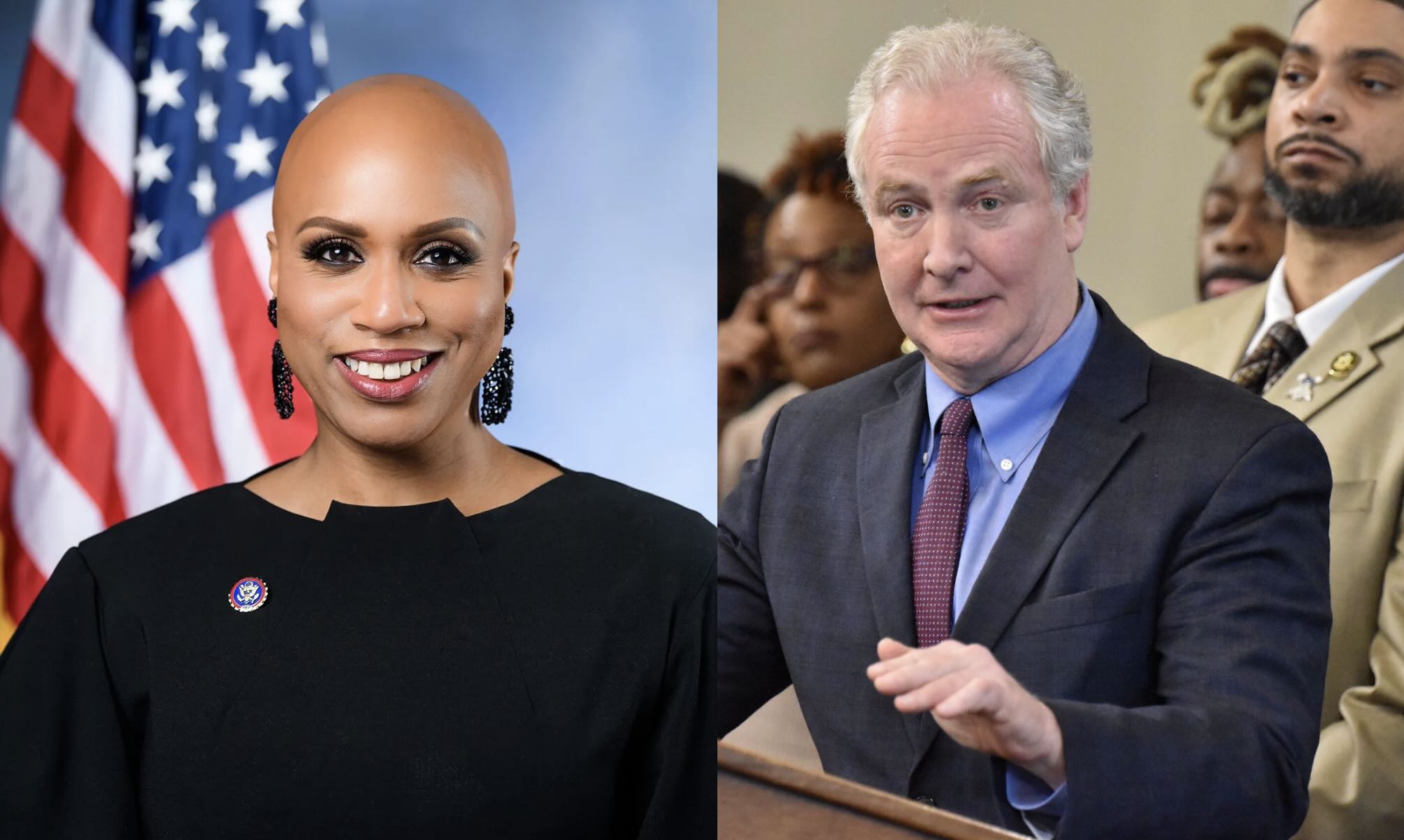
Senator Chris Van Hollen (right) and Representative Ayanna Pressley (left) | Photo: Emerald Book Image
Neither has formally declared a candidacy. But the case for each is explicit, and it maps directly onto the criticisms driving the revolt.
Pressley: the anti-donor, fighter-in-the-room option. Supporters point out that Pressley rejects corporate PAC donations and has never accepted funding from AIPAC or J Street, according to Track AIPAC and grassroots organizers. Where Jeffries is criticized for donor ties, Pressley is held up as proof that a Democrat can win and govern without them. As noted by Zeteo and Common Dreams, she champions policies popular with the base that Jeffries does not endorse, including Medicare for All, restricting offensive weapons transfers to Israel, expanding national abortion protections, abolishing ICE, and placing strict oversight on artificial intelligence and data centers.
Her supporters also argue she brings a bolder style. In November 2026 social media posts cited by TAG24, Pressley argued that Democrats cannot simply be "the adults in the room," but must prove they are "FIGHTERS" who use congressional gavels for accountability—a direct contrast to the bipartisan tone critics fault in Jeffries. And as the first Black woman elected to Congress from Massachusetts, she would make history as the first Black Speaker of the House. A Change.org petition launched in November 2026 urging lawmakers to elect Pressley as Speaker has gathered over 30,000 signatures, prompting Pressley to circulate her own policy agenda petition.
Van Hollen: the institutionalist who broke with the establishment. In the Senate, Van Hollen has emerged as the primary alternative backed by progressive activists and lawmakers, including Senator Bernie Sanders and Senator-elect Peggy Flanagan, according to Politico and The Nation. Unlike some outside challengers, he is not viewed as an inexperienced rebel: he previously chaired both the Democratic Congressional Campaign Committee and the Democratic Senatorial Campaign Committee, giving him deep ties to moderate senators and a proven record of winning tough elections.
Supporters point to concrete actions. Van Hollen spearheaded Senate amendments requiring the U.S. government to verify that countries receiving American weapons—specifically Israel during the war in Gaza—comply with international humanitarian law and allow humanitarian aid delivery. He publicly broke with party norms by backing progressive primary challengers against establishment-favored candidates and criticizing the influence of billionaire super PACs, a move praised by Sanders in The Nation. And after the midterms, he publicly stated that the Senate leadership vote should not be a "coronation" for Schumer and began calling colleagues to test a potential challenge.
Sanders told The Nation that Van Hollen understands the economic struggles of working-class families and supports strong populist reforms, including overturning Citizens United, protecting Social Security and Medicare, and taxing wealthy corporations. For voters who want both a fighter and a legislator who knows how to win, supporters argue, Van Hollen is the rare combination.
Because more than two-thirds of Democratic voters now favor cutting or conditioning military aid to Israel—and nearly half say AIPAC funding is a disqualifier— Schumer and Jeffries represent an outdated party consensus. Even presumed 2028 Democratic presidential contenders, including Governors Gavin Newsom and JB Pritzker, have publicly distanced themselves from AIPAC in 2026, signaling how mainstream the opposition has become inside the party.
The leadership elections will test whether the party's voters or its institutions have the final say. For now, the two leaders hold the votes—but not the base. And the base has names in mind for who should hold them instead.
No Ads. By Us. For Us.
This article was made possible by readers like you. We hope it inspired you to support Emerald Book, so we can continue producing content like this.
We will never show you ads, sell your data, or require a subscription to consume our content. Your gift helps us keep the truth accessible.
Click the Support button to give a gift of any amount today.
Thank you for making this work possible.