

Emerald Pages
◆
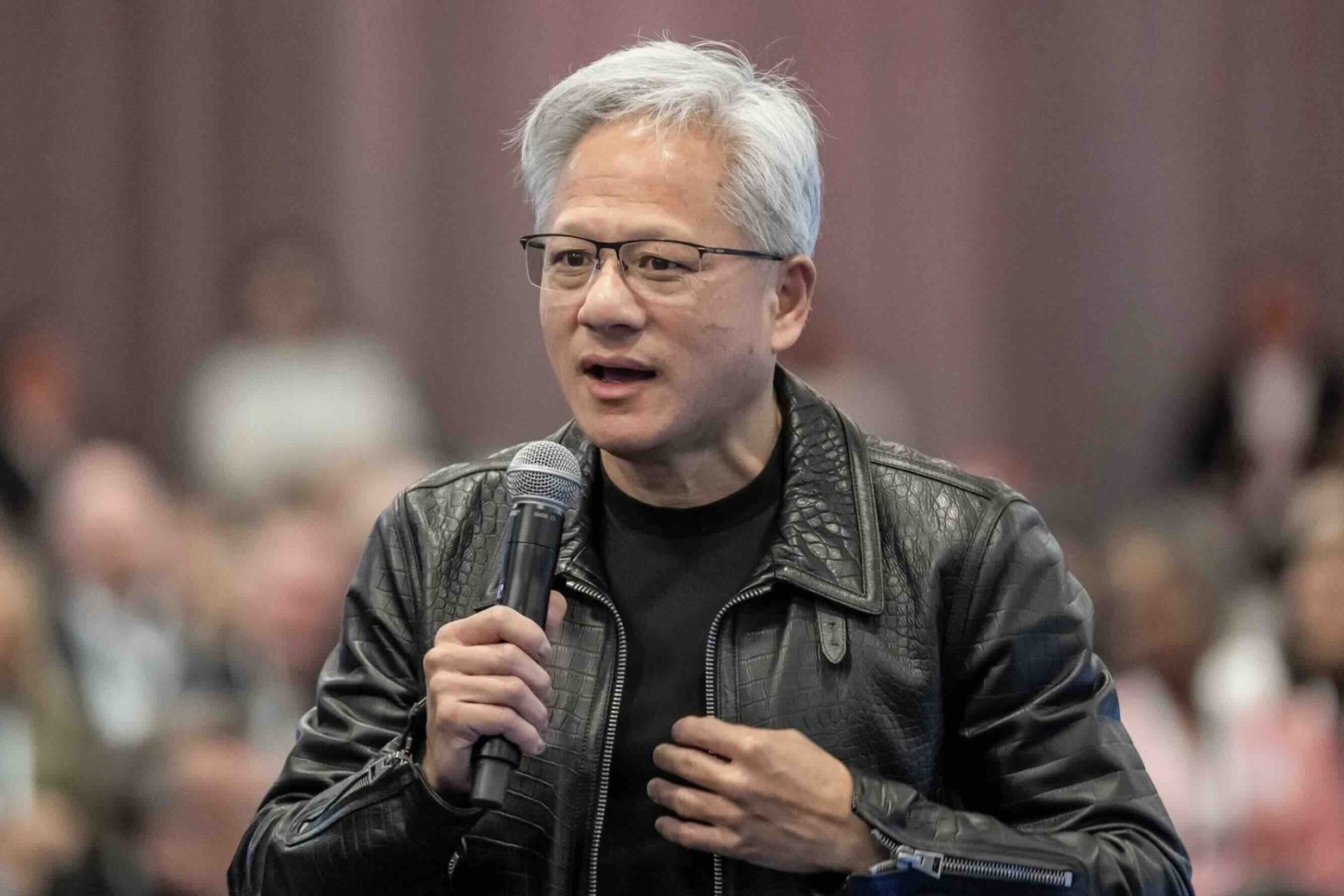
Nvidia's CEO Jensen Huang | Photo: Bloomberg
When Nvidia's board decided to meet on the night of November 11, 2026 to decide whether to remove co-founder and CEO Jensen Huang, it wasn't just adjudicating a personal scandal. It was confronting a structural problem that Huang himself had spent three decades constructing: a company, and by extension an industry and a national economy, engineered so that everything flows through one man.
The trigger was a rapidly escalating crisis involving two extramarital affairs—one with an executive at the Singapore-based data firm Megaspeed, whom U.S. intelligence officials suspect is a Chinese spy, and a second with Kimberly Powell, Nvidia's vice president of healthcare, who reports directly to Huang. The board hired Wachtell, Lipton, Rosen & Katz to conduct an independent inquiry; the FBI is investigating whether national security secrets were compromised; and lawmakers in Congress have threatened subpoenas. Nvidia shares fell roughly 7.5% to 8% in after-hours trading, extending a roughly 25% decline over the month since the scandal began emerging.
But the scandal only matters because of the architecture beneath it. Huang did not simply lead Nvidia. He designed it so that no one else could.
Two Rings of Vulnerability
The fragility now on display is best understood as a nested single point of failure—two rings of vulnerability, one inside the other, that reinforced each other on the way up and are now compounding each other on the way down.
- The outer ring (industry-wide): The global AI economy concentrated its compute, its software stack in CUDA, and much of its venture financing inside one company—Nvidia. Tech giants like Microsoft, Meta, Alphabet, and Amazon build annual capital expenditure budgets around Nvidia's hardware roadmap. Dozens of server makers, memory suppliers, and power and cooling companies depend on its production schedule. Nvidia also acts as a primary financier and investor for AI startups and cloud providers like OpenAI, CoreWeave, and Nebius—a circular financing loop in which Nvidia funds companies that then buy Nvidia chips.
- The inner ring (company-wide): Huang concentrated Nvidia's decision-making, organizational structure, and strategic relationships inside one person. Roughly 60 executives report directly to him. He has publicly stated he does not believe in succession planning and deliberately avoided naming a COO or heir apparent, believing it would create internal politics and competition.
In engineering, systems without redundancy fail catastrophically when a single component breaks. Nvidia built a structure optimized for maximum speed on the way up—and it has zero shock absorption on the way down.
The Self-Inflicted Crisis
Every core element of the current fallout traces back to choices Huang made—personally and structurally. He chose to engage in the undisclosed relationships, including one with a direct subordinate, a standard corporate governance violation that left the board blindsided when The New York Times uncovered it. And he chose, over decades, to refuse succession planning and centralize power, ensuring that any crisis affecting him personally would immediately paralyze the company's top operational layer.
Most Fortune 500 companies operate like replaceable machines, with division presidents and a COO trained to step in. Huang rejected that model. The result is a flat organization that was not built for anyone else to run. He acts as the company's primary product strategist, its chief closer with major cloud customers, and its key deal-maker—personally allocating scarce AI chips to tech giants and negotiating multi-billion-dollar investments in AI startups.
He is also the industry's chief evangelist and its primary lobbyist in Washington, advocating for looser chip export controls and favorable AI regulations. Those relationships rely on personal trust built over decades. Analysts estimate that 25% to 30% of Nvidia's stock value is tied directly to investor faith in Huang's vision—a "Jensen premium" that Wall Street treats as the ultimate proof that AI spending will eventually pay off.
When Nvidia rises, investors justify pouring hundreds of billions into data centers, power grids, and AI startups. When Nvidia stumbles, doubt spreads instantly across the entire sector. The stock is the bellwether for the whole AI trade.
The board bears secondary responsibility. Because Huang delivered unprecedented stock returns for more than 30 years, directors deferred to his unconventional management style—until the risks caught up with them.
A Global Economy on the Edge
The causal links from Nvidia's boardroom to the broader American economy run through four channels. If the board freezes major capital commitments during a leadership transition, the circular financing loop breaks, and smaller AI labs and data center operators that rely on Nvidia-backed credit could run out of cash. If internal disruption delays next-generation chips, tech giants cannot deploy new AI clusters on schedule, slowing model releases and revenue across cloud computing. Huang's entanglement with a firm suspected of smuggling chips to China has triggered FBI and congressional scrutiny that could impose harsher compliance rules and export restrictions on all U.S. chipmakers—not just Nvidia. And a sharp drop in Nvidia's share price forces portfolio managers to cut overall AI exposure, triggering selling across semiconductor ETFs, cloud software stocks, and data-center utilities, while making it harder for private AI companies to command high valuations ahead of IPOs.
The timing could hardly be worse. Nvidia reports Q3 earnings on November 17, less than a week away, with Wall Street already anxious about whether AI infrastructure spending is slowing. Three House committees demanded Huang respond by the end of Wednesday regarding a closed-door intelligence briefing scheduled for November 18—the day after earnings—or face subpoenas. Meanwhile, Google, Amazon, and Microsoft are racing to develop in-house chips, and AMD and Broadcom are pushing alternatives. Maintaining Nvidia's lead requires relentless focus at the exact moment its leadership is in limbo.
A Replacement Can Step In—But Not Seamlessly
Nvidia has a massive engineering bench. Its next several generations of AI hardware and its dominant CUDA software ecosystem are already engineered and in motion, and tech giants need its hardware regardless of who sits in the corner office. Veteran insiders like Ian Buck, who helped invent CUDA and runs the data center business, and CFO Colette Kress could stabilize operations.
But the real risk is not that Nvidia collapses overnight. It is that it slows down—giving hungry rivals a rare opening to catch up while Nvidia reorganizes. And even if removed as CEO, Huang cannot be kicked off the board without a shareholder vote or his resignation. As Nvidia's largest individual shareholder, owning roughly 3.5% of the company alongside substantial family foundation holdings, his continued presence could create ongoing governance friction for any successor.
That is the paradox the board now confronts: the underlying business is remarkably strong, but the man who built it made himself the single biggest vulnerability in the chain. Keeping him risks ongoing federal crackdowns and boardroom paralysis. Firing him forces the company to rebuild its entire leadership structure on the fly—in the middle of a live emergency, with earnings days away and the whole AI trade watching.
No Ads. By Us. For Us.
This article was made possible by readers like you. We hope it inspired you to support Emerald Book, so we can continue producing content like this.
We will never show you ads, sell your data, or require a subscription to consume our content. Your gift helps us keep the truth accessible.
Click the Support button to give a gift of any amount today.
Thank you for making this work possible.