

Emerald Pages
◆
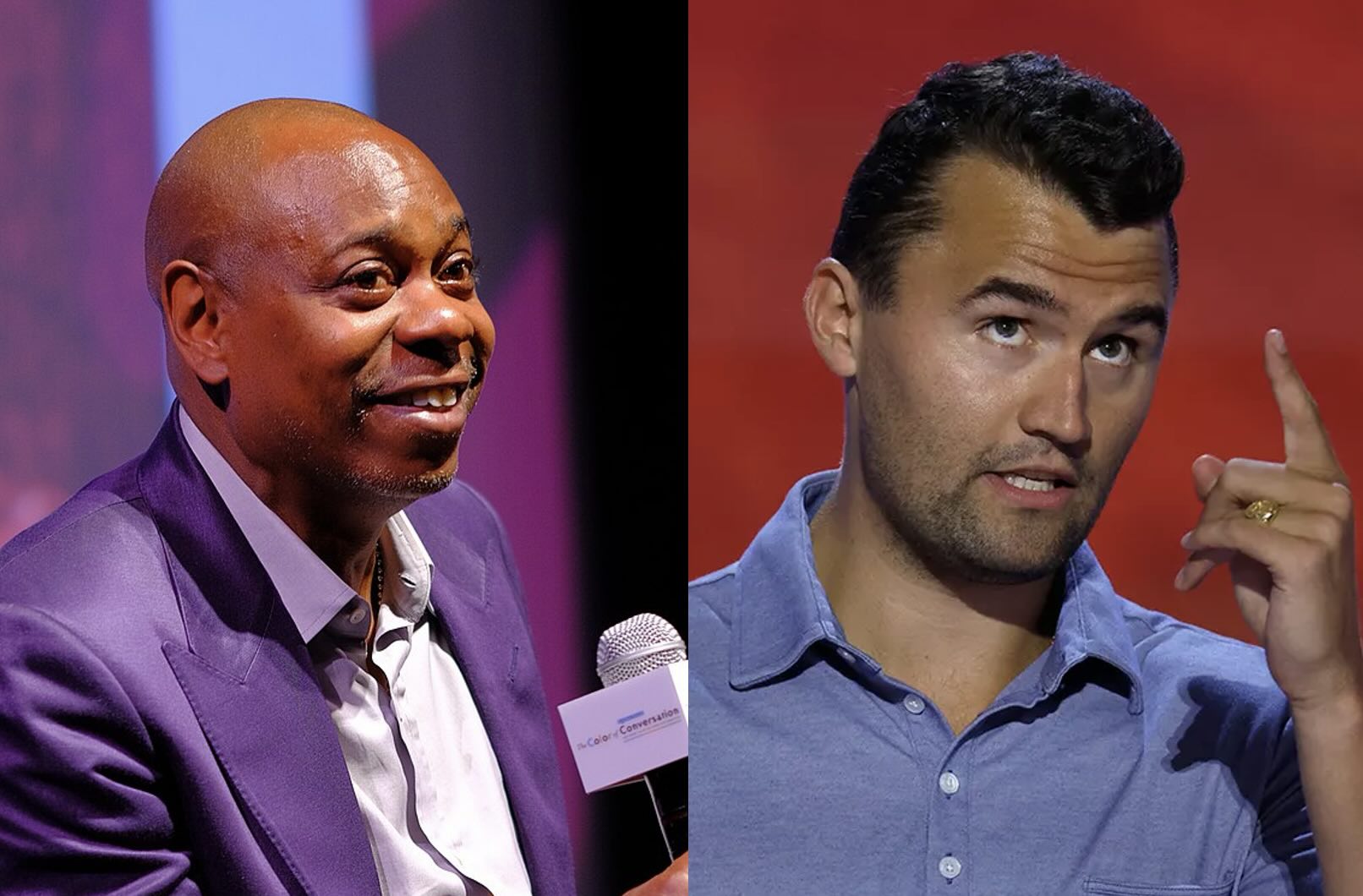
Dave Chappelle (left) and Charlie Kirk (right) | Photo: Emerald Book Image
On November 7, 2026, at Madison Square Garden, Dave Chappelle paused while discussing how dangerous it had become to be a public speaker — a nod to the September 2025 assassination of Turning Point USA founder Charlie Kirk — and said what he claimed he shouldn't. "Ever since that guy Charlie Kirk got murdered — and I shouldn't say this publicly — but, I feel better. I know I shouldn't say that, but it's just a feeling." In a second leaked clip, he added that Kirk was "looking up at us right now, laughing so hard he can't breathe." By morning, the footage was everywhere.
The reaction was ferocious. Erika Kirk, Charlie's widow and current CEO of Turning Point USA, called the routine "beyond disgusting," writing that "a culture that laughs at assassination is one of profound moral decay." Piers Morgan called the joke "repellent," especially given that Chappelle survived an on-stage assault in 2022. Elon Musk called him "cruel." Fox News and CBN News ran segments labeling the remark "disturbing" and "vile." Conservative media reached swift consensus: a line had been crossed.
But the backlash missed the architecture of the joke. Chappelle was not inventing a cruelty — he was mirroring one. Six months earlier, Tony Hinchcliffe, on Netflix's live roast of Kevin Hart, said George Floyd was "looking up at us all, laughing so hard he can't breathe" — weaponizing Floyd's final words while implying he was in hell. Chappelle took that exact structure, down to the "looking up" framing and the defensive trailing phrase "it's just jokes," and swapped in Kirk. It was a controlled experiment: is "everything is fair game in comedy" a principle, or a partisan convenience?
The irony is architectural. When Hinchcliffe made his Floyd joke, right-wing free-speech absolutists rushed to defend him: comedy is transgressive, nothing is off-limits in a roast, the offended are too sensitive. Kevin Hart himself defended the format on The Breakfast Club — "that's what a roast is." When the target changed from a murdered Black private citizen to a murdered conservative, the same ecosystem discovered some jokes were beyond the pale. The intensity of the reaction proved the point: American outrage is rarely about the cruelty of a joke. It is about whose side is targeted.
Why Conservatives Actually Loved Charlie Kirk
To understand the fury, understand what Kirk represented — and it was never legislation. He passed no laws, held no office, gave his followers no rights they lacked, and altered no one's material position. What he offered was validation. Through Turning Point USA's thousands of campus chapters, conferences, and daily media apparatus, his core product was permission. He called the Civil Rights Act of 1964 a "huge mistake." He called Martin Luther King Jr. "awful" and "not a good person." He said Black women like Ketanji Brown Jackson, Michelle Obama, and Joy Reid "did not have the brain processing power" to succeed and had to "steal a white person's slot." He said seeing a Black pilot would make him doubt that pilot's qualifications. He claimed "prowling Blacks go around for fun to target white people" in major cities — rhetoric civil rights groups traced to white supremacist tropes.
The defenses were familiar: the pilot comment was about DEI quotas, not Black people; the Civil Rights Act critique was about federal overreach, not segregation; the MLK comments were about "woke ideology." These justifications are nonsensical — a way to launder old racial tropes through the language of policy. But for Kirk's base, the comfort mattered more than the argument. The relationship was transactional: he supplied intellectual cover for prejudice; they supplied the adoration and funding that built his empire.
- The validation engine: Kirk reframed racially hostile ideas as policy critiques, giving his audience plausible deniability while feeling vindicated. The point was never to win the argument; it was to feel permission.
- The parasocial proxy: Followers lived vicariously through his campus confrontations, experiencing the thrill of saying it out loud without facing real-world consequences.
- The credibility gap: No formal expertise in law, history, or sociology. For critics, that made his pronouncements suspect; for followers, it made him a self-made outsider who rejected the "higher education cartel."
- The double standard: The same absolutists who defended Hinchcliffe's Floyd joke demanded Chappelle's cancellation for an identical structure aimed at Kirk.
What Kirk built was an epistemic bubble in which information's value was confirmation, not accuracy. Factual corrections were dismissed as attacks from a hostile establishment. His campus tours, famous for "destroying" opponents in short edited clips, were performances of certainty, not inquiries into truth. The validation became the ultimate authority — which is why attacking it was not political but existential. For millions who felt unable to speak their most racist, bigoted thoughts, Kirk was a proxy standing in the colosseum, saying what they could not. In real life, that speech carries social and professional costs. Watching him say it with total defiance let them feel the thrill without the fallout. Chappelle's joke didn't just mock a dead commentator. It mocked the proxy — and it used the exact comedic structure his defenders had championed six months earlier.
The Relief Was Real — And That's the Point
This is the uncomfortable truth at the center of the bit: a great many people genuinely did feel better. Not because they wanted Kirk dead, and not because they celebrated political violence, but because of what he represented in public life — bigotry dressed as debate, a megaphone telling Black Americans their achievements were stolen, their intelligence suspect, their safety an afterthought. For those communities, Kirk's voice was the loudest in a growing chorus, and it was exhausting.
"I feel better" voiced a relief polite society doesn't permit: the relief of a relentless, culturally sanctioned hostility finally going quiet. That is not rejoicing in murder. It is the pressure release of a room when the person who had been shouting stops. Chappelle didn't invent the feeling. He refused to pretend it wasn't there.
The loudest critics were often the same people who had spent years insisting Kirk's rhetoric was harmless — just jokes, just debate, just questions — and then demanded the country mourn its author without a single unkind word. That demand rang hollow, because it came from people who never extended such solemnity to anyone else. The fury wasn't really about cruelty. It was about a movement that had grown comfortable with bigotry in public, discovering that comfort is a two-way street.
The final irony: Kirk spent his career arguing that speech boundaries were drawn too tightly, that brave commentators should say uncomfortable things. Chappelle took him at his word — in America's most public venue, using the tools Kirk's coalition had defended. And the coalition that built its identity on "saying the quiet part out loud" could not stomach hearing its own logic turned around. That is not a defense of the joke. It is an observation about what the reaction reveals: the two sides are not arguing about the same man. They are arguing about what kind of country gets to feel safe, and who gets to decide.
No Ads. By Us. For Us.
This article was made possible by readers like you. We hope it inspired you to support Emerald Book, so we can continue producing content like this.
We will never show you ads, sell your data, or require a subscription to consume our content. Your gift helps us keep the truth accessible.
Click the Support button to give a gift of any amount today.
Thank you for making this work possible.