

Emerald Pages
◆
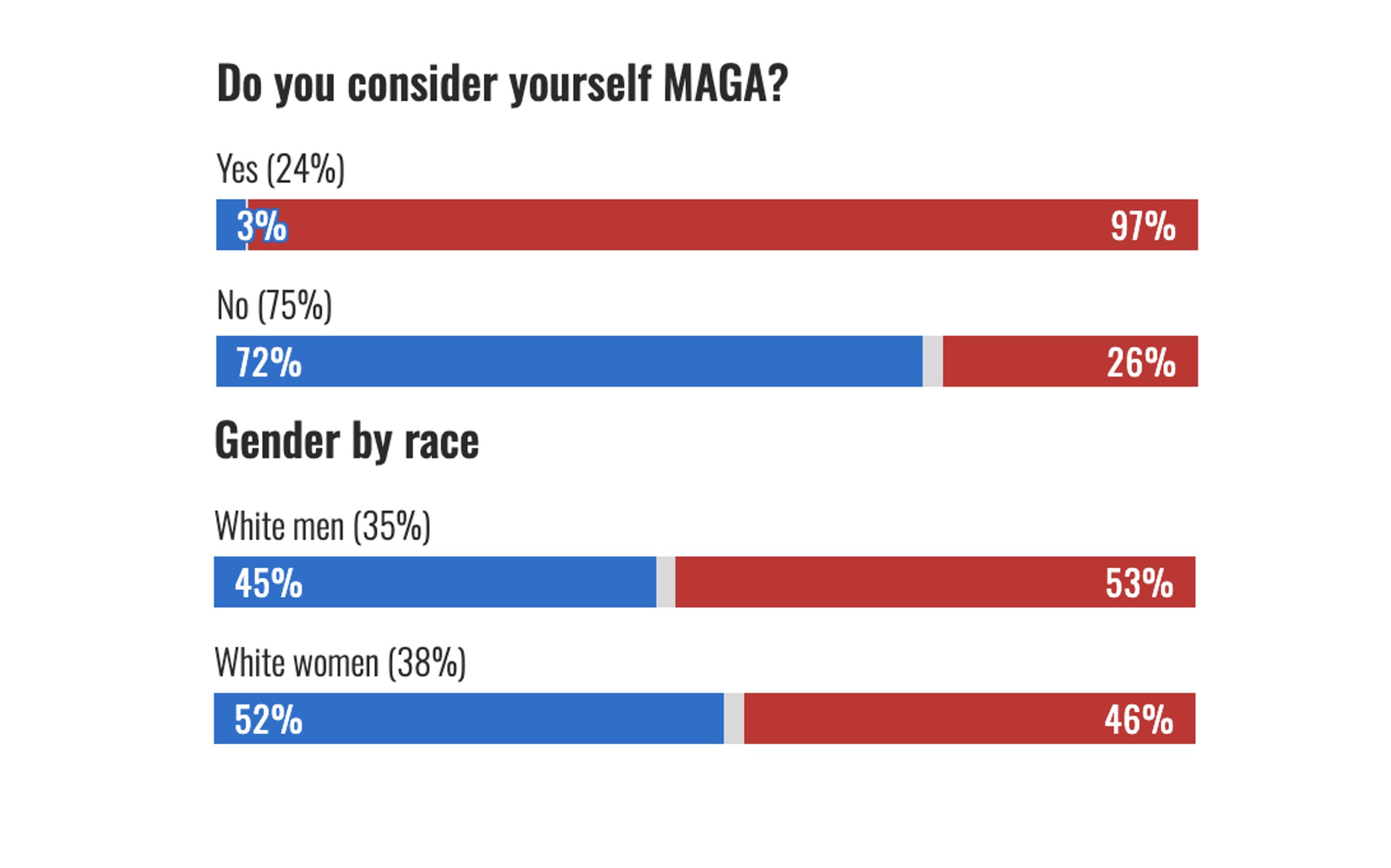
Photo: NBC News exit polling data
A Democratic tsunami swept through the country this week. The temptation now is to treat it as a verdict—a national rebuke, a cleansing tide, proof that the worst of American racism has been left behind. That temptation is a mistake. White supremacy in this country did not begin with Donald Trump, and it did not end when the votes were counted. It was present at the founding, it was written into the Constitution, it survived the Civil War, it outlasted Reconstruction, and it adapted to every attempt to dismantle it. A single election does not wash away four centuries.
The national exit poll, conducted by NBC News and a group of other news organizations across 45 key states, is not a story of a country that has moved past white identity politics. It is a story of a country in which white identity politics remains a viable, organized, and well-funded electoral force. The polls show a racial gulf as wide as any in modern American history—and they show a quarter of the electorate openly identifying with MAGA, a movement whose central political project is the restoration of a racial hierarchy that many Americans desperately want to believe is already gone.
Look at the numbers, and then look past them to the history that produced them. Voters of color made up 27 percent of the electorate and broke 72 percent for Democrats. Black women voted 93 percent Democratic. Black men, 86 percent. Latino women, 68 percent. Asian voters, 71 percent.
Those figures are not abstractions. They describe a multiracial coalition that turned out in force and held a line—not against a fringe, but against a party that has made white identity its organizing principle and has been rewarded for it again and again. The coalition won this round. But a coalition that has to assemble every cycle to stop the same thing is not proof that the thing is gone. It is proof that the thing is still here.
On the other side of the ledger, white voters split almost evenly—49 percent Democratic, 49 percent Republican. White men went 53 percent Republican. White voters without a college degree—38 percent of the electorate—went 60 percent Republican. White women without a college degree went 57 percent Republican. White men without a college degree went 63 percent Republican.
These are not voters who were suddenly converted by a wave. They are the descendants of a political tradition that has always defined American citizenship in racial terms, and they did not disappear. They were outvoted—this time. The margins matter, but so does the persistence. A bloc that shows up election after election, anchored in racial identity and education level, is the constituency.
A Quarter of the Electorate Says It Is MAGA
The poll asked directly: "Do you consider yourself MAGA?" Twenty-four percent of voters said yes. Among them, 97 percent voted Republican.
That is not a fringe. That is a quarter of the electorate self-identifying with a movement whose central political currency is the restoration of a racial hierarchy that many believed had been consigned to history. White supremacy did not need to be invented by MAGA. It was already in the soil. MAGA simply gave it a ballot line.
The exit polls make the connection explicit. Voters who said they were white evangelical or born-again Christians—17 percent of the electorate—voted 82 percent Republican. Voters who usually think of themselves as Republicans voted 93 percent Republican. Among those who consider themselves "conservative Republicans," 97 percent voted Republican.
The party has not shed its most reactionary elements. It has consolidated them. And the consolidation did not begin in 2016. It is the latest chapter in a much older story—one that runs from the Three-Fifths Compromise through Jim Crow through the Southern Strategy through the Tea Party to the present day.
- MAGA identifiers: 24% of voters, 97% backed Republicans.
- White evangelicals: 17% of voters, 82% backed Republicans.
- White voters without a college degree: 38% of voters, 60% backed Republicans.
- Conservative Republicans: 24% of voters, 97% backed Republicans.
- Voters of color: 27% of voters, 72% backed Democrats.
Why Black Voters Overwhelmingly Vote Democrat
The same exit polls that reveal the Republican Party's consolidation of white identity politics also explain, with brutal clarity, why Black voters vote overwhelmingly Democratic. Black women voted 93 percent Democratic. Black men, 86 percent. These are not random numbers. They are the most lopsided racial voting bloc in American politics, and they have been for generations.
The reason is not complicated. When one party is the home of white supremacy—when its coalition is anchored in the 24 percent of voters who call themselves MAGA, when 97 percent of MAGA identifiers vote Republican—Black voters do not need a focus group to tell them where they stand. They have watched the Republican Party spend decades courting the white grievance vote, from the Southern Strategy to the present day. They have seen what happens when that coalition wins.
So they vote Democratic. Not because the Democratic Party is perfect—no one who has watched American politics would claim that—but because the alternative is a party that has made white identity its organizing principle. Black voters are not voting for a savior. They are voting against a threat. And the exit polls show the threat is still very real.
This is the cycle that will not break as long as the Republican Party remains the home of white supremacy. Black voters will keep turning out, cycle after cycle, because the thing they are voting against has never gone away. The blue tsunami did not change that. It only confirmed it.
The Trump Factor Is Not Past Tense
The Trump-era realignment is not a past tense. Forty-four percent of voters said they voted for Donald Trump in 2024. Among them, 91 percent voted Republican this week.
On the other side, 44 percent of voters said expressing opposition to Trump was one reason for their House vote—and 97 percent of those voters backed Democrats. But 40 percent said Trump was not a factor at all, and that group split 30 percent Democratic, 67 percent Republican. The country is not done with Trumpism. It is still organized around it—even among those who claim he was not on their mind.
The poll also asked whether Trump "fights for people like you." Thirty-seven percent said yes—and 96 percent of them voted Republican. It asked whether Trump prioritizes "his own personal interests" or "the country's interests." Sixty-two percent said his own interests, and 86 percent of those voters backed Democrats. But 38 percent said the country's interests, and 95 percent of them backed Republicans. The lines are drawn, and they are racial and cultural as much as they are economic.
The Country Is Angry, and the Anger Is Racialized
Asked how they feel about the way things are going in the country, 39 percent said angry. Among angry voters, 90 percent backed Democrats. Among the 24 percent who said they were enthusiastic or satisfied, 95 percent backed Republicans.
One coalition is furious about the direction of the country and the other is content with it. That is not a recipe for reconciliation. It is a recipe for continued conflict.
The poll asked whether immigrants to the U.S. today do more to help or hurt the country. Sixty-one percent said help, and 83 percent of them backed Democrats. Thirty-nine percent said hurt, and 86 percent of them backed Republicans.
It asked whether support for transgender rights has gone too far. Fifty-two percent said yes, and 77 percent of them backed Republicans. Twenty-six percent said not gone far enough, and 96 percent of them backed Democrats.
These are not policy disagreements. They are fights about who belongs—the same fight that has been waged on this soil since before the country had a name.
The blue tsunami is real. Democrats won. But a wave is not a transformation. The exit polls show a country where a quarter of the electorate openly identifies with MAGA, where white voters without college degrees remain a reliable Republican bloc, and where the racial divide in American politics is as sharp as it has been in generations. The water receded. The foundation did not move.
White supremacy is alive and well in the United States. It has been since America's inception. It was not defeated by a Democratic victory, and it will not be defeated by one. Anyone who believes otherwise is making a mistake—the same mistake Americans have made after every supposed turning point, every march, every bill, every election that was supposed to finally settle the question. The polls do not show a country that has moved past white identity politics. They show a country where white identity politics is still a winning strategy for nearly half the electorate, and where the Republican Party remains its most powerful vehicle.
The tsunami came and went. The current underneath it is older than the country itself, and it is still strong. Electoral victories matter. But they are not exorcisms. The work of confronting white supremacy in America does not end when the wave recedes. That is when it begins again.
No Ads. By Us. For Us.
This article was made possible by readers like you. We hope it inspired you to support Emerald Book, so we can continue producing content like this.
We will never show you ads, sell your data, or require a subscription to consume our content. Your gift helps us keep the truth accessible.
Click the Support button to give a gift of any amount today.
Thank you for making this work possible.