

Emerald Pages
◆
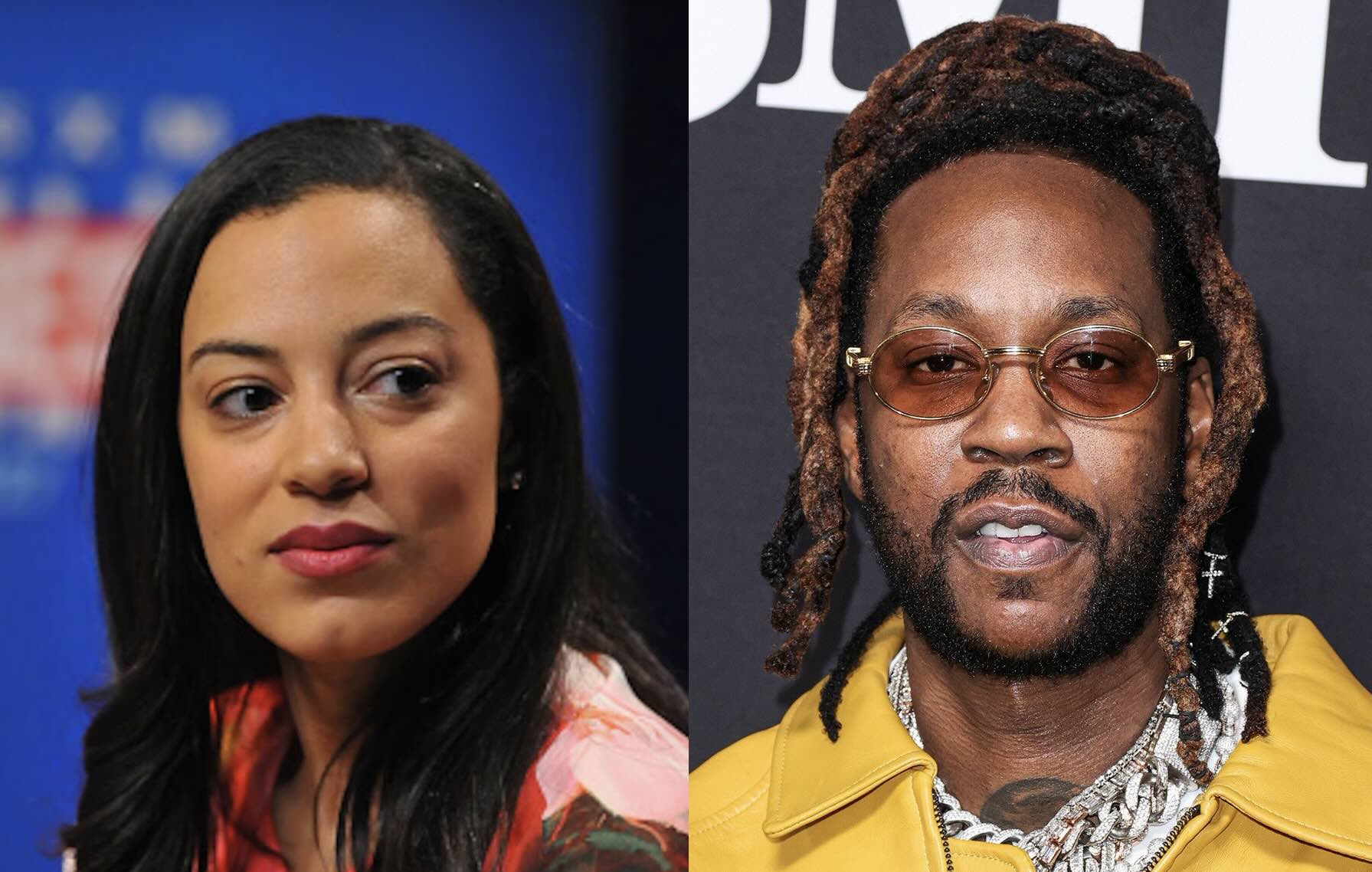
Angela Rye (left) and 2 Chainz (right) | Photo: Emerald Book Image
In the span of a single week, two viral controversies exposed the same ugly fracture running through Black America—and the same uncomfortable truth. One involved a Washington political insider. The other involved a Grammy-winning rapper. Both responded to grassroots Black creators who challenged them by doing exactly what the gatekeepers of white institutional power have always done: demanding credentials, questioning legitimacy, and policing who is allowed to speak.
The first firestorm erupted when Angela Rye, former executive director of the Congressional Black Caucus and a prominent CNN political commentator, responded to criticism from Detroit-based content creator Brandi McGill—known online as "Brandi Thee Millennial Manager." McGill had pushed back on Rye's podcast critique of Barack Obama. Rye's response wasn't a counterargument. It was a credential check. "You never worked on The Hill, you didn't work in an administration, you ain't even worked in city hall," Rye said, suggesting everyday critics "lacked the range" to understand complex political decision-making.
The second controversy arrived days later when 2 Chainz, appearing on Kirk Franklin's Den of Kings podcast, defended celebrity privilege in a clash with food critic Keith Lee. "I'm an entertainer, and obviously we get perks that other people don't get," 2 Chainz said. "I don't stand in line at the airport... because I done worked my a** off to do this." Like Rye, when challenged by a grassroots creator with massive public credibility, the celebrity didn't engage the substance—he pulled rank, questioning Lee's credentials to judge his restaurant and dismissing the legitimacy of the critique.
The parallel is not coincidental. It is a recurring script in Black American life: the moment an individual accumulates enough institutional proximity or commercial success, they begin to mistake their invitation into the room for proof of personal superiority—and then turn around to lock the door behind them. But there is a word for what happens when Black people use the tools of white institutional gatekeeping against other Black people. It is anti-Blackness.
Credential-Checking Is a White Institutional Tool
The demand for credentials has never been neutral. It has always been one of the primary mechanisms by which white institutions exclude Black people from power. "You don't have the right degree." "You haven't worked in the right rooms." "You don't have the right experience." These are the exact phrases that have been used for generations to keep Black people out of Capitol Hill, out of corporate boardrooms, out of newsrooms, and out of the rooms where policy is written.
When Angela Rye picked up that same tool and used it against a Black working mother from Detroit, she wasn't demonstrating political literacy—she was demonstrating that she had internalized the gatekeeping logic of the institutions she spent her career navigating. The message was unmistakable: legitimacy is conferred by proximity to white institutional power, not by lived experience, community impact, or the simple fact of being a citizen whose life is governed by the policies in question.
This is what makes the "OJ Syndrome" so insidious. It isn't just classism. It is the reproduction of anti-Black exclusion by Black people who have convinced themselves that their proximity to power has made them different—that they are the exception, not the rule. And in reproducing that exclusion, they do the work that the system has always relied on: they fracture the community and police its own boundaries from the inside.
- Policing legitimacy: Requiring a Washington resume before a Black citizen's political voice is taken seriously replicates the exact exclusionary logic used to keep Black people out of institutional power in the first place.
- Devaluing lived experience: Dismissing grassroots knowledge ignores that working-class Black people live the consequences of policy—inflation, underfunded schools, healthcare costs—every single day, often more directly than the insiders who claim to speak for them.
- The "range" fallacy: Claiming everyday people "lack the range" is not an argument about expertise. It is a status claim—an assertion that proximity to power confers superior humanity.
- The apology gap: 2 Chainz eventually apologized, admitting his ego got the best of him. Rye doubled down, retreating into defenses of "intellectual curiosity" and institutional rank—alienating her audience further.
The Historical Script That Never Changes
This is not a new phenomenon. It is the modern, digital iteration of a century-old ideological war. W.E.B. Du Bois championed the "Talented Tenth"—the idea that educated elites would master white institutions and lift the race up. Marcus Garvey fiercely rejected this, arguing that relying on elite integration was a trap and that true power lay in grassroots, working-class self-reliance. In the 1960s, the "suits" of legacy civil rights organizations clashed with SNCC and the Black Panthers, who argued the establishment was too compromised by proximity to white power to represent working-class survival needs. In the 1990s, the civil rights establishment tried to censor hip-hop, claiming rap lacked "range" and respectability—and the hip-hop generation fired back with the exact argument Brandi used: you are trapped in your ivory towers, detached from the lived experience of the people you claim to represent.
The script never changes because the trap never changes. As long as dominant systems of power exist, they will always offer a small number of marginalized individuals entry into the room where it happens. And inevitably, some of those individuals will mistake their invitation for a sign of personal superiority, turning around to lock the door behind them. What has changed is the microphone. In the past, the elite controlled the media networks. Today, a grassroots creator in Detroit can look directly at a Washington insider and dismantle their entire gatekeeping apparatus in a sixty-second video.
The Illusion of Immunity
The deepest tragedy of the OJ Syndrome is that it is built on a lie. In the eyes of the dominant power structure, an elite insider is still a Black person. They are treated as an exception only as long as they are useful, compliant, or quiet. The moment an exception steps out of line or loses their institutional value, the system reminds them exactly how it views them. Proximity to power is not a shield; it is a temporary lease.
History has proven this time and again. Class, titles, and wealth are completely superficial defenses against anti-Blackness. A D.C. insider's credentials or a celebrity's platinum plaques will never make them immune to structural racism. When elites forget that reality and look down on the grassroots community, they aren't just acting arrogant—they are actively weakening the very foundation of the collective struggle. They trade unified bargaining power for a fragile, individualized proximity to white institutional validation. They fight for a seat at a table that will never truly belong to them.
At the end of the day, as the public reaction to both controversies made unmistakably clear, they are Black. The system sees them as Black first and foremost, regardless of their resume. And when the smoke clears, the system sees no difference between the political insider on Capitol Hill and the grassroots citizen on the ground.
The fierce public backlash against both Rye and 2 Chainz proved that the community refuses to let this behavior slide. By standing with Brandi McGill and Keith Lee, the public sent a clear message: institutional credentials do not give anyone ownership over political thought, celebrity status does not entitle anyone to superior dignity, and the community will always value real, ground-level impact over elite gatekeeping. The OJ Syndrome thrives on the belief that proximity to power makes you different. The response from the people reminded the elites of a simple truth: it doesn't—and policing your own community to protect that illusion is anti-Blackness by another name.
No Ads. By Us. For Us.
This article was made possible by readers like you. We hope it inspired you to support Emerald Book, so we can continue producing content like this.
We will never show you ads, sell your data, or require a subscription to consume our content. Your gift helps us keep the truth accessible.
Click the Support button to give a gift of any amount today.
Thank you for making this work possible.