

Emerald Pages
◆
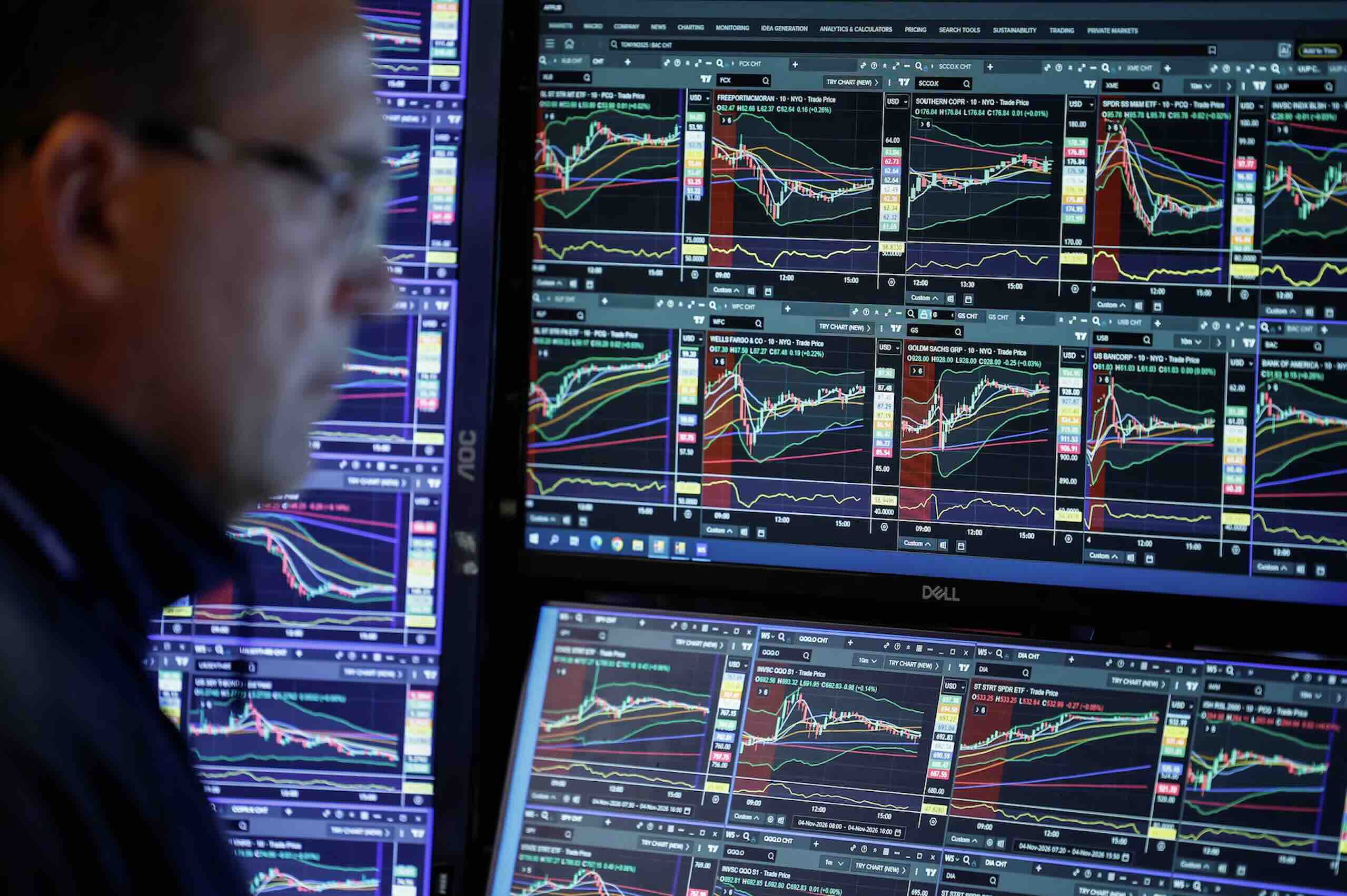
Photo: Reuters
There are weeks when the market speaks plainly, and this was one of them. In the space of a single month, an estimated $5 trillion to $7.5 trillion in market value has evaporated from the AI and semiconductor sector—a sum larger than the annual GDP of Japan. On Thursday, November 5, the Nasdaq Composite plunged 5.52%, erasing an unprecedented $2.5 trillion in one session, the largest single-day loss in the benchmark's history. NVIDIA fell 9.3%, surrendering its entire year-to-date gain before lunch. Advanced Micro Devices dropped 17.3%. Intel, already wounded, lost more than half its valuation in a month.
But the losses, however staggering, are not the story. The story is the instability that produced them. Twenty-four hours earlier, the Dow had surged 1,569 points—its best post-midterm performance in 44 years—and the Nasdaq had risen 1.44%. Investors cheered a decisive election result and an 8.7% collapse in crude oil. By Thursday morning, that entire gain, and more, was gone: the Dow down 1,833 points, the Nasdaq in official correction territory.
In a healthy bull market, prices move in an orderly fashion, guided by incremental data. When a market regime breaks down, price discovery turns chaotic. The explosive reversal from Wednesday's euphoria to Thursday's capitulation is a textbook indicator of liquidity thinning out and institutional conviction collapsing. The instability, in other words, is not noise around the signal. It is the signal.
The CapEx Crossover: Where the Math Broke
The roots of this selloff trace back to a disconnect that crystallized in Q3 2026 earnings. For three years, the AI buildout was funded out of corporate free cash flow—a self-financing boom that masked how speculative the underlying bet had become. That era is over.
The five largest hyperscalers—Amazon, Alphabet, Microsoft, Meta, and SpaceX/xAI—ballooned their combined 2026 capital expenditure forecasts to an unprecedented $828 billion. That investment has now officially outrun cash generation, and the gap is widening every quarter:
- Amazon reported negative free cash flow of $42.4 billion in Q3, its worst on record
- Alphabet posted negative $9.1 billion as AI search summaries cannibalized ad margins
- Meta dropped to negative $2.12 billion despite aggressive cost-cutting elsewhere
To keep buying data centers and NVIDIA GPUs, the giants have turned to debt. Borrowing climbed from 9% of CapEx in 2024 to more than 32% in 2026, and the bond market has begun raising rates for AI-linked issuers—signaling default concerns long before equities acknowledged them. Credit markets, after all, are concerned with the return of capital, not the return on capital; they identify overvalued companies and bubble risk well before the stock market does.
This is the first structural crack. When the companies building the future can no longer pay for it out of pocket, they borrow. When they borrow, they become sensitive to interest rates. When they become sensitive to interest rates, the entire edifice becomes fragile.
The Blue Tsunami
A political headwind has made the fragility worse. In the November 2026 midterms, a blue tsunami of anti-AI candidates won majorities across the country, with hundreds of newly elected lawmakers pledging to tighten regulation and rein in data centers over environmental and power-grid concerns. For the first time, AI infrastructure became a campaign issue—and the industry lost.
As leading lawmakers publicly call for an immediate moratorium on data center construction, investors are confronting a vertiginous possibility: that Big Tech will not be able to plug in the infrastructure it is building. The Wednesday rally—fueled by relief that President Trump accepted the results and by an oil crash on peace-deal speculation—evaporated overnight as the regulatory implications sank in. What looked like gridlock on Tuesday looked like a green light for regulation by Thursday.
The whiplash is instructive. Markets first celebrated the removal of political uncertainty, then realized the new certainty was hostile to the AI thesis. That is the definition of a regime change: when the same news that once brought relief becomes the cause of panic.
The 2000/2008 Mirror
Overlay 2000, 2008, and the present, and a four-phase pattern emerges—a psychological and mechanical script that has repeated with eerie precision for a quarter-century.
Phase 1: Extreme Euphoria. The Nasdaq peaked at 5,048 in March 2000 on the belief that the internet would rewire the economy overnight. Today's AI cycle mirrors that excess: valuations priced for a future that had not arrived, and a consensus that this time is different.
Phase 2: The Warning Crack. In 2000, Barron's "Burning Up" cover story revealed that dozens of internet firms were months from running out of cash. Today, the negative free cash flow reports and the debt surge from 9% to 32% of CapEx serve as the warning shot. The bond market is already repricing the risk; equities are only beginning to catch up.
Phase 3: The Violent False-Hope Rally. After an initial 20% drop in April 2000, the Nasdaq staged massive intraday recoveries that convinced retail investors the correction was over. In 2008, the Dow jumped 400 points on bailout rumors days before Bear Stearns collapsed, and triple-digit up-days repeatedly lured buyers back in before Lehman. Wednesday's 1,500-point surge, erased within hours, fits the pattern precisely. The biggest up-days in market history tend to occur during secular bear markets. They are not recoveries; they are bull traps.
Phase 4: Systemic Liquidation. The final phase arrives when credit markets freeze and forced selling drags down even healthy companies. In 2008, margin calls forced hedge funds to liquidate everything—including unrelated, profitable businesses—to cover losses. That is the phase the AI trade now risks entering.
What History Says Comes Next
The closest historical twin to the current AI crash is the telecom buildout of the late 1990s. Companies raised billions to lay millions of miles of fiber-optic cable on the assumption that internet traffic would grow exponentially overnight. The internet did become a utility—but the companies that built the cables went bankrupt long before society figured out how to use the bandwidth. The infrastructure survived; the builders did not.
Today's giants have built a massive surplus of computing power, but enterprise software adoption is moving far more slowly than hardware manufacturing. Roughly 35% of companies use AI, but few can produce hard data showing higher margins or greater transaction volume. Enterprise customers are sticking with older, cheaper models that are good enough—exactly the dynamic that killed the first generation of dot-com infrastructure plays.
The 2008 parallel lies in the financing. Unlike 2000, when companies issued speculative stock, the 2026 buildout leans heavily on debt—increasingly through specialized structures and off-balance-sheet joint ventures. The sudden rise in rates for AI-related corporate bonds feels uncomfortably like early 2008, when the first tremors of subprime trouble were dismissed as contained.
The likely playbook, based on these precedents: first, a major hyperscaler announces a surprise 20–30% cut to 2027 CapEx, triggering a wave of hardware order cancellations. Second, one or more leveraged neo-cloud startups that borrowed against GPUs default on infrastructure bonds, freezing tech credit. Third, the OpenAI IPO is permanently shelved and venture funding for mid-tier AI startups evaporates, producing a wave of bankruptcies and layoffs. Finally, forced selling drags down even the cash-rich monopolies as multi-asset funds raise cash indiscriminately.
The Key Difference: Core Earnings
The saving grace that may prevent a 2008-style depression is that Alphabet, Microsoft, and Amazon are not empty shells. Even if their AI divisions lose billions, their core monopolies—Google Search, Office 365, AWS—remain highly profitable utilities generating enormous baseline revenue. Cloud segments such as AWS and Google Cloud are still posting strong double-digit growth driven by baseline modernization, not AI hype.
On Thursday, while the Nasdaq plunged 5.52%, the broader S&P 500 and defensive sectors suffered far milder losses. Capital is rotating out of tech and into traditional businesses—healthcare, consumer staples, utilities—rather than fleeing the financial system entirely. That decoupling is the difference between a sector crash and a systemic crash.
The Federal Reserve, too, is watching the credit strains. Unlike 2000 and 2008, when policymakers were slow to grasp the severity of the unwind, the Fed has tools to inject liquidity or adjust rates if a credit freeze threatens the wider economy. That backstop will not prevent a brutal re-pricing of tech; it may prevent a global banking collapse.
The Bottom Line
This is no longer a routine dip. The risk of a concentrated tech crash is the highest in years. But unless the panic spills into the broader banking system and causes a widespread credit freeze, this is more likely to be a brutal, multi-month re-pricing of the technology sector than a 2008-style collapse of the global economy.
The speculative, momentum-driven market of the past two years is broken. Even if prices bounce from these levels, the return of extreme volatility means the market has fundamentally re-priced the risk of the AI thesis. The giants are being forced—by credit pressures, political gridlock, and furious shareholders—to shift from aggressive, fear-of-missing-out infrastructure spending toward structural discipline and provable profitability.
The bubble will find its floor when AI is no longer traded as a speculative concept but priced as a utility—when the term disappears from earnings presentations, valuations fall to conservative multiples of actual free cash flow, and surviving infrastructure is bought for pennies on the dollar by traditional industries. That process has begun. The instability itself is the signal. What comes next depends on whether the credit markets hold—or freeze.
No Ads. By Us. For Us.
This article was made possible by readers like you. We hope it inspired you to support Emerald Book, so we can continue producing content like this.
We will never show you ads, sell your data, or require a subscription to consume our content. Your gift helps us keep the truth accessible.
Click the Support button to give a gift of any amount today.
Thank you for making this work possible.