

Emerald Pages
◆
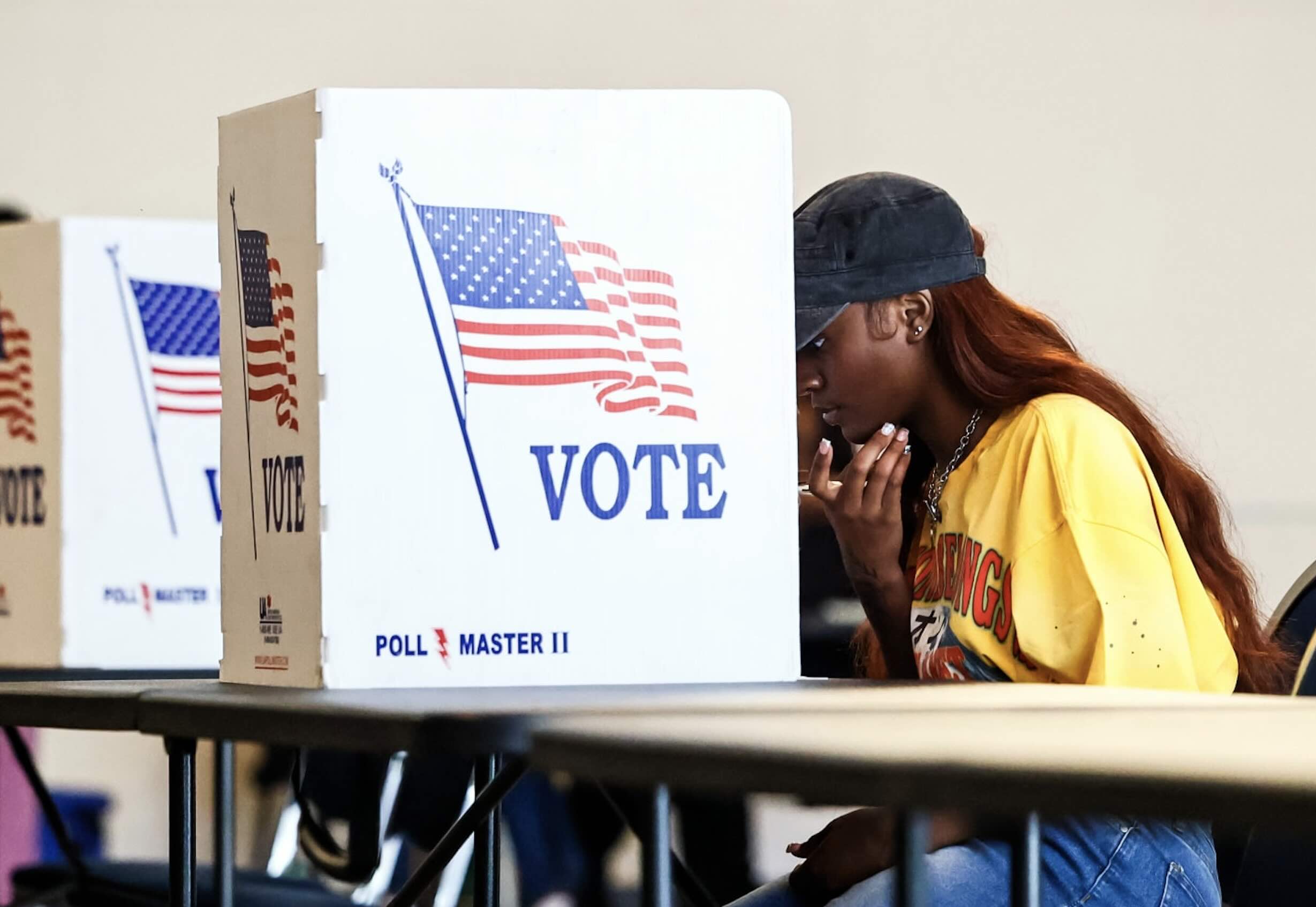
Photo: Getty Images
In the 2026 midterms, one number cut through the noise: 93%. That was the share of Black women voters who backed Democratic candidates, according to national exit polls published November 4 and 5. It was not an anomaly. It was the continuation of a pattern that has held for decades — 92% for Joe Biden in 2020, 94% for Hillary Clinton in 2016, 96% for Barack Obama in 2008 and 2012. No other demographic group in American politics approaches this level of loyalty to a single party. And because of the way American elections are structured, that loyalty has become the load-bearing wall of the entire Democratic coalition.
This is not merely a story of gratitude or tradition. It is a story of structural arithmetic — and the arithmetic says that Black women hold a form of power that the Democratic Party cannot ignore, cannot replace, and cannot afford to lose.
Black women have voted at higher rates than Black men in every election since 1998, and they consistently register and turn out at levels that outpace their male counterparts. In 2026, they were again the most solid voting bloc for Democrats nationwide, helping fuel victories that flipped competitive districts and produced historic firsts. Among them: Keisha Lance Bottoms, who defeated Republican Rick Jackson in Georgia to become the nation's first Black woman governor. That outcome was not incidental to Black women's turnout. It was produced by it.
To understand why that is true, you have to look at the math of a competitive election. Take a hypothetical swing state or district where the baseline vote is a 50-50 tie. Black voters make up roughly 30% of the electorate; Black women are about 55% of Black voters, which equals 16.5% of the total electorate. If they vote 93% Democratic, they single-handedly deliver roughly 15.3% of the total vote straight to the Democratic column. In a race decided by one or two points, that is not a margin. It is the margin.
What Happens When the Bloc Moves
The structural power becomes unmistakable when you model what happens if that support disappears. If Black women stayed home entirely, the Democratic candidate loses that 15.3% share, and out of the remaining active voters the Republican share mathematically expands to roughly 59% — a nearly 20-point blowout. If those voters flipped Republican instead, the swing is twice as severe, producing a result in the mid-60s for the GOP that has no modern precedent. And if they defected to a third party, the Republican total stays the same but wins by a massive 15-point margin, because in a winner-take-all plurality system, pulling votes from one major party hands victory to the other. The third party would not win a single seat. It would simply act as a spoiler — and Democrats would lose the House, the Senate, and dozens of local offices in a uniform, nationwide wipeout.
- 2026 midterms: 93% of Black women backed Democrats — the party's most reliable voting bloc nationwide.
- Historical loyalty: 92% for Biden (2020), 94% for Clinton (2016), 96% for Obama (2008 and 2012).
- Turnout consistency: Black women have voted at higher rates than Black men in every election since 1998.
- The 2026 shift: In the SSRS poll, Black voters overall split 90% Democratic to 9% Republican — indicating that the Republican inroads with Black voters seen in 2024 had effectively stalled.
Democratic leadership knows this. Political scientists, party strategists, and candidates openly describe Black women as the backbone of the party's electoral strategy — the turnout engine, the community organizers, the high-propensity voters who bring family members and neighbors to the polls. It is why the party elevated Kamala Harris to the vice presidency in 2020 and promoted figures like Bottoms in 2026. It is why platforms emphasize Black maternal health, voting rights, and equal pay. The recognition is not in dispute. What is in dispute is whether the party's actions match its rhetoric.
The Paradox of Captured Voters
Here is the irony at the heart of this power. In political science, there is a concept known as electoral capture: when a demographic group votes so consistently for one party that both parties begin to alter their behavior toward it. Democrats can fall into the trap of taking the group for granted, shifting resources and softening policy stances to chase swing voters who are perceived as harder to win. Republicans may give up on competing for the group's votes entirely. The result is a party that assumes their vote and a party that ignores them — which minimizes their leverage to demand concessions from either side.
Black women organizers point to a sharp contrast between how the party speaks about them and how it funds them. Candidates routinely call Black women the "backbone of the party" on election night. But traditional Democratic funding pipelines — super PACs and major donors — historically direct the vast majority of campaign cash toward white-led consulting and advertising firms rather than the grassroots, Black-women-led organizations doing year-round community organizing. Party gatekeepers also invoke the "electability" trap, worrying that Black women candidates cannot appeal to rural or moderate white voters in swing states, and steering financial support toward more conventional candidates in competitive primaries. Black women candidates are left to run uphill battles with fewer resources.
Even when Democrats hold power and genuinely want to deliver — on federal voting rights protections, the racial wealth gap, or the maternal health crisis — they face structural gridlock: the Senate filibuster, a deeply polarized Congress, and sweeping legislation that stalls. For a voter who turned out in historic numbers to deliver a victory, seeing little material change creates a justified feeling that loyalty did not produce a return on investment. Black women are three to four times more likely to die from pregnancy-related causes than white women, a disparity that persists regardless of income or education. They face an unemployment rate that regularly doubles that of white women, a persistent wage gap, and less than 1% of venture capital funding despite being the fastest-growing group of entrepreneurs. These are not abstract grievances. They are the policy returns that have not arrived.
The Leverage Point — and Why It Stalls
The strategies for converting electoral power into material change are well developed. Black-women-led organizations such as Black Voters Matter Fund and Higher Heights for America control mobilization infrastructure and can condition get-out-the-vote efforts on explicit party commitments. Because Democratic primaries are low-turnout events, a unified bloc can override traditional gatekeepers and force the party to back Black women candidates. The threat of staying home is a potent mathematical lever — a drop of even a few percentage points in turnout guarantees a Democratic loss in swing states. And independent PACs and donor networks allow candidates to bypass risk-averse national committees entirely.
Yet executing these tactics on a massive, unified scale is extraordinarily difficult. The stay-at-home threat carries a severe defensive risk: if Black women withhold their votes to punish Democrats, it mathematically guarantees Republican victories, and a Republican administration may actively roll back reproductive rights, dismantle diversity initiatives, and restrict voting rights further. This creates what scholars call "caretaker voting" — protecting families and civil rights from immediate threats, which overrides the ability to use non-participation as a bargaining chip. Deep capital gaps compound the problem: because Black women face a persistent wage and wealth gap, they cannot self-fund campaigns or rely on networks of wealthy, same-race donors, and mega-donors still skew heavily white and male. The winner-take-all two-party system makes an independent party a spoiler rather than a winner. And the burden of constant organizing falls on a demographic already economically and socially strained, with little year-round institutional funding to turn temporary campaign energy into permanent political institutions.
Perhaps the deepest tension is internal. Black women are not a monolith. They are bound together by shared systemic threats — the same medical biases, wage gaps, and institutional hurdles — which is precisely why they vote as a unified bloc in general elections. But they disagree sharply on strategy. Institutionalists, largely older generations and established politicians, believe in working within the system, electing Black women to the Senate and governorships, and treating party loyalty as a seat at the table. Disruptors, driven largely by younger organizers and progressive activists, argue that decades of institutional participation have failed to close the maternal mortality gap or the wealth gap, and advocate aggressive, transactional politics — withholding votes and publicly calling out Democratic leadership. Autonomy strategists, favored by entrepreneurs and economic organizers, believe true leverage only comes from building independent Black-women-owned financial institutions and community health networks. The institutionalists worry the disruptors will break the shield; the disruptors worry the institutionalists are settling for crumbs; the autonomous groups are trying to build an entirely new table.
But the disagreement is about tactics, not about the underlying fact. The Democratic Party's modern coalition cannot win national or statewide elections without the high turnout and near-unanimous support of Black women. That is not a rhetorical flourish. It is arithmetic — and it is the reason Black women hold absolute structural power over the party, whether or not the party has fully recognized what that power demands.
No Ads. By Us. For Us.
This article was made possible by readers like you. We hope it inspired you to support Emerald Book, so we can continue producing content like this.
We will never show you ads, sell your data, or require a subscription to consume our content. Your gift helps us keep the truth accessible.
Click the Support button to give a gift of any amount today.
Thank you for making this work possible.