

Emerald Pages
◆
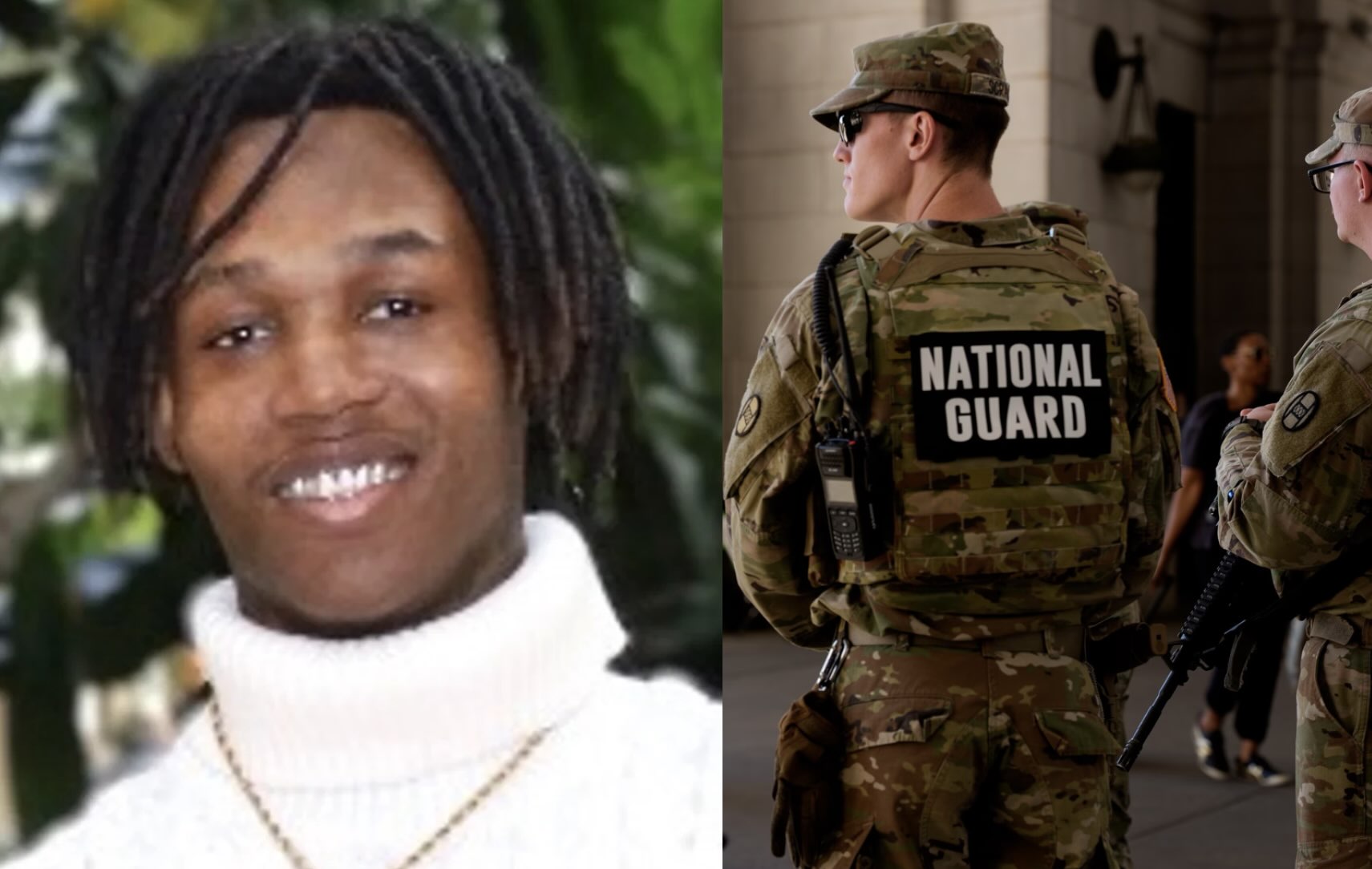
Tyrin Johnson (right) is the only civilian to be killed by the Trump deployed National Guard. : Emerald Book Image
On the night of July 5, 2026, 20-year-old Tyrin Johnson was shot and killed in downtown Memphis by two Tennessee National Guard soldiers. According to an autopsy report obtained by his family, he was shot once in the back. Nearly four months later, on November 2, the Shelby County District Attorney's Office released body camera, surveillance, and bystander footage of the incident. The videos do not capture the exact moment the fatal shot was fired — but they show at least six National Guard troops standing over Johnson with handguns trained on him as he lay dying on the sidewalk, while a Memphis police officer can be heard asking whether anyone has a medical kit.
This is the only confirmed instance of a National Guard member killing a civilian under the domestic anti-crime deployments ordered by President Trump. The person killed was a Black man. The task force he was killed by has now been linked to four fatal shootings — all of them Black men.
According to police and National Guard reports, authorities were responding to a "shots fired" call when they chased Johnson. A surveillance video from the downtown entertainment zone shows Johnson firing shots in an empty parking lot; an officer's body camera records the sound of gunfire, prompting the foot chase. The Guard members claimed Johnson "rounded on them" and pointed a tan handgun at them, prompting them to fire.
The autopsy tells a different story. The bullet's upward path is consistent with someone fleeing, not confronting. Bystander footage captures Johnson running down Union Avenue, away from the Guard members. There is no evidence or claim from investigators that Johnson discharged his weapon at the Guard members or police during the chase itself — the only gunfire captured on video occurred before the pursuit began.
A Task Force Created by Trump
The Memphis Safe Task Force was officially created by a presidential memorandum. Under the federal initiative, hundreds of federal law enforcement agents from 13 different agencies — including the FBI, DEA, ATF, and ICE — were sent into Memphis to conduct large-scale, hypervigilant street sweeps and saturation policing.
Tennessee's Republican governor, Bill Lee, deployed hundreds of Tennessee National Guard members specifically to support and reinforce Trump's federal task force. The troops were not acting under local command; they were there to augment a federal operation that local officials had not requested.
The political context has been sharply divided from the start. President Trump and senior administration officials have heavily championed the Memphis operation, holding press conferences and high-profile roundtables to praise its high volume of traffic stops and arrests. Conversely, local Democratic officials — including the Mayor of Memphis and the Shelby County government — strongly opposed the deployment from the beginning, challenging the introduction of military personnel into their community in court and calling it a dangerous "federal overreach."
Four Dead, All Black Men
The task force has been linked to four fatal shootings between May and July 2026. All four of the individuals killed were Black men: Tyrin Johnson (20), Darrin Pigram (41), Jonah Neal (25), and Alfonso Ivy (47).
Out of those four fatalities, Johnson's death is the only incident where National Guard members are confirmed to have fired the shots. The other three fatalities involved federal task force agents, such as the Drug Enforcement Administration. That distinction matters legally — but it reinforces a broader pattern: a militarized federal intervention concentrated in Black communities, producing Black casualties.
- Tyrin Johnson, 20 — shot in the back by two Tennessee National Guard soldiers on July 5, 2026
- Darrin Pigram, 41 — killed by federal task force agents
- Jonah Neal, 25 — killed by federal task force agents
- Alfonso Ivy, 47 — killed by federal task force agents
Teenage Soldiers Patrolling the Streets
The two Guard members who fired their weapons were identified as Alyssa Hout (19) and Dallas Jellineck (20). Both are from the Knoxville area and are too young to legally serve as Memphis police officers, which requires individuals to be at least 21. The age gap is not a technicality to critics: it underscores that these were teenagers with military firearms, not sworn officers with years of de-escalation training.
National Guard soldiers are trained for combat rather than community policing or de-escalation — a gap that critics say contributed directly to the fatal outcome. In a chaotic, fast-moving foot pursuit, military firearms training can override the split-second judgment that community policing is designed to cultivate.
The legal framework is equally contested. The Posse Comitatus Act of 1878 bars the federal military from domestic law enforcement, but the National Guard occupies a dual role: under state command (Title 32), governors can deploy it for law enforcement, and the Insurrection Act allows the President to use military personnel domestically under certain conditions. Critics argue that using federalized task forces to put troops on city streets to chase criminal suspects violates the spirit of the law, even where legal loopholes exist. The ACLU has a pending lawsuit alleging task force members have used Tennessee's "Halo Law" to harass residents who film them.
The Tennessee Bureau of Investigation is finalizing its independent probe into the shooting. Shelby County District Attorney Steve Mulroy has stated that his office has not yet made a decision on whether criminal charges will be filed against the Guard members, and that his office is reviewing the clash between the physical evidence and the guardsmen's statements. Under U.S. Supreme Court precedent — Tennessee v. Garner, a landmark case that also originated in Memphis — law enforcement officers, including military personnel acting in a law enforcement capacity, cannot use lethal force against a fleeing suspect unless they have probable cause to believe the suspect poses an immediate threat of death or serious physical injury.
The fact that the only civilian killed by the National Guard under these deployments was a Black man is not a coincidence. It is the predictable result of policy choices: task forces concentrated in predominantly Black and brown urban neighborhoods, staffed by combat-trained soldiers rather than community police, operating under aggressive saturation and foot-patrol strategies.
The communities most affected by violence are also the ones now subjected to militarized patrols — and that the primary victims of both the violence and the intervention are Black residents. Sending heavily armed military personnel into minority neighborhoods shifts the relationship from community protection to adversarial containment, creating an environment where tragic escalations are far more likely.
The newly released footage has shifted the debate from political argument to a concrete legal question: whether the actions of two 19- and 20-year-old National Guard members crossed the line from a law enforcement pursuit into a criminal act. The autopsy and the video do not show a man turning on his pursuers. They show a man running — and a bullet in his back.
No Ads. By Us. For Us.
This article was made possible by readers like you. We hope it inspired you to support Emerald Book, so we can continue producing content like this.
We will never show you ads, sell your data, or require a subscription to consume our content. Your gift helps us keep the truth accessible.
Click the Support button to give a gift of any amount today.
Thank you for making this work possible.