

Emerald Pages
◆
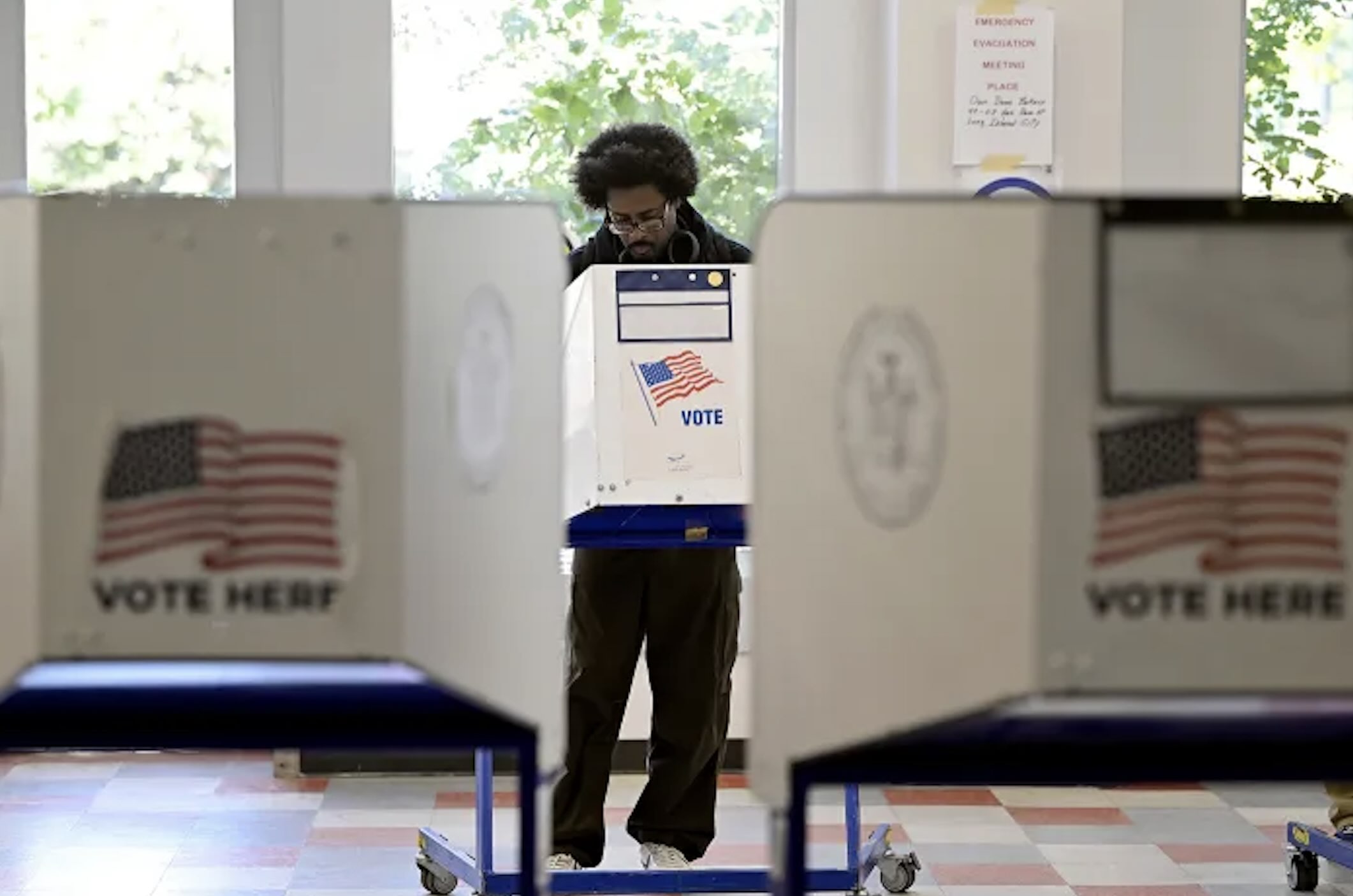
Photo: AP Images
Here's a question worth sitting with: the last time you voted, did you know the name of your school board member? Your county executive? The judge who sets bail in your local courthouse? Most people don't. And yet those are the officials whose decisions show up in your mailbox, your classroom, and your neighborhood—far faster than anything that comes out of Washington. The presidential election is the loud one. The midterm is the one that actually runs your life.
This is not a rhetorical flourish. It is a structural fact of how American government is built. The Constitution divides power deliberately, and the vast majority of the decisions that shape a household's day-to-day existence—what a school teaches, what a county spends, who gets prosecuted, how high the property tax goes—are made by officials who appear on the ballot in the middle of a president's term, when attention is lowest and turnout collapses. Understanding why that happens, and what it costs, is the difference between voting as a ritual and voting as a tool.
The Half-Empty Ballot Box
Start with the numbers, because they explain everything that follows. Presidential elections consistently draw 60% to 66% of eligible voters. Midterms typically pull in 40% to 50%. The 2018 midterms saw turnout spike to 49.4%—the highest since 1914—and even that historic surge meant roughly half the eligible electorate stayed home. In the decades before 2014, midterm turnout routinely languished at 36% to 40%.
What that produces is a specific kind of distortion. In a midterm, the most motivated slice of the electorate makes 100% of the decisions for everyone else. And that slice is not a random cross-section of America. Census Bureau and political tracking data show the midterm electorate is consistently older, wealthier, more highly educated, and more partisan than the presidential electorate. Retirees with flexible Tuesdays vote at the highest rates, motivated by Social Security and Medicare—programs Congress directly controls. Homeowners vote because local ballot measures and county races dictate their property taxes and their neighborhood school funding. College graduates are more likely to have the time and resources to research the obscure down-ballot races. Party loyalists and single-issue activists turn out because they are already tuned into the political system and don't need a national advertising campaign to remind them.
Who stays home? Almost entirely younger voters between 18 and 29, lower-income workers, and political independents. These groups face the highest physical friction—inflexible hourly shifts that make a Tuesday at the polls a genuine sacrifice, frequent moves that disrupt voter registration and miss strict state deadlines—and the highest informational friction, because local campaigns rarely target them and rarely reach them.
The result is a self-reinforcing loop. The people with the most at stake in the long term—younger voters who will live longest with the consequences—are the least likely to be in the room when the rules get written. The people with the most immediate stake in property values and pension programs are the most likely to show up. Neither group is acting irrationally. The system is simply tilted toward those with the time to navigate it.
Why the Drop-Off Happens: Friction, Not Apathy
It would be comforting to believe that half the country skips midterms out of laziness or indifference. The reality is more interesting and more damning. Political scientists describe the problem as the "cost of voting"—the combined time, energy, and research required to cast an informed ballot—and midterms maximize that cost in ways presidential elections never do.
In a presidential year, the information finds you. You cannot avoid it. Candidates appear on television, social media, billboards, and in your mailbox for more than a year. The race is a single, easily identifiable person running for a single, easily understood job. The friction to make a choice is near zero.
In a midterm, you are handed a ballot with dozens of names you have never heard of and asked to make responsible choices about jobs like Circuit Court Clerk, Soil and Water Conservation Supervisor, or Comptroller. To vote responsibly, you have to spend an hour or more researching. That is an information tax, and most people decline to pay it. The ballot also tends to include complex ballot measures written in dense legal jargon—sometimes with double negatives where a "Yes" vote actually means changing a law to stop something. Figuring out what a vote achieves creates intense cognitive friction, and people either guess or leave it blank.
Layer on the administrative barriers and the picture is complete. Because midterms don't get the same massive public service announcements as presidential years, people forget to update their registration after a move and miss deadlines. Voting on a Tuesday workday introduces physical friction—childcare, time off work, waiting in line—and people are far less willing to fight through those logistics for an election they don't feel informed about. This is why political scientists call midterms the ultimate example of a design flaw in American civics: they ask for high cognitive effort in exchange for low, invisible rewards.
The Two-Year Leash
The federal stakes are easy to underestimate because they arrive in the middle of a presidency, when the national narrative has already been set. But midterms decide all 435 House seats and roughly one-third of the Senate. That is not a footnote—it is a leash on the executive branch.
The first two years of a presidency are often a legislative honeymoon, when a president whose party controls Congress can push through an agenda. Midterms frequently function as a report card or referendum on the sitting president, and the pattern is remarkably consistent: the president's party has lost seats in 20 of the last 22 midterm cycles. If the opposition party takes control of the House or Senate, it gains the power to block the president's agenda, launch investigations, and reject judicial or cabinet appointments. A president without Congress can give speeches. A president with Congress can govern. The midterm is the difference.
This is why political analysts argue that midterms are sometimes more consequential than presidential elections. A president cannot pass laws or a federal budget without Congress. The presidential election decides who sits in the driver's seat, but the midterm election decides how much gas is left in the tank for the remainder of the term.
The Races That Reach Your Front Door
But the real story isn't in Washington. It's on the part of the ballot most people never scroll to—and it is where the case for midterms becomes overwhelming. When you strip away the national media noise, a midterm ballot is essentially a toolkit for managing your daily life, your wallet, and your local laws. Here is what each major position actually does.
- State legislators write the laws governors sign—setting sales, grocery, and income taxes, the state minimum wage, property law, and even speed limits.
- Governors run state budgets rivaling major corporations and decide tuition, transit funding, income tax rates, abortion law, and emergency response.
- School boards hire superintendents, set teacher pay, choose curricula and textbooks, and control billions in property tax revenue.
- District attorneys and judges decide what gets prosecuted, who gets bail, and whether local jails rehabilitate or warehouse.
- Sheriffs answer directly to voters—unlike appointed police chiefs—running county jails, executing evictions, and setting policing priorities.
- County commissioners and city councils set property tax rates, write the zoning rules that decide what gets built next door, and fund transit, trash, and libraries.
- Attorneys general and secretaries of state choose which corporations to sue and whether to defend state laws in court—and set the rules for how you register, vote, and have results audited.
- Ballot initiatives let a single yes-or-no vote raise the minimum wage, legalize substances, approve billions in bonds, or change constitutional protections.
Taken together, these offices decide the rules you live under every day. They are also where the money is. When the federal government passes a trillion-dollar bill, it dominates national news. When a county allocates $200 million for road repaving, it happens quietly in a Tuesday afternoon budget hearing. The money isn't small—the coverage is. The scale of local financial power stays invisible precisely because it is spread across thousands of boring line items.
So Why Is It So Quiet?
If local officials hold so much power, why aren't they talked about? The answer lies in the modern media business model, which is designed for national outrage, not local governance.
Over the past two decades, thousands of local newspapers have gone out of business, and those that survived have seen their reporting staffs gutted. The result is a "news desert" crisis: there are simply fewer journalists sitting in city council meetings, reading school board budgets, or interviewing county sheriffs. If a reporter isn't there to write the story, the public never hears about it.
At the same time, cable news networks, digital publishers, and social media algorithms make money based on scale. A story about a presidential scandal or a national culture war can get millions of clicks from coast to coast. A story about a zoning dispute or a county tax hike in your specific town only appeals to a few thousand residents. Local TV stations are increasingly owned by large national conglomerates, and local broadcasts frequently feature national political commentary rather than deep dives into local candidates.
There is also a structural problem: there are more than 89,000 local governments in the United States, and your ballot looks completely different from someone living three miles away in a different school district or municipality. It is logistically impossible for a major media outlet to cover all of those hyper-specific races. National media can talk about the presidential race because it is exactly the same for every person in the country. Nothing local works that way.
And many local incumbents prefer the silence. Local candidates don't have the multi-million-dollar budgets required to flood your phone, mailbox, and streaming services with ads. For many local officials—judges, tax assessors—less coverage is a strategic advantage. When voters know nothing about a challenger, they usually vote for the incumbent name they vaguely recognize, or skip that part of the ballot entirely. This keeps the status quo in place without forcing politicians to answer tough questions.
You Don't Have to Do All of It
The ballot is long, the jargon is dense, and the system is built to exhaust you. So don't play its game. A strategy called bullet voting lets you bypass the friction entirely: open a single nonpartisan tool like Ballotpedia or Vote411, type in your address, spend five minutes picking the top races—governor, county executive, state delegates—and leave the rest blank. Your vote for those offices still counts 100%, and you skip the homework on the rest of the complicated ballot. You can also use these tools to preview your ballot before Election Day, so nothing on it is a surprise when you arrive.
Because the truth is simple. The presidential election owns the headlines. The midterm owns the rules you actually live under. Half the country is making those rules for the other half, and the half that shows up is not a random sample. The only question is whether you're in the room.
No Ads. By Us. For Us.
This article was made possible by readers like you. We hope it inspired you to support Emerald Book, so we can continue producing content like this.
We will never show you ads, sell your data, or require a subscription to consume our content. Your gift helps us keep the truth accessible.
Click the Support button to give a gift of any amount today.
Thank you for making this work possible.