

Emerald Pages
◆
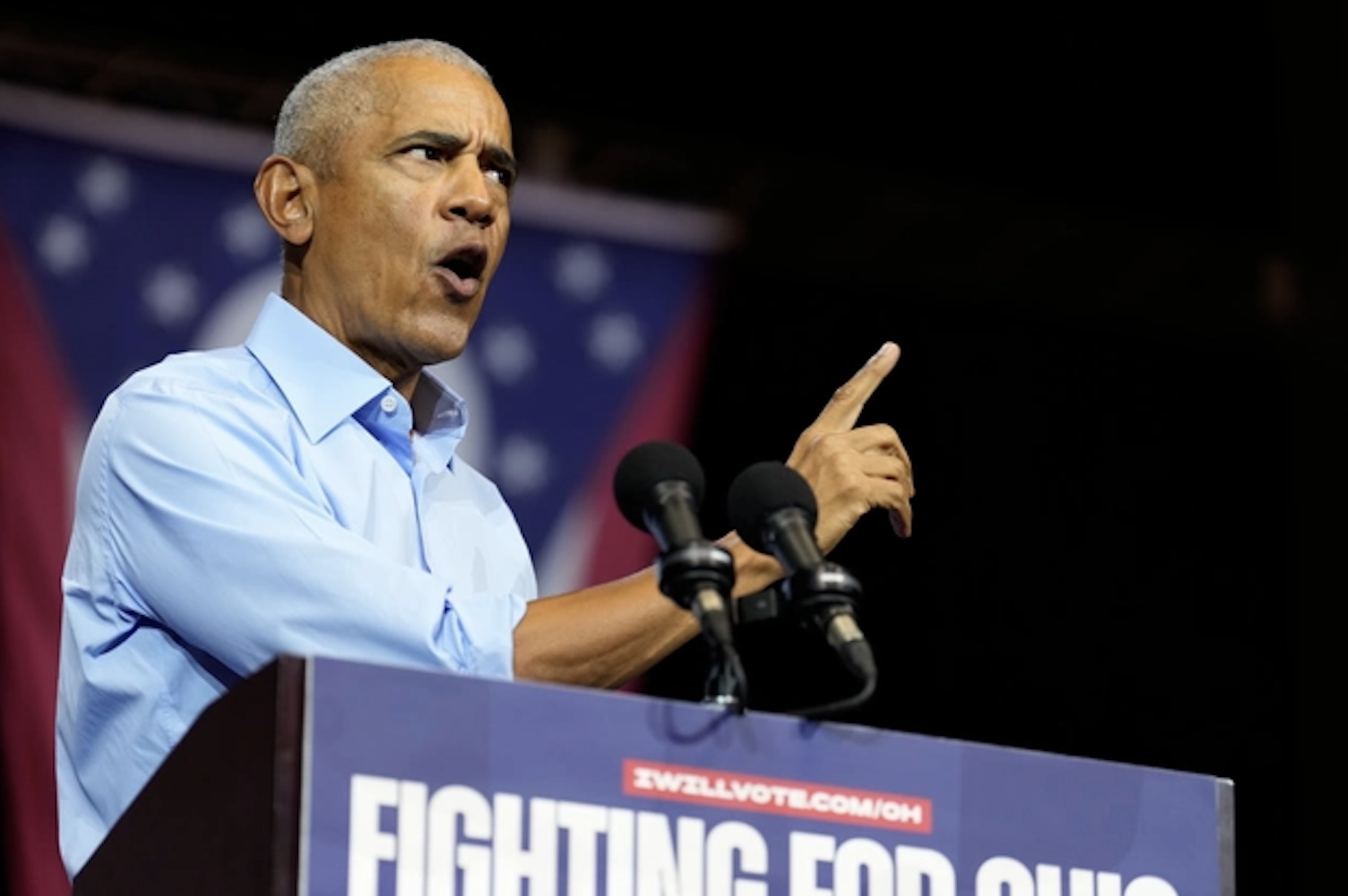
Photo: AP
During a campaign swing through Cleveland and Detroit in late October 2026, former President Barack Obama delivered what many political commentators described as a searing rebuke of the Trump administration. He mocked the president's obsession with White House renovations, joking that the building looked like "Saddam Hussein opened a Cheesecake Factory." He blamed Trump's "bad decisions" for inflation and an "unnecessary war" with Iran. He warned of "chaos, cruelty, corruption, and incompetence." He targeted the administration's immigration tactics, arguing that securing the border should not require "masked federal agents on American streets." He expressed alarm over the erosion of civil rights, the sidelining of the free press, and efforts to intimidate political opponents.
His language was sharp, specific, and personal. It was the kind of performance that reminded Democrats why Obama remains their most valuable surrogate—a politician who can still command a room, frame a message, and land a punch.
Yet, in the same speeches designed to energize Black voters in crucial swing states, Obama did not mention the name Nolan Wells. He did not speak the name Kohen Wiley. He did not address the rise in suspicious hangings of Black Americans across the South. He did not center the specific economic pain of Black unemployment.
This dichotomy—a fierce, partisan warrior for the Democratic coalition, yet a cautious, bureaucratic advocate on explicitly Black issues—has defined Obama's political identity from his first national speech to his post-presidency campaign appearances. And for many Black voters, it remains a source of profound frustration.
The Names He Does Not Say
In July 2026, 18-year-old Nolan Wells was found dead in Mississippi after a boating trip with white peers. A grand jury refused to hand down indictments, sparking protests and demands for federal intervention. That same summer, the body of Tasia Fortune was found hanging from a tree in Jackson, reigniting trauma over the history of racial terror in the South. And in June 2026, 1-year-old Kohen Wiley was fatally shot by a police officer outside a Walmart in Senatobia, Mississippi—a killing that led to the officer's resignation but no criminal prosecution. The state attorney general declined to pursue charges, and family attorney Ben Crump has demanded a federal civil rights probe.
Obama has not mentioned Kohen Wiley publicly at all. He issued a single statement on the Nolan Wells case in late August, over six weeks after the death, under heavy public pressure. In that statement, he called for thorough investigations and said families have every right to "ask—loudly, publicly, and without apology—what happened to our child." He emphasized that an "undetermined" medical ruling is not an acceptable conclusion.
But he has never brought these names to the campaign stage, even when speaking directly to Black audiences in cities like Detroit—where he was stumping for Senate candidate Abdul El-Sayed and gubernatorial candidate Jocelyn Benson.
For grassroots organizers in Mississippi, who are marching and demanding justice, the omission is not academic. They see a leader who can mock the president's taste in interior design with vivid, specific language but who cannot bring himself to name a lynching victim on a campaign stage.
Prioritizing White Swing Voters
Obama has consistently argued, from his 2004 Democratic National Convention speech onward, that broad, colorblind policies—universal healthcare, financial protections, economic recovery packages—lift Black communities more effectively than race-specific programs, which he believes can alienate white swing voters and fracture the multiracial coalition needed to win elections.
It is a calculation that has produced real results. But the philosophy has also produced moments of painful distance. During the Great Recession, as Black unemployment soared to 16.7%, Obama kept his public remarks focused on broad recovery packages like the American Jobs Act. Black leaders—including BET founder Robert Johnson and Rev. Jesse Jackson—publicly pressed him to stop being "shy" and explicitly target Black unemployment. He resisted, arguing that universal policies were the most effective remedy.
- Black unemployment did drop from 16.8% in 2010 to 7.8% by the time he left office—but critics argue he was slow to address it explicitly during the Great Recession, and he continues to avoid race-specific economic data on the trail.
- His response to racial flashpoints—from Trayvon Martin to Michael Brown to Alton Sterling—has been characterized by careful de-escalation, often validating Black grief while simultaneously defending law enforcement and calling for calm.
- His post-presidency speeches remain tightly bound to the Democratic Party's macro-strategy: attack Trump, protect democratic norms, and mobilize the base without centering localized racial crises.
- He has addressed the historical horror of lynching—most notably in his 2009 NAACP address—but consistently avoids applying the term to contemporary deaths, deferring instead to federal civil rights investigations.
The criticism is not limited to activists. Black thinkers have long noted that his silence on specific cases is not an accident—it is a deliberate choice. And it is a choice that has drawn scrutiny from within the Black community for years, dating back to his first presidential campaign.
Allegiance to the Party
Even out of office, Obama will go to war for the Democratic Party. His role is not to speak for the Black community; it is to secure majorities. And in the calculus of national politics, that means prioritizing inflation, healthcare costs, and the threat of Trump over the names of dead Black children.
His passion is clear. It is unmistakable on the campaign trail—in the sharpness of his mockery, the specificity of his attacks, the relish with which he dismantles an opponent. When Obama steps onto a stage, he does so as the party's chief strategist and most influential elder, a man whose post-presidency is dedicated to defending the Democratic coalition, protecting its legislative legacy, and dismantling the Republican opposition. He will mock Trump's interior design, attack his tariffs, and warn of a "circuit breaker" election with ferocity.
But you never see that passion directed at uniquely Black issues. Not with the same intensity. Not with the same specificity. Not with the same willingness to name names, to summon moral outrage, to fight.
The reasons are structural. Obama is stumping for competitive candidates in tight, cross-racial districts where the margins are razor-thin, and national strategists believe the party's best path to victory is to keep the focus on shared economic pressures rather than localized racial crises. His post-presidency identity is also built on defending transracial universalism—the philosophy that broad, colorblind policies are the only durable vehicle for Black progress—so a pivot to explicit, race-first advocacy would contradict the foundational theory of his entire political life. And by staying above volatile local controversies and active investigations, he preserves his status as an elevated, unifying elder statesman for the whole coalition, rather than diminishing his utility by stepping into polarizing daily media cycles.
The result is a man whose passion is rationed. He goes to war for the Democratic Party with everything he has—his wit, his prestige, his political capital—while offering the Black community a statement.
The First Black President That Wasn't
For many Black Americans, the first Black president was never meant to be just a party leader. He was supposed to be a champion. That he chooses to be something else—a calculated coalition-builder, an elder statesman, a loyal Democrat—remains the central tension of his legacy.
The expectation of advocacy was rooted in history. Because of his historic achievement, many Black voters and organizers expected Obama to act as a direct champion for the community—a leader who would use the White House and the national campaign trail to forcefully confront systemic racism, police violence, and explicit racial terror. Traditional Black leaders—from Ida B. Wells and Martin Luther King Jr. to modern civil rights attorneys like Ben Crump—derive their power by directly confronting the system, naming specific victims of racial terror, and demanding distinct protections for Black people. Obama, by contrast, built his power by working within the system, which required him to secure the votes of a predominantly white electorate to win and maintain power.
Obama's sparse rhetoric represents a missed opportunity and a political failure. By defaulting to a "colorblind" approach to appease white swing voters, he effectively sidelined the unique, life-or-death crises facing Black communities—leaving local organizers to fight battles against police violence and economic disparity without the full weight of the executive branch behind them.
Ultimately, while Obama's historic presidency remains a point of immense pride for millions of Black Americans, his deliberate choice to prioritize broad, national messaging over explicit Black advocacy continues to be a source of profound disappointment for those who feel their most urgent struggles are treated as "too politically risky" to mention.
He goes to war for the Democratic Party. For Black people, he offers a statement—sometimes—and a silence that speaks volumes.
No Ads. By Us. For Us.
This article was made possible by readers like you. We hope it inspired you to support Emerald Book, so we can continue producing content like this.
We will never show you ads, sell your data, or require a subscription to consume our content. Your gift helps us keep the truth accessible.
Click the Support button to give a gift of any amount today.
Thank you for making this work possible.