

Emerald Pages
◆
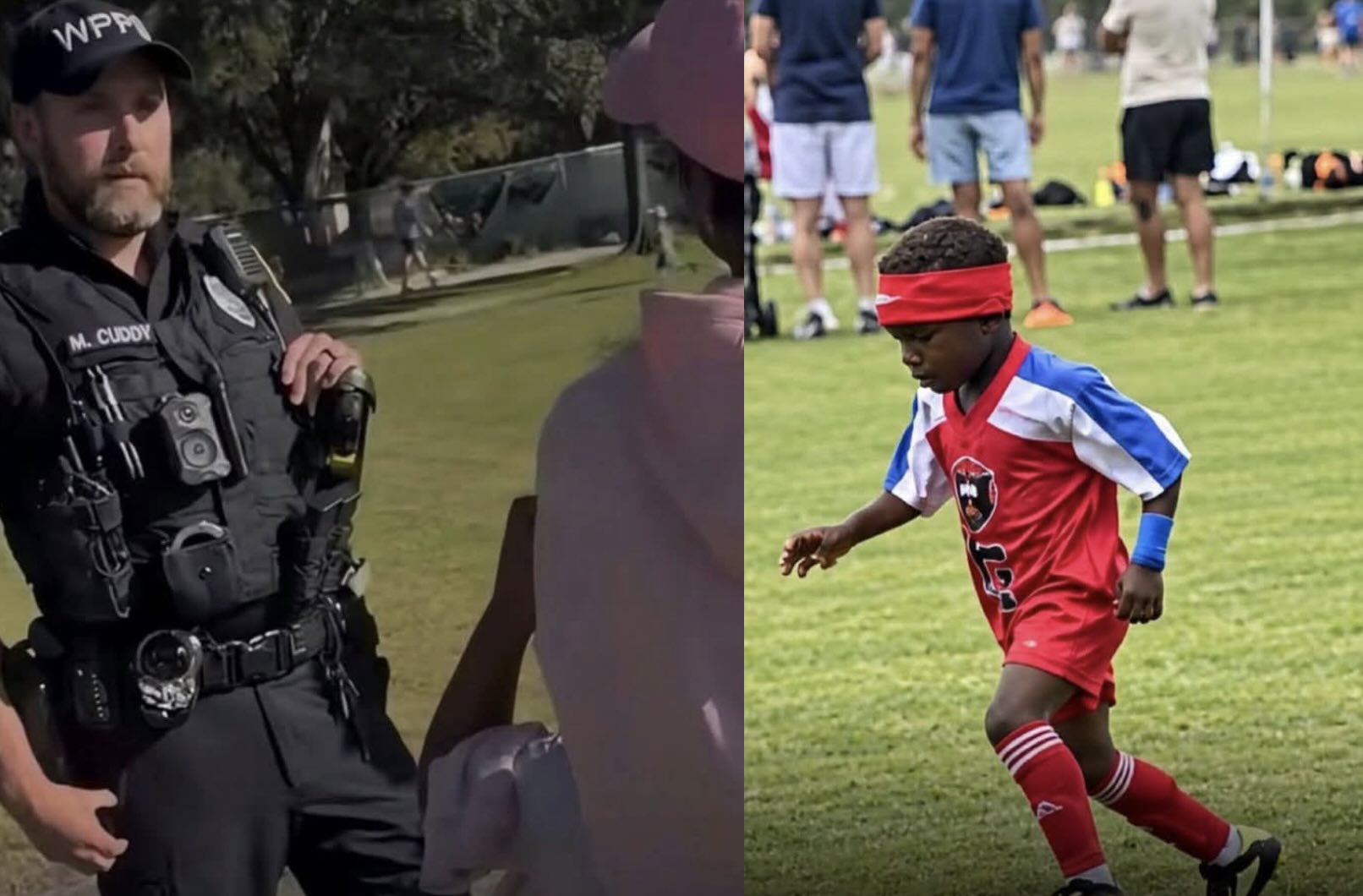
Photo: Nevadaney10 | Instagram
Nevada was three years old. He was playing soccer. He was, by every account, extraordinarily good at it. And for that, a group of grown adults in Winter Park, Florida, decided he needed to be removed from the field by armed police officers.
The incident unfolded during an i9 Sports league youth soccer match, where Nevada—a Black toddler—was playing up in a division against five-year-old children. According to videos posted by his family under the handle @nevadaney10, he wasn't just competitive. He was completely dominating. In one of his final matches before the league intervened, the three-year-old reportedly scored ten goals by himself against children two years his senior.
The opposing parents, unable to watch their older children fail to strip the ball from a toddler, grew increasingly frustrated. They accused Nevada of "ball-hogging" and "trying to put on a show." The sideline tension escalated until the league issued a trespass notice to Nevada's family. Police officers arrived at the field and escorted the family away in front of the other children and spectators.
The league ultimately refunded the family's registration fees and removed Nevada from the program. But the damage—and the message—was already delivered: a Black child's excellence, even at the age of three, can be reframed as a transgression worthy of law enforcement intervention.
The Adultification of a Toddler
Child development experts and sports psychologists are unequivocal: a three-year-old is cognitively incapable of the calculated malice the adults accused Nevada of. Children under five operate in what Piaget called the "egocentric play phase." They lack the spatial awareness, strategic reasoning, and emotional maturity to understand passing lanes, team dynamics, or the concept of humiliating an opponent.
When a toddler "ball-hogs," it is not a conscious choice to deny others. It is a child tracking a moving object, experiencing the joy of running, and kicking a ball into a net. The accusation that Nevada was "trying to put on a show" projects adult motivations onto a brain that has not yet developed the capacity for them.
But the adults in Winter Park did not see a toddler having fun. They saw something else—something that required a trespass warning and police presence. This is the mechanics of adultification bias: a documented phenomenon in which Black children are perceived as older, more mature, more calculated, and more threatening than their white peers of the same age.
- The Illusion of Intent: Research from the American Psychological Association and Georgetown Law shows that adults routinely perceive Black children as significantly older and more calculated than they actually are. A white toddler outplaying older kids is a "prodigy." A Black toddler doing the same is "aggressive" and "showing off."
- Criminalizing Play: By manufacturing a "transgression" out of normal childhood behavior, the adults justified severe punitive measures—including calling the police and issuing a criminal trespass notice—against a family simply watching their baby play soccer.
- Weaponizing Safety: The parents huddled on the sidelines framed their complaints as protecting their own children. In doing so, they stripped Nevada of the basic grace and protection that all three-year-olds are supposed to receive from society.
A Predominantly White, Affluent League
Winter Park is an affluent suburb of Orlando with a population that is over 74% white. Private recreational leagues like i9 Sports function as pay-to-play programs, and in predominantly white, high-income areas, they reflect those local demographics. Nevada's family was navigating a space where they were heavily outnumbered—and where the institutional power rested entirely with the majority.
In the viral footage, the parents huddled up, complaining to league officials, are predominantly white. When they became uncomfortable, the league's response was immediate: side with the majority, criminalize the family, and use law enforcement to physically remove them from the space. This is not a failure of individual sportsmanship. It is a structural pattern.
The History of Policing Black Talent
The NCAA banned the slam dunk from 1967 to 1976—a rule change widely understood as a direct response to Kareem Abdul-Jabbar's dominance at UCLA. The NFL implemented the "Mel Blount Rule" in 1978, banning contact between defenders and receivers past five yards, effectively neutralizing the physical, dominant style of Black defensive backs. Leagues across professional sports have policed "excessive celebration" and "taunting"—codes that disproportionately target Black cultural expression and joy.
What happened to Nevada is the same dynamic, applied at the absolute entry point of childhood athletics. When the adults could not beat his talent on the field, they used administrative power and police authority to change the environment and remove the player entirely. The lesson taught to every child on that field was clear: Black excellence is acceptable only when it can be managed, contained, and controlled.
The Double Standard of Institutional Response
i9 Sports markets itself as a league where "all skill levels are welcome," where the focus is on "fun, not pressure," and where "inclusivity and character development" are core values. The league's own parental pledge emphasizes teaching children respect and good sportsmanship.
Yet when a three-year-old Black child's natural talent made a group of affluent white parents uncomfortable, the league abandoned every one of those principles. They did not mediate. They did not tell the complaining adults to let the children play. They did not offer to move Nevada to a higher division where he could find an appropriate challenge. They issued a criminal trespass warning and called the police.
As of this writing, i9 Sports corporate leadership has issued no public statement, no apology, and no explanation. The silence is itself a statement. It suggests a corporate crisis management strategy that hopes the story will fade—and a refusal to reckon with the fact that their operational decisions violated their own stated values.
What the Viral Backlash Reveals
The family's TikTok video has transitioned from local community groups onto major news aggregators, lifestyle blogs, and civil rights platforms worldwide. Commentators across sports and culture are overwhelmingly rallying behind Nevada. The adult backlash, intended to dim his light, has instead given him a global platform.
But the viral outrage is not simply about one child. It is about the recognition—deep and widespread—that Black talent in America is celebrated only when it exists within boundaries set and managed by others. When that talent shows up independently, naturally, and completely unregulated—especially in a space where it is outperforming the dominant demographic—the reaction from the system is often to suppress it.
Nevada's father, in the footage that has now been viewed millions of times, summarized the absurdity with devastating clarity: "They really called the police on a 3-year-old because he had the ball too much."
That is what white supremacy looks like at its most intimate and insidious. Not a burning cross or a shouted slur, but a group of affluent adults huddled on a soccer sideline, unable to bear the sight of a Black toddler excelling, and a league that chose to protect their comfort at the expense of a child's joy. The police were called not because Nevada was dangerous, but because he was too good—and his excellence was something the system could not control.
No Ads. By Us. For Us.
This article was made possible by readers like you. We hope it inspired you to support Emerald Book, so we can continue producing content like this.
We will never show you ads, sell your data, or require a subscription to consume our content. Your gift helps us keep the truth accessible.
Click the Support button to give a gift of any amount today.
Thank you for making this work possible.