

Emerald Pages
◆
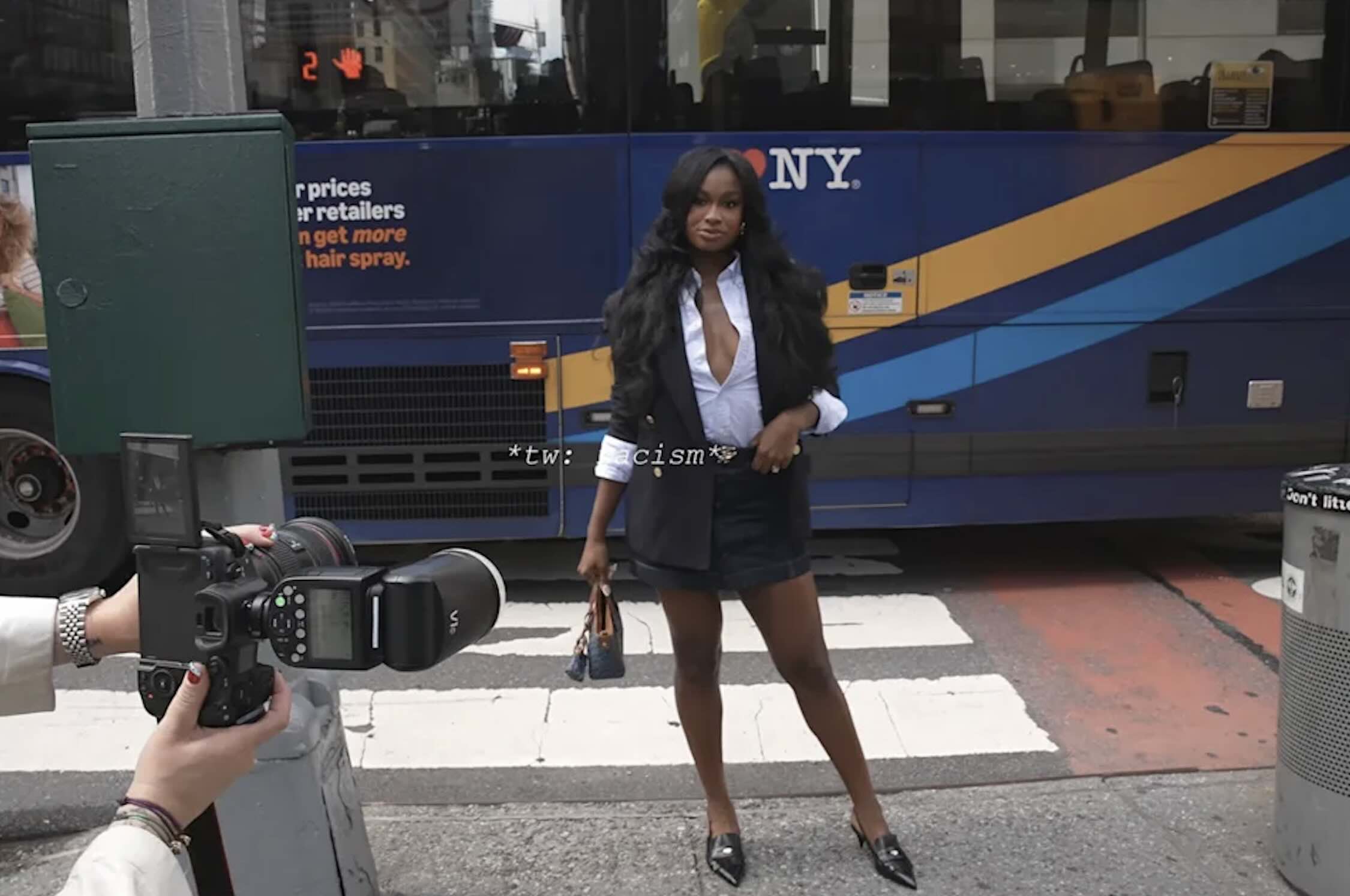
Photo: Coco Jones | Youtube
Outside the Plaza Hotel, in the middle of New York Fashion Week, Coco Jones was doing what she has done a thousand times: standing in her light, posing for photographers, working. She had not approached anyone. She had not spoken to anyone. She had given no one a reason. And still, a woman off-camera began to shout. "Ew." "So disgusting." "You look so freaking Black." Then the slur, repeated: "Blacky."
Jones kept her composure. She smiled. She said, "I'm Black and I'm proud." She blew the woman a kiss and walked away with the kind of strut that turns humiliation into choreography. The internet, when the footage surfaced in her YouTube vlog, called it grace. But grace is not the story. The story is what surrounded her: a street full of people who did nothing.
The heckler was never identified. She stayed off-camera, her face unseen, her voice the only evidence she existed. Social media users widely assumed she was a white woman based on the sound of her voice and the nature of the insults, but no one knows for certain. What is certain is that she was able to scream racial slurs at a Black celebrity in one of the most photographed intersections in America and then simply disappear. No security guard stopped her. No bystander confronted her. No authority figure intervened. She faced zero friction, zero consequence, zero cost.
The Crowd That Watched
The footage is painful not only for what the heckler said but for what everyone else didn't do. Paparazzi kept shooting. Passersby kept walking. Onlookers watched from a distance, treating the verbal assault like street theater rather than a human being under attack. Jones and her immediate team were left entirely isolated to handle the situation themselves, and even her own team—the people paid to protect her—stood by silently, prioritizing the photoshoot and the content over her dignity.
This is the bystander effect in its purest, most racialized form. In crowded public spaces, people assume someone else will step in. But when the target is a Black woman and the aggressor is shouting about her Blackness, the silence carries a different weight. It becomes a message: this is tolerable. This is normal. This is not worth disrupting my day.
- No bystander confronted the heckler or formed a protective barrier around Jones.
- No security or authority figure intervened to remove the aggressor.
- Her own team de-escalated by walking her away—but did not confront or hold the woman accountable.
- The heckler remained anonymous and faced no immediate consequence of any kind.
When a Black woman can mind her own business, thriving in her element, and still be subjected to public dehumanization while a crowd watches silently, it proves that the public square is still a place where the safety of Black women is compromised. People are often more willing to tolerate the presence of blatant hatred than they are to disrupt their own comfort to stop it.
Disrespect Without Consequences Invites More Disrespect
This is a foundational truth of human behavior: an environment without consequences is an environment that permits abuse. Bullies and racists rarely stop on their own. If a person can scream slurs outside a luxury hotel in Manhattan and walk away completely anonymous and unbothered, she is effectively given a green light to do it again to the next person. The silence of the crowd does not neutralize the hatred—it incubates it.
The reaction online was fiercely divided. Half the internet praised Jones for her poise, calling her composed and classy. The other half was furious—not at Jones, but at the recognition that her grace, while protective of her own peace, did not punish the offender. The insults were "fighting words," an explicit attack on her humanity, and that no one should be expected to smile through dehumanization. The expectation that Black women must always take the high road places the entire burden of dignity on the victim while the aggressor walks away scot-free.
Jones's response was tactical, and it was hers to make. She refused to give a miserable stranger control over her time, her energy, or her Fashion Week. But her choice does not absolve the crowd. True consequences require a collective boundary—where bystanders intervene, institutions enforce rules, and society actively penalizes the aggressor. Without that collective pushback, the high road becomes a path that victims are forced to walk alone while the disrespect continues to grow.
The Deeper Truth
Not even fame, success, or immense talent can shield Black people—and particularly dark-skinned Black women—from blatant, public racism. The specific slurs thrown at Jones targeted her dark skin directly, reigniting conversations about how colorism and racism intersect, and how dark-skinned Black women frequently bear the brunt of both even at the peak of their careers. The unprovoked nature of the attack served as a stark reminder that public spaces can still feel fundamentally unsafe or hostile, regardless of a person's achievements or social standing.
Elie Wiesel famously said, "Neutrality helps the oppressor, never the victim. Silence encourages the tormentor, never the tormented." When people who claim to oppose racism do nothing when it happens right in front of them, the gap between personal belief and actual accountability is exposed. It is easy to oppose racism in theory. It is harder to step out of comfort, risk social discomfort, and interrupt. When people choose comfort over action, the status quo remains unchanged.
Systemic racism does not require everyone to be actively malicious. It only requires the majority to be passively complicit. The street outside the Plaza Hotel was not full of villains. It was full of people who chose not to get involved. And that, too, is a choice—one that tells every future heckler that the crowd will not stop them.
Coco Jones walked away with her head high, her dignity intact, and her peace protected. But she should never have had to. No one should ever be put in that position in the first place—and until the people standing around decide that silence is no longer acceptable, the disrespect will keep coming, and the consequences will continue being nonexistent.
No Ads. By Us. For Us.
This article was made possible by readers like you. We hope it inspired you to support Emerald Book, so we can continue producing content like this.
We will never show you ads, sell your data, or require a subscription to consume our content. Your gift helps us keep the truth accessible.
Click the Support button to give a gift of any amount today.
Thank you for making this work possible.