

Emerald Pages
◆
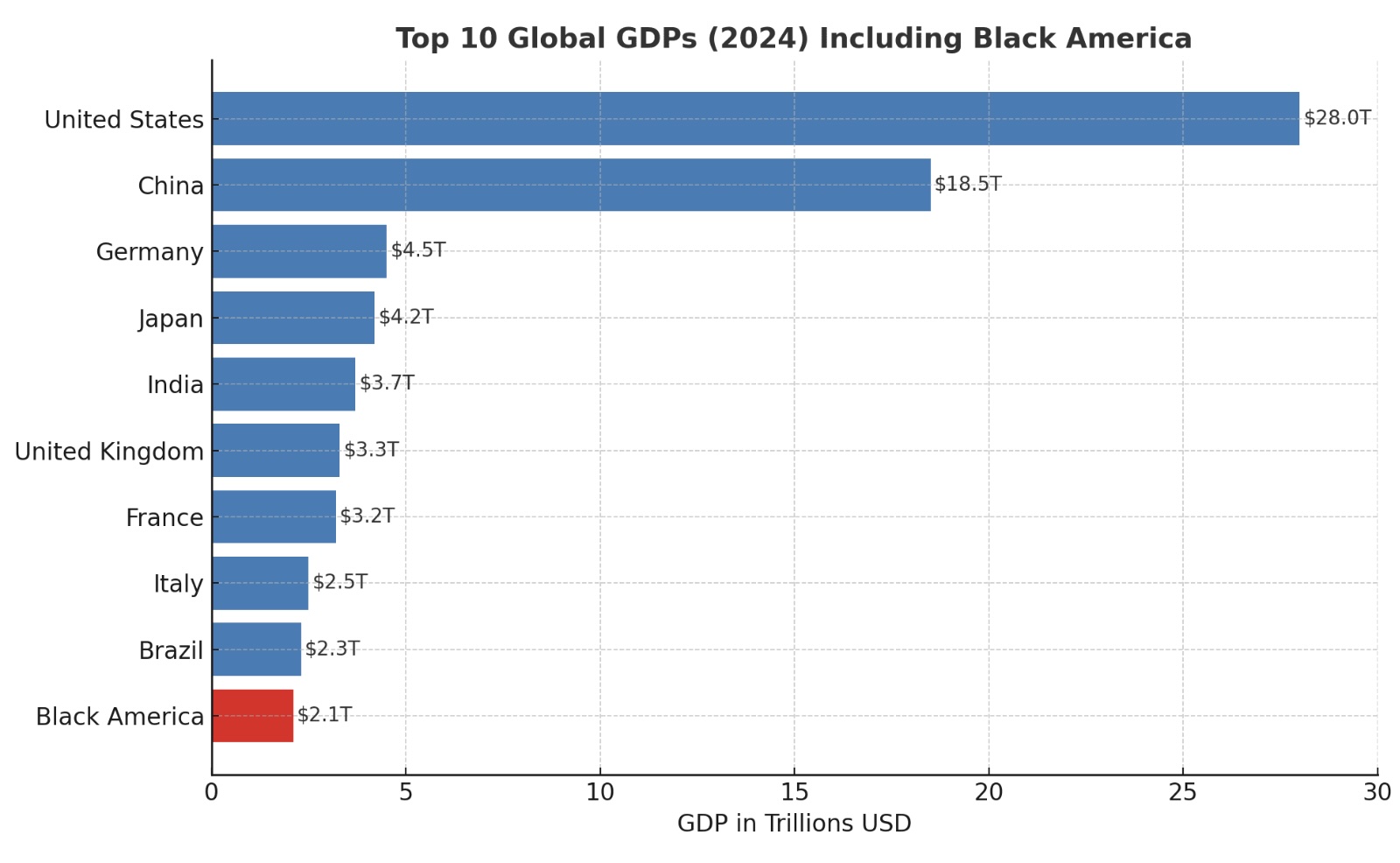
Photo: Stephanie Gadlin | The Chicago Crusader
Black America wields an economic force that rivals sovereign nations. With an estimated $2.1 trillion in annual buying power, if Black Americans were treated as a standalone economy, that collective spending would rank around 15th in the world in 2026—ahead of the total GDP of Spain, South Korea, and Saudi Arabia, and roughly the size of Canada's economy. It is larger than the entire economic output of Mexico, Australia, or the Netherlands, and it is growing faster than most of the countries it outranks.
This is not a myth. It is a measurable, bankable market force that major corporations compete for daily. It is the reason brands from Nike to Apple to Walmart build entire marketing divisions around reaching Black consumers. It is the reason Black cultural production—music, fashion, film, slang, aesthetics—gets absorbed into global commerce within weeks of emerging. The raw economic energy is real.
But here is the paradox that economists and community organizers have been screaming into the void for decades: that $2.1 trillion does not stay in the Black community for even a single day. The Black dollar, according to multiple economic studies, leaves the Black community in approximately six hours. By contrast, a dollar circulates for 28 days in Asian communities, 20 days in Jewish communities, and 17 days in white communities. That is not a small gap. It is the difference between an economy that compounds wealth generationally and one that functions as a high-volume extraction zone.
The money is there. The power is there. The problem is the plumbing.
The 98% Leak: Where the Money Actually Goes
The statistics on where Black dollars land are brutal, and they compound. Less than 2% of total Black spending is directed toward Black-owned enterprises. Less than 1% of Black Americans place their primary deposits or secure loans through Black-owned financial institutions. Out of over $24 trillion in total U.S. banking assets, Black-owned commercial banks hold under $7 billion—roughly 0.03%. Black Americans own about 2% of businesses with employees and hold about 2% of total U.S. household wealth, despite representing roughly 14% of the population. The median white household holds $285,000 in wealth; the median Black household holds $44,900. That is a gap of roughly 6.3x.
This means that when a Black consumer earns a dollar, it overwhelmingly flows immediately into external corporations—mainstream retailers, digital platforms, megabanks, insurance companies, landlords, and auto dealers—and is used to build infrastructure, fund mortgages, create jobs, and generate shareholder returns elsewhere.
The financial leakage happens through two primary channels, and they reinforce each other. The first is the banking gap: when deposits go to mainstream megabanks, that capital is loaned out to build infrastructure elsewhere—commercial real estate in other neighborhoods, corporate expansion in other sectors, mortgages for other demographics. Meanwhile, Black entrepreneurs are left capital-starved, often forced into predatory lending or venture terms that strip equity. Less than 1% participation means the Black community is essentially depositing its capital into institutions that do not lend it back.
The second is the commercial void. Because historic segregation networks—Black-owned banks, insurance companies, retail corridors, manufacturing—were dismantled without a matching transfer of industrial capital, the modern community lacks the integrated supply chains needed to keep a dollar moving internally. A Black-owned retail store cannot survive if its landlord, wholesaler, manufacturer, distributor, and accountant are all external corporations extracting margin at every step. The store becomes a pass-through, not a retention node.
The result is an extraction economy: a demographic that possesses the sheer volume of a global economic superpower while simultaneously experiencing severe localized capital drainage. High consumer spending paired with low asset ownership is not a sign of economic strength. It is a sign of economic vulnerability dressed in brand logos.
The Six-Hour Dollar: A Timeline of Leakage
To understand the leak, trace a single dollar. A Black worker in Atlanta, Chicago, or Los Angeles receives a paycheck deposited into a mainstream megabank. Within hours, that dollar is spent at a national grocery chain headquartered elsewhere. It is swiped at a major retailer whose corporate profits flow to shareholders in other states. It is used to pay a utility owned by an investor-owned conglomerate. It is applied to an auto loan held by a national bank that securitizes and sells the debt. It is routed through a digital payment platform that takes a transaction fee and holds float. It is paid to a landlord whose mortgage is held by a real estate investment trust.
By the end of the day, that dollar has touched Black hands exactly once—as it left them. It will not return. It will not circulate. It will not fund a Black-owned business, a Black-owned bank, or a Black-led development project. It will fund someone else's infrastructure, someone else's equity, someone else's generational wealth. Multiply that single dollar by 42 million people transacting daily, and you begin to see the scale of the leak. It is not a drip. It is a literal firehose pointed outward.
The Multiplier Effect: What 1% Could Actually Build
Redirecting just 1% of Black consumer spending—approximately $21 billion annually—would create a massive economic multiplier effect. This is the part that gets glossed over in most discussions. Because capital in an enclosed network changes hands multiple times, keeping that money internal doesn't just add $21 billion to the ecosystem; it geometrically compounds into new businesses, jobs, and systemic financial protection.
According to data on small business employment dynamics, every $100,000 to $150,000 in sustained revenue for a local firm typically supports one full-time job. Capturing just 1% of that leakage would retain $21 billion within Black-owned ecosystems, creating or sustaining 140,000 to 200,000 jobs. If that $21 billion circulates just three to four times within Black-owned ecosystems, it generates $60 billion to $80 billion in total economic activity—an immediate, self-funding employment loop that bypasses traditional corporate gatekeepers.
But the real leverage is not in retail spending. It is in banking. If that 1% ($21 billion) is strategically routed through Black-owned banks and Community Development Financial Institutions (CDFIs) rather than spent purely on retail, the wealth-building effect scales even faster. In banking, every $1 in stable deposits can back roughly $8 to $10 in local commercial loans, lines of credit, and home mortgages. This is the fractional reserve system—the same mechanism that built white middle-class wealth in the 20th century through savings and loan institutions, FHA loans, and union-backed credit unions. A $21 billion deposit injection turns into nearly $200 billion in deployable capital. That is not a marginal improvement. That is the difference between a community that rents its infrastructure and one that owns it.
The Banking Power Shift
Banking Black is the single highest-leverage first step to unlocking that wealth, precisely because the numbers are currently so low. When a dollar sits in a major commercial megabank, it is loaned out to fund multinational corporations and development projects globally. When that same dollar is placed into a Black-owned bank, it is legally and structurally bound to be loaned out locally—funding mortgages, commercial lines of credit, and small business loans directly within the community.
If the community collectively raised that 1% participation rate to even 10%, total system deposits would rise from roughly $5.5 billion to $55 billion, and deployable lending capital would scale from about $50 billion to $500 billion—a permanent, self-sustaining credit engine for housing, business, and tech. At 20%, deposits would reach roughly $110 billion and deployable lending capital would approach $1 trillion, enough to fund major infrastructure, commercial real estate, and industrial projects at scale.
The mechanics are not complicated. The barriers are not mathematical. They are behavioral, informational, and structural—and all three can be addressed.
From Consumers to Ownership
To unlock this wealth, Black America must shift from uncoordinated individual consumption to structured, collective capital routing. Wealth is not unlocked by earning more; it is unlocked by plugging the financial leaks and owning the infrastructure that handles the money. The framework requires four coordinated moves—and none of them work in isolation. They need a connective layer: a directory, a discovery engine, a place where the intent to circulate capital meets the actual businesses prepared to receive it.
That is precisely the problem Emerald Book exists to solve. Our entire platform is dedicated to connecting people to the Black economy—mapping Black-owned businesses, institutions, and services so that the decision to spend internally stops being a research project and starts being a reflex. Every tool required to take action lives in one place: Participate in the Black Economy.
- Institutionalize the capital. Move deposits to Black-owned banks and CDFIs. Scale lending capacity. Use fintech tools to automatically route a percentage of daily transactions into community investment pools. Make banking Black the default, not the exception. Emerald Book's directory makes it trivial to find the Black-owned bank or CDFI nearest you—so the first step of the framework takes minutes, not months.
- Build interconnected supply chains. Shift focus from small consumer shops to B2B logistics, manufacturing, and software firms. Connect Black agricultural producers directly to Black-owned distributors and grocery networks. Contract internally for legal, marketing, and accounting services. Emerald Book is building the map for exactly this—so a Black-owned café can find its Black-owned roaster, its Black-owned landlord, and its Black-owned accountant without leaving the ecosystem.
- Coordinate consumer power. Shift spending on non-discretionary items—groceries, insurance, utilities—where spending is recurring and predictable. Execute strategic buy-ins. Turn individual choices into collective leverage. Coordination requires visibility, and visibility requires a shared directory. Emerald Book provides that infrastructure: a verified, searchable layer that turns scattered individual intent into a coordinated economic bloc.
- Pool capital for asset ownership. Form investment clubs. Create Community Land Trusts to buy up neighborhood real estate and prevent displacement. Fund localized angel investor networks to self-fund high-growth startups. Stop renting infrastructure and start owning it. Every pooled vehicle needs a pipeline of vetted opportunities and a network of trusted operators—Emerald Book is building both.
The framework is not abstract. It is a set of behaviors that require infrastructure to scale. A directory is not a small thing. It is the difference between "I would support Black businesses if I knew where they were" and "I moved my deposits, redirected my spending, and joined an investment club this quarter." Emerald Book was built for that gap.
The Choice Point
The capital is already there. The $2.1 trillion is already being generated. The ultimate transition to economic equality lies entirely in changing the direction of the flow. A 1% shift is not a sacrifice—it is a strategic redirection of existing power.
The power is immense. It is simply misdirected. And that means it can be redirected. The question is not whether Black America has enough money. It does. The question is whether that money will continue to build someone else's infrastructure, or whether it will finally build its own. The answer is not determined by economics. It is determined by choice—individual choices aggregated into collective outcomes.
The dollar is already in your hand. The only question is where it goes next.
No Ads. By Us. For Us.
This article was made possible by readers like you. We hope it inspired you to support Emerald Book, so we can continue producing content like this.
We will never show you ads, sell your data, or require a subscription to consume our content. Your gift helps us keep the truth accessible.
Click the Support button to give a gift of any amount today.
Thank you for making this work possible.