

Emerald Pages
◆
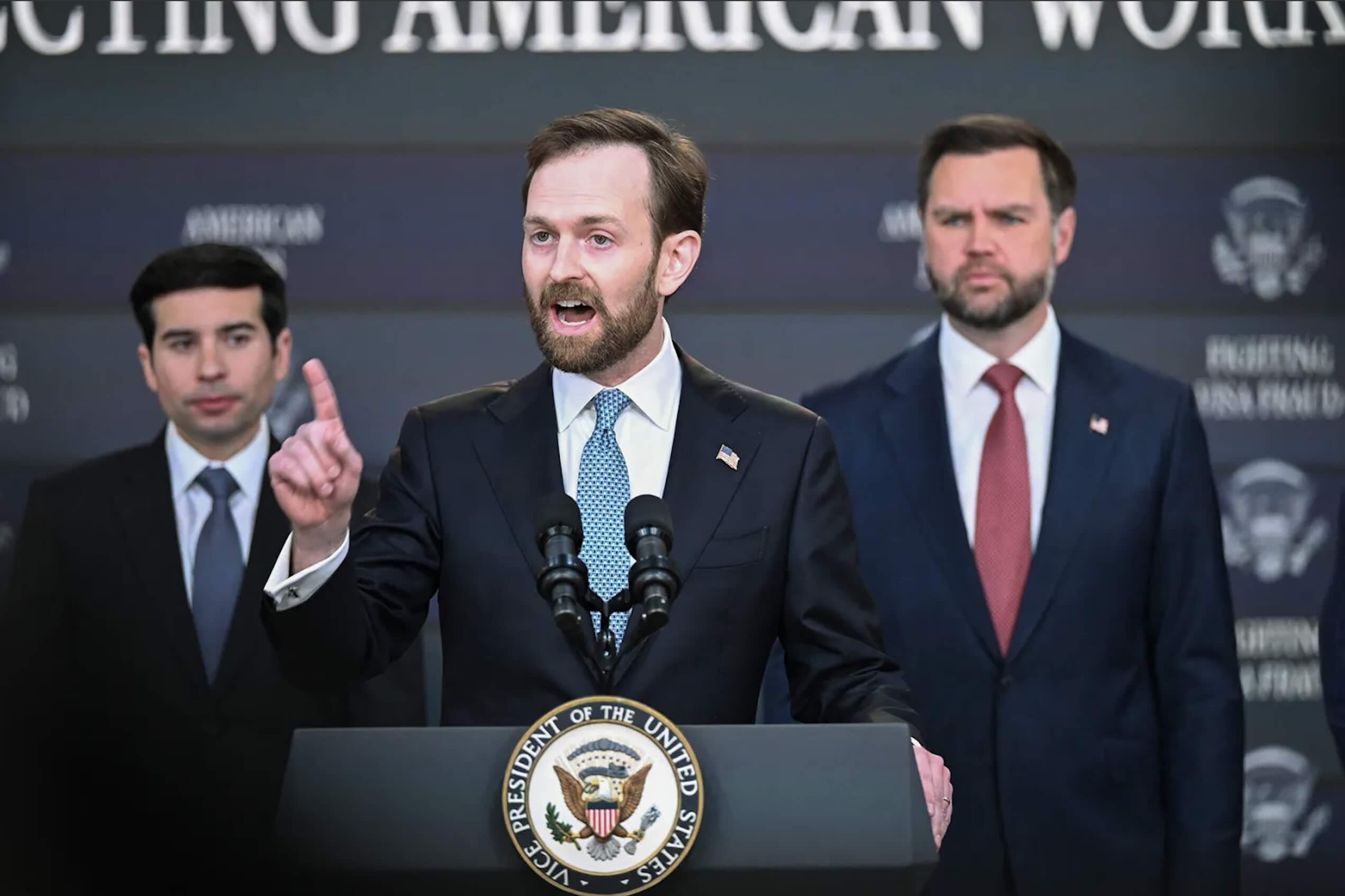
FTC Chair Andrew Ferguson praised EEOC Chair Andrea Lucas for protecting "white American men from discrimination" at an October 8, 2026 press conference. | Photo: Getty Images
In December 2025, the Equal Employment Opportunity Commission (EEOC) under Chair Andrea Lucas released a video explicitly urging white men who believe they have faced workplace discrimination to file formal charges with the agency. The move was celebrated by FTC Chair Andrew Ferguson, who at an October 8, 2026 press conference alongside Vice President JD Vance praised Lucas for protecting "white American men from discrimination." Ferguson called her the greatest EEOC chair since Clarence Thomas and commended her for tackling areas "that previous EEOCs refused to touch." The administration's message is unmistakable: white men are a victim class in need of federal protection. There is just one problem. The empirical data says the exact opposite.
Labor economists, civil rights organizations, and federal data repositories like the U.S. Bureau of Labor Statistics (BLS) have tracked workplace demographics for decades. Across virtually every industry and every measure of economic power, white men remain the most advantaged demographic group in the country. The idea that they face systemic discrimination is not supported by a single major dataset. In fact, the data reveals a structural monopoly on wealth, institutional authority, and executive power that has persisted across generations.
The administration's claims rely entirely on ideological arguments and isolated anecdotes. They conflate legal corporate diversity goals with illegal quotas, and they elevate individual complaints into a false narrative of systemic oppression. An internal review reported by The New York Times highlighted how difficult it has been for the administration to find actual cases. In one instance, EEOC staff had to justify abandoning a high-profile "reverse discrimination" case because the position went to another white man—every single applicant for the role had been white.
Even before the administration's new push, actual data from the EEOC showed that out of tens of thousands of race-based workplace discrimination charges filed annually, only about 10% ever even alleged bias against white individuals. Because the evidence does not exist naturally, EEOC Chair Andrea Lucas moved to actively delete the agency's 50-year-old affirmative action guidelines—a rule change explicitly designed to lower the legal bar so the federal government could manufacture and litigate lawsuits on behalf of white men where they couldn't before.
The Corporate C-Suite: A White Male Monopoly
The peak of corporate power remains almost entirely monolithic. Out of the 500 largest companies in America, white men hold roughly 85% to 90% of CEO positions. As of 2026, there are only a tiny handful of Black CEOs leading Fortune 500 companies. Corporate board seats—which control executive hiring, corporate policy, and hundreds of billions in capital allocation—are overwhelmingly occupied by white men. According to Fortune, 72% of senior executives are white men.
This pattern holds across every high-paying sector. In venture capital, roughly 80% of partners are white men, and Black founders receive less than 1% of total VC funding annually. The gatekeepers of the economy—the people who decide which businesses get funded and which ones do not—are overwhelmingly white and male. In law firms, white men make up the vast majority of equity partners—the highest-earning, decision-making layer of the legal industry—while Black attorneys account for less than 3% of equity partners nationwide. In asset management, approximately 98% of the entire industry is run by white men.
Research into corporate board appointments found that white men secured 55% of all new S&P 500 board seats over a recent tracking period—their first absolute majority since 2017. Analysts note that amid shifting political winds, major corporations have actively reverted to appointing traditional executive profiles, which due to historical patterns remain overwhelmingly white and male.
The Economic Data: Unemployment, Wealth, and Ownership
If white men faced systemic discrimination, you would expect to see it in unemployment rates, wealth accumulation, and business ownership. You do not. The statistical reality of the job market shows that white workers consistently experience far more stability than Black or Hispanic workers.
- Unemployment: The Black unemployment rate has consistently hovered at nearly double the rate of white workers. Even during periods of historic job growth, systemic vulnerabilities mean that Black workers—and particularly Black women—often experience higher volatility, steeper job losses during contractions, and slower recoveries, while the white unemployment rate remains structurally insulated.
- Wealth: White households command 82.9% of all household wealth in the United States. The top 10% of wealthiest Americans—who own over 77% of all U.S. wealth—are 88.5% white. According to the Brookings Institution, approximately 90% of all billionaires are male and 65% are white.
- Business Ownership: Approximately 80% of all employer firms in the U.S. are white-owned, while only about 3% are Black-owned. Structurally, this means Black workers are over 26 times more likely to work for a white employer than a Black employer.
- Hiring Bias: Labor market studies consistently show that hiring biases—such as resume-scanning discrepancies and closed professional networks—significantly favor white applicants over Black applicants, even when qualifications are identical.
Congress and Capitol Hill: The Same Story
The disparity extends to the halls of government. White men make up only about 30% of the U.S. population but hold the vast majority of seats in both the House and Senate. Women and people of color remain statistically underrepresented relative to their actual percentages in the American electorate.
The unelected staff who draft legislation, run committees, and manage congressional offices show the same pattern. According to the Joint Center for Political and Economic Studies, people of color make up 42.9% of the U.S. population but hold just 21.6% of top staff roles in the House. White staffers are paid significantly more on average than their non-white colleagues—a disparity driven primarily by the systemic exclusion of minorities from senior leadership roles. Black and Hispanic mid-level staffers on Capitol Hill face higher exit and turnover rates and are statistically far less likely to receive internal promotions to senior-level positions than white staffers.
In early 2026, House Education and the Workforce Committee Ranking Member Robert C. Scott led a formal congressional inquiry demanding answers from EEOC Chair Andrea Lucas. House Democrats accused the EEOC of abandoning its statutory mandate to dismantle actual systemic racism, pointing out that spending federal resources to exclusively solicit claims from white men ignores the deep, empirical inequalities that persist in both corporate America and the halls of Congress itself.
Industry by Industry: A Structural Pattern
The concentration of power held by white men spans nearly every corner of American life. From energy and aerospace to agriculture and entertainment, the pattern repeats: diverse entry-level workforces overseen by overwhelmingly white male executive suites.
- Energy and Aerospace: White men hold the overwhelming majority of executive leadership positions at major commercial airlines and federal defense contractors. 93% of commercial aircraft pilots are white. The oil, gas, and mining sectors are among the most heavily male-dominated fields in the country, averaging roughly 85% male across the workforce.
- Construction and Real Estate: The construction industry is roughly 89% male. While the manual labor workforce is highly diverse, the executives, developers, and principal investors who dictate zoning, land acquisition, and multi-billion-dollar commercial developments are overwhelmingly white men.
- Sports Franchise Ownership: Across the NFL, NBA, and MLB, team ownership remains almost entirely white and male. These owners control the franchises, broadcasting rights, and stadiums, commanding massive financial leverage while the athletic talent is disproportionately Black.
- Hollywood Studio Leadership: Despite public-facing initiatives to greenlight more diverse films and television shows, the major studio chairpersons, network executives, talent agency partners, and distribution executives who control capital and production greenlights remain overwhelmingly white and male.
- Agriculture: According to federal tracking data, 95.8% of agricultural farm owners and managers in the United States are white. The executive suites of major multi-national seed, chemical, and agricultural logistics companies exhibit the same structural pattern, keeping food supply-chain power firmly in the hands of white male leadership.
- High-Paying Trades: According to BLS demographic monitoring, high-earning specialized trades feature near-monolithic white male representation. This includes fields like millwrights (94.3% white), chemical-processing machine workers (94.1% white), and cost estimators (93.9% white).
- Media and Publishing: A review by The New York Times analyzing hundreds of the most powerful positions in American culture revealed extreme underrepresentation among minorities in publishing, network television, and mainstream news leadership. The executive editors and media company presidents who decide what stories are funded, printed, or broadcasted are overwhelmingly white men.
What the Administration Is Actually Doing
The administration's actions are not a response to a real economic threat but a strategic effort to protect an existing power dynamic. By framing white men as a "protected class," the EEOC creates a legal environment where changing the demographic makeup at the top becomes highly risky for corporations.
Over the last few decades, incremental progress through DEI initiatives, targeted recruitment, and corporate fellowships has allowed Black, Hispanic, and female professionals to secure positions they were historically locked out of. Critics argue that the administration views this gradual upward mobility as a threat to traditional power bases. By labeling these inclusion programs as "reverse discrimination" and threatening lawsuits, the federal government creates a chilling effect, forcing companies to scale back programs that help minorities catch up.
By actively rewriting the EEOC's internal rules—such as removing decades-old affirmative action guidelines—the administration is systematically altering the machinery of the civil rights state. This is a classic consolidation tactic: repurposing an agency originally built to dismantle systemic racism and turning it into a tool that legally immunizes the dominant demographic group from future civil rights challenges.
The NAACP and the Lawyers' Committee for Civil Rights Under Law have filed a joint lawsuit demanding internal EEOC records regarding the agency's solicitation of white men's complaints. They argue that the administration is weaponizing civil rights bureaucracy to push a "false, divisive narrative" and actively drawing resources away from combating well-documented, generational systemic barriers faced by Black, Hispanic, and female workers. Derrick Johnson, president of the NAACP, said there was "no evidence that white men were discriminated against as a result of the civil rights movement."
The comprehensive data proves that the U.S. workforce is organized like a pyramid: while the bottom tiers of labor are highly diverse, the top layer across every single sector—from food production and energy to finance and media—is structurally insulated and overwhelmingly controlled by white men. The administration's new policy has no basis in empirical market realities.
The data is not ambiguous. White men do not face systemic discrimination in America. They hold a multi-generational, structural monopoly on wealth, institutional power, and executive positions across almost every major industry. The administration's push to protect them is not an economic intervention. It is an ideological and structural defense mechanism designed to sustain the status quo—and the empirical evidence exposes it as exactly that.
No Ads. By Us. For Us.
This article was made possible by readers like you. We hope it inspired you to support Emerald Book, so we can continue producing content like this.
We will never show you ads, sell your data, or require a subscription to consume our content. Your gift helps us keep the truth accessible.
Click the Support button to give a gift of any amount today.
Thank you for making this work possible.