

Emerald Pages
◆
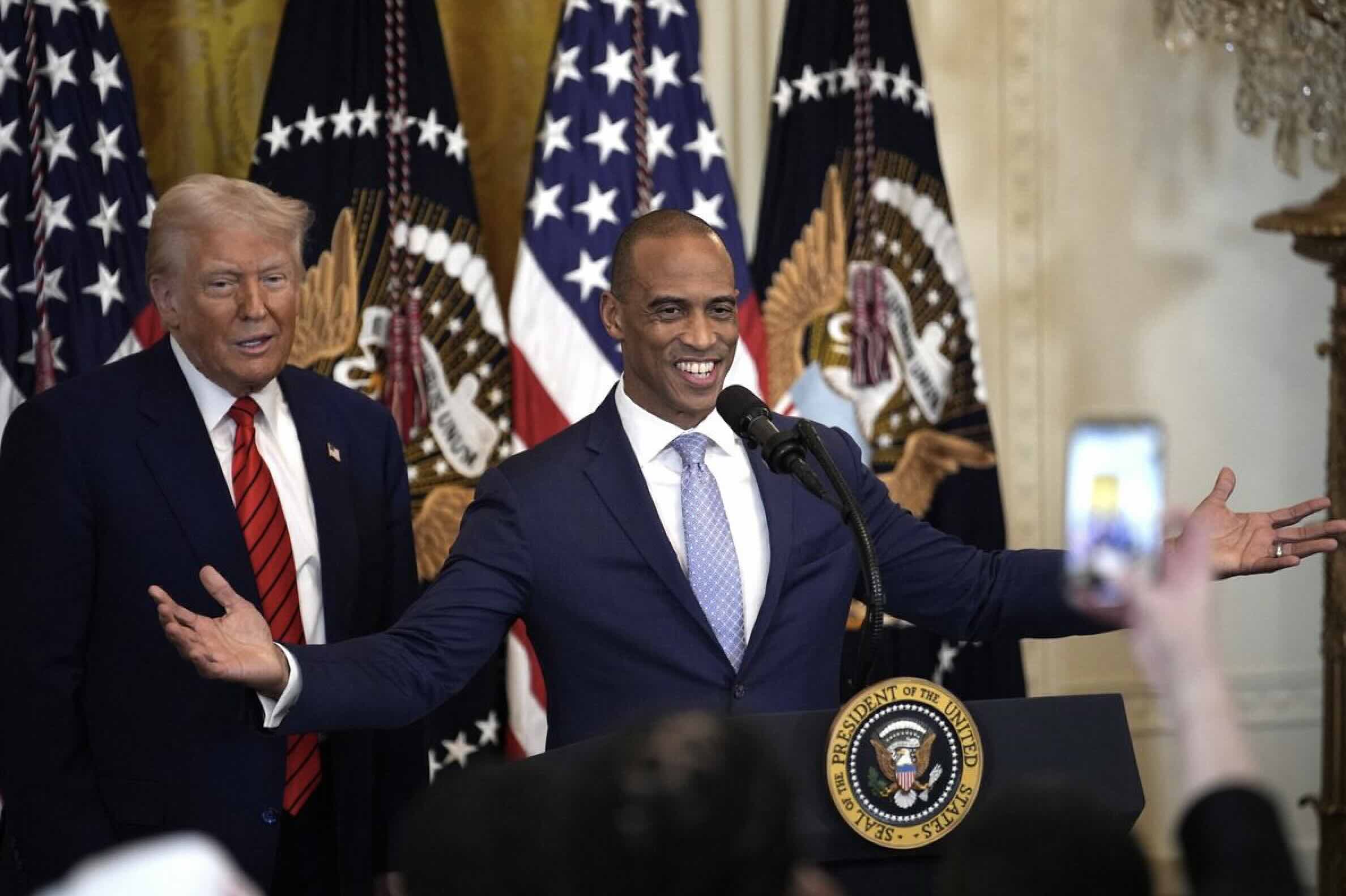
HUD Secretary Scott Turner with Donald Trump | Photo: Bloomberg
The Department of Housing and Urban Development has launched a federal investigation into Wells Fargo's mortgage initiatives designed to boost homeownership rates among Black and minority borrowers. But a close examination of HUD's own historical research reveals a troubling contradiction: the agency's internal data has consistently shown that the race-neutral, deregulatory approach it now champions cannot close the 30-point racial homeownership gap.
On October 7, 2026, HUD sent a letter to Wells Fargo Chief Executive Charlie Scharf alleging that the bank engaged in "sorting" homeowners by race and violating fair-lending laws under the Fair Housing Act. The probe centers on nearly a decade of racial equity homeownership initiatives, including a $60 billion lending commitment made in 2017 to add 250,000 Black homeowners by 2027, and a $210 million initiative from 2022 that utilized Special Purpose Credit Programs to lower refinancing costs for minority families.
HUD Secretary Scott Turner blasted the bank's race-based lending programs as "immoral, unethical and un-American." The investigation signals a strict pivot by the current Trump administration against diversity, equity, and inclusion frameworks in corporate America. It follows recent federal updates to Regulation B, which now explicitly prohibit for-profit lenders from utilizing race as an eligibility factor in credit programs.
The structural gap in U.S. homeownership remains highly pronounced. According to the latest U.S. Census Bureau data from mid-2026, the Black homeownership rate stands at 45.4%, compared to 74.5% for non-Hispanic White households. This gap of nearly 30 percentage points has persisted for decades.
The Contradiction at the Heart of the Probe
The friction between the low Black homeownership rate and the current investigation comes down to competing legal and ideological frameworks. Wells Fargo instituted Special Purpose Credit Programs to actively close the wealth gap, arguing that historical and systemic inequities required targeted financial tools. HUD, under the current administration, argues that the Fair Housing Act explicitly protects individuals from being categorized by race, regardless of whether the program's intent is benevolent or remedial.
But HUD's own research tells a different story. Decades of internal reporting by HUD's Office of Policy Development and Research highlight a direct conflict between the agency's current policy stance and its own documented findings.
- The Down Payment Capital Barrier: In its official reports on Barriers to Minority Homeownership, HUD explicitly states that "lack of capital for the down payment and closing costs" is the single greatest barrier to homeownership. HUD's own data notes that minority families lack the accumulated wealth to afford these upfront costs. Deregulation lowers the ultimate cost of a house, but HUD's historical research shows it does nothing to provide the initial liquid capital that Black buyers lack due to generations of exclusion.
- The Persistence of Market Discrimination: HUD's landmark Housing Discrimination Studies, which use paired testers to measure bias, have consistently shown that even when you control for income and credit scores, Black buyers are shown 17% fewer homes and face persistent friction in the mortgage market compared to white peers with identical financial profiles.
- The Safety Net vs. Wealth Loop: HUD's research data shows that while federal housing assistance programs provide a critical safety net for low-income Black families, the lack of targeted wealth-building mechanisms keeps those families locked out of the generational wealth loop that historically subsidized white homeownership.
Housing research organizations such as the Urban Institute attribute the persistent 30-point gap to several systemic variables, including income disparities, credit scoring differences, and intergenerational wealth. White buyers are significantly more likely to receive family assistance for a down payment, a factor that no amount of deregulation can address.
The Race-Neutral Pivot and Its Limits
Under its current leadership, HUD does not have any active programs or initiatives specifically designed to target or increase Black homeownership by race. Instead, Secretary Turner and the Trump administration have systematically pivoted away from race-conscious initiatives, replacing them with a policy framework focused on geographic and race-neutral economic development.
In August 2026, HUD proposed rules to eliminate its longstanding "disparate impact" regulations under Title VI. This removes the legal framework used to penalize housing providers or lenders whose policies are facially neutral but result in unequal racial outcomes. HUD's stance is that federal law should only target intentional, explicit discrimination.
The administration's supply-side framework focuses on lowering construction costs through deregulation, expanding alternative housing types like manufactured homes, and expanding credit access through alternative scoring models. HUD argues that artificial barriers, not systemic discrimination, are what keep minority buyers priced out of the market.
However, the data on this approach is mixed at best. Research published by the Economic Innovation Group found that the Opportunity Zones framework increased new housing construction by 70% in designated low-income tracts. But an extensive analysis by the Urban Institute on where Opportunity Zone capital actually went found a distinct urban bias. Census tracts that successfully attracted investment actually had lower shares of Black residents and higher median incomes than zones that were ignored.
A simulation study on housing market deregulation published in 48 Hills showed that relying strictly on market-rate supply and deregulation to naturally lower housing costs enough for marginalized families would take between 100 to 124 years to register significant impacts.
The Unqualified Secretary Leading the Charge
The investigation is being led by HUD Secretary Scott Turner, a man with virtually no background in housing, urban development, or fair housing law. His career before HUD spanned professional sports, local politics, corporate consulting, and faith-based ministry. Critics argue that his appointment represents a fundamental mismatch for an agency with a massive budget and a critical safety-net mission.
Turner spent nine seasons as an NFL cornerback from 1995 to 2004, then served two terms as a Texas State Representative from 2013 to 2017. He worked in corporate consulting and technology, including stints as "Chief Inspiration Officer" for a software company and briefly as "Chief Visionary Officer" for a Texas multifamily housing developer. His only direct exposure to federal urban policy came as Executive Director of the White House Opportunity and Revitalization Council from 2019 to 2021, coordinating investment across 14 agencies into designated Opportunity Zones.
Critics, including housing advocacy groups and progressive lawmakers, argue that this background does not translate to the specialized knowledge required to navigate the nation's affordable housing crisis. Historically, HUD has been led by individuals with deep roots in municipal government, urban development, or housing policy. Under this traditional framework, the Secretary's job is to manage the federal housing safety net, distribute community development block grants, enforce fair housing laws, and protect low-income tenants. From this perspective, appointing an outsider like Turner is viewed as a direct abandonment of the agency's core responsibilities.
A Functional Recession for Black Homebuyers
Civil rights organizations, including the National Fair Housing Alliance and the NAACP, argue that HUD's current actions are devastating to the Black community.
Because the 30-point homeownership gap was created by explicitly racial policies such as federally sanctioned redlining, Jim Crow covenants, and modern predatory lending, it is impossible to fix the problem with race-neutral tools. Opportunity Zones and generic supply-side deregulation do not guarantee that Black families will get mortgages. Because of persistent disparities in credit scoring and intergenerational wealth, generic programs often result in gentrification, where outside investors buy up the land rather than local residents becoming homeowners.
The Black economy has functionally been in a recession over the past year, making the sudden elimination of specialized lending programs and Title VI protections uniquely damaging.
The Data Confirms Regression
The data confirms that deregulation successfully manufactures more inventory at lower baseline costs. However, the data also explicitly shows that without targeted corporate or federal guardrails to direct that inventory into the hands of minority buyers, the newly built housing is overwhelmingly absorbed by outside corporate investors and wealthier demographics.
The conclusion that HUD's policy shift is an intentional effort to stifle Black progress is exactly the argument being made by civil rights advocates, legal scholars, and political opponents. Given that the administration is forging ahead with a strategy despite its own internal data showing a purely race-neutral framework does not close the racial homeownership gap, the outcome is a deliberate political choice.
The standoff between HUD and the civil rights community represents a total, irreconcilable break in American politics over the very definition of equality. One side sees the administration's actions as a targeted rollback of civil rights to stifle minority advancement, while the other side sees it as a necessary defense of constitutional colorblindness to ensure equal treatment under the law.
But when HUD's own data is placed alongside the agency's current enforcement actions, the conclusion becomes difficult to avoid: the investigation into Wells Fargo, coupled with the dismantling of disparate impact protections and the elimination of targeted lending programs, amounts to a deliberate stifling of Black progress. The administration is not simply choosing a different path toward the same goal. It is actively removing the tools that its own research identifies as essential to closing the racial homeownership gap, while offering no viable replacement. What one side calls a defense of constitutional colorblindness, the other correctly identifies as a deliberate refusal to fix a known, documented injustice.
No Ads. By Us. For Us.
This article was made possible by readers like you. We hope it inspired you to support Emerald Book, so we can continue producing content like this.
We will never show you ads, sell your data, or require a subscription to consume our content. Your gift helps us keep the truth accessible.
Click the Support button to give a gift of any amount today.
Thank you for making this work possible.