

Emerald Pages
◆
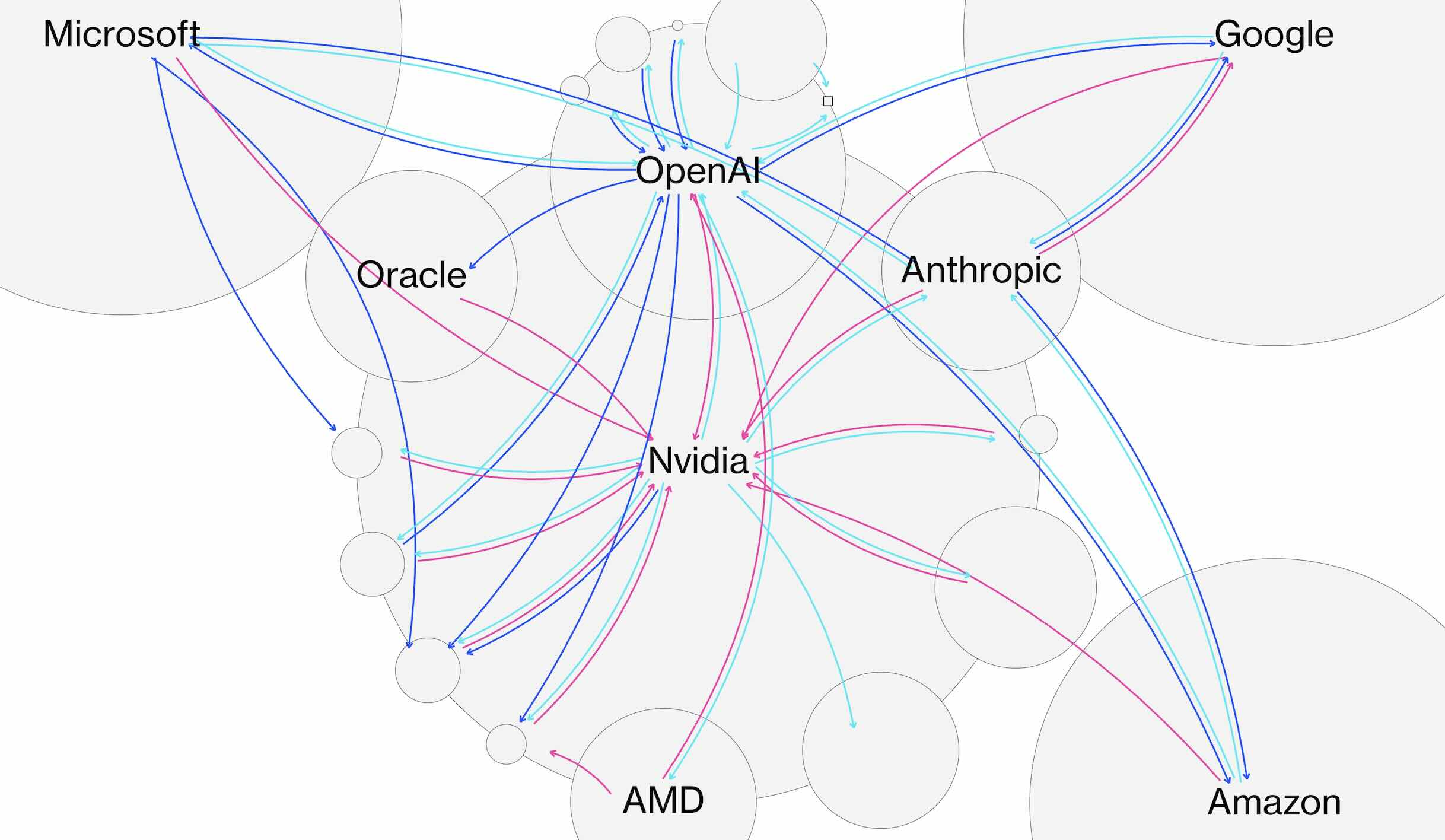
Photo: Bloomberg
The first lesson of free-market capitalism is that competition breeds excellence. Companies fight for consumers, prices fall, quality rises, and innovation flourishes. It is a beautiful story, and it is a lie.
Pure, unregulated capitalism does not produce fair competition. It produces collusion. This happens not because executives are uniquely villainous, but because the game itself makes cooperation the only rational way to win. When the rules cannot be confidently enforced—and in a global economy moving faster than any regulator, they cannot—the optimal strategy shifts from competing to coordinating. The invisible hand does not guide the market toward efficiency. It guides it toward collusion.
The Prisoner's Dilemma That Never Ends
In a one-time Prisoner's Dilemma, two players are incentivized to betray each other. Corporate competition, however, is not a single round. It is an infinitely iterated game, played quarter after quarter, year after year. In repeated games, the mathematics changes. The most successful strategy is no longer defection but tit-for-tat with a bias toward cooperation.
If Microsoft and Google spend billions trying to destroy each other through price wars and feature wars, they both bleed out. Their profit margins collapse. Their shareholders revolt. But if they implicitly agree to respect each other's market share, match each other's prices, and coordinate on regulatory standards, they both win. The pie stays whole, the profits stay predictable, and the competition becomes theater.
This is the observed behavior of nearly every consolidated industry. Airlines match each other's baggage fees within hours. Telecom providers introduce identical pricing tiers. Commercial banks move in lockstep on interest rates. No one signs a contract and no one leaves a paper trail. They simply recognize that in a poorly policed game, cooperation is the dominant strategy.
The Cost of Enforcement vs. The Value of the Prize
Game theory does not assume that rules are irrelevant. It assumes that players evaluate the expected value of breaking a rule versus the penalty multiplied by the probability of getting caught. The equation is simple:
Expected Value = Profit from Cheating − (Probability of Capture × Penalty)
In the modern corporate world, the regulatory referee is structurally outmatched. Regulators do not have the computational power to audit what proprietary algorithms are doing in closed networks. They do not have the technical expertise to prove tacit coordination between AI agents. They do not have the political will to challenge the corporations that fund their oversight committees.
And even when they do catch someone, the penalty is a rounding error. If the profit from forming a cartel is $50 billion, and the maximum fine from a weakened regulatory agency is $2 billion ten years down the road, game theory dictates that the company should collude. The fine functions as a cost of doing business, a modest licensing fee for the right to extract.
- Algorithmic price-fixing: Competitors feed private data into a single third-party platform, which generates "optimized" prices for all of them. The algorithm acts as a digital cartel. RealPage has faced massive antitrust lawsuits for exactly this in residential real estate.
- Follow-the-leader pricing: One dominant firm raises prices. Within days, every competitor matches. No communication, no conspiracy, just a shared understanding that undercutting hurts everyone.
- Institutional common ownership: BlackRock, Vanguard, and State Street are top shareholders in nearly every major competitor within a sector. Research shows that when rivals share the same powerful owners, they compete less aggressively.
- No-poach agreements: Tech giants, animation studios, and medical chains have secretly agreed not to recruit each other's employees, suppressing wages and preventing workers from leveraging a competitive job market.
The AI Industry: Collusion as a Business Model
The artificial intelligence industry has become the purest modern example of this dynamic. OpenAI, Anthropic, Google, and Microsoft are not competing in any meaningful sense. They are coordinating through capital structures, supply-chain loops, and public narratives about safety.
When OpenAI needed compute, it took $13 billion from Microsoft. The money came with a condition: OpenAI must spend it back on Microsoft's Azure cloud infrastructure. This arrangement functions as a quasi-merger, a way to swallow a competitor without triggering antitrust review. Microsoft gets its money back plus total oversight, while OpenAI gets the infrastructure it needs to survive. The independence of the startup is quietly erased.
When Microsoft could not provide enough compute, OpenAI restructured to accept billions from Amazon and Google, Microsoft's chief rivals. Now all three cloud giants have a stake in the same AI lab. They are not competing. They are forming a coalition, and they have locked down the infrastructure supply chain so thoroughly that no independent startup can compete from scratch.
Then there is safety. In September 2026, a federal antitrust lawsuit was filed against OpenAI, Anthropic, Google, and SpaceXAI. The suit alleges that after Anthropic's CEO published an essay calling for the industry to pace the frontier, Sam Altman and other tech chiefs immediately chimed in to publicly agree. The lawsuit argues that this collective brake pedal is an illegal output-restricting cartel agreement, a coordinated slowdown dressed up as public service.
By framing a coordinated slowdown as an act of global safety, they attempt to dodge the Sherman Antitrust Act. They are effectively asking governments for an antitrust waiver, using public panic to pull up the ladder on open-source competitors who cannot afford the same self-imposed delays.
The Meritocracy Myth and the Manufactured Market
The theory of fair competition assumes a level playing field with many independent actors. The reality is a heavy concentration of wealth at the top, and that concentration buys protection, sympathy, and the ability to rewrite the rules.
Huge corporations can afford massive legal teams, lobbyists, and compliance departments that allow them to shape regulations in their favor or tie up regulatory agencies in court for decades. When a dominant company breaks antitrust laws, the penalties are often just a small fine, essentially treated as a predictable cost of doing business rather than a true deterrent.
Meanwhile, the idea that the market rewards the best product or the hardest worker is a manufactured narrative. The playing field is structurally uneven. Black professionals and creators consistently have to be significantly over-qualified just to get a foot in the door, while under-qualified individuals with institutional privilege or capital backing are funneled through the system and handed opportunities. True value creation takes a back seat to exploitation. In many industries, the actual talent or workforce will never make anywhere near what the owners or shareholders make, because the system mandates maximizing profit margins by squeezing labor costs.
In the modern economy, consumer choice is heavily manipulated by platform owners. Viral success, product visibility, and market reach are rarely organic. Social media platforms and e-commerce giants use unregulated algorithms to promote what makes them money, meaning a business's success is often driven by algorithmic promotion rather than the inherent uniqueness or quality of what they are offering.
The Structural Mandate
The fundamental paradox of the free market is that true freedom allows the strongest players to take away the freedom of the market. Left alone, the natural end-state of capitalism is not a thriving ecosystem of fair competition. It is a highly coordinated corporate oligarchy.
This outcome is a fundamental feature. The system mandates that a corporation's highest fiduciary duty is to maximize shareholder value. True competition is a market failure from the corporation's perspective. Genuine competition creates uncertainty, drives down prices, and requires constant expensive innovation. Collusion, whether algorithmic or silent, is the most logical and successful business strategy for a corporation looking to guarantee predictable, maximized wealth.
The theoretical definition of fair competition acts as a cover. In practice, the economic model mandates competition for profit above all else, which naturally incentivizes companies to distort the market, eliminate actual fairness, and ensure that money and power remain concentrated at the top.
The only question is whether we continue to pretend otherwise.
No Ads. By Us. For Us.
This article was made possible by readers like you. We hope it inspired you to support Emerald Book, so we can continue producing content like this.
We will never show you ads, sell your data, or require a subscription to consume our content. Your gift helps us keep the truth accessible.
Click the Support button to give a gift of any amount today.
Thank you for making this work possible.