

Emerald Pages
◆
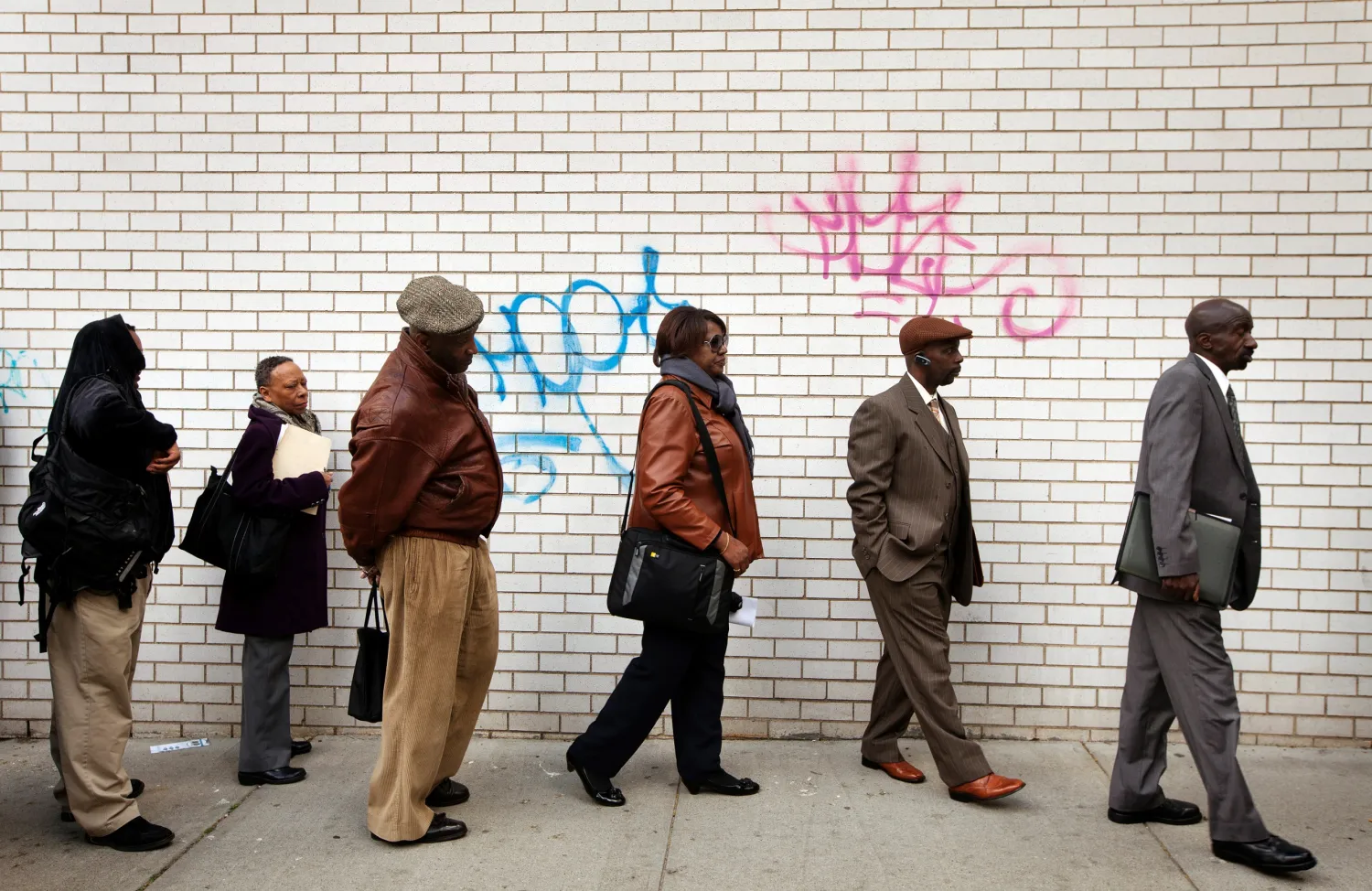
Photo: Brookings
The September 2026 jobs report delivered a number that should stop every policymaker, investor, and worker cold: Black unemployment jumped a full percentage point in a single month, rising from 6% in August to 7% in September. This represents the fastest one-month increase in Black unemployment since the initial wave of the COVID-19 pandemic in March–April 2020. Outside of that unprecedented shock, it is the largest single-month spike the demographic has experienced since 2012.
On its face, the national headline number looks relatively stable. The overall unemployment rate ticked up only slightly, from 4.1% to 4.2%. But beneath that calm surface, the labor market is fracturing along racial lines. The unemployment rate for White workers remained flat at 3.6%. Hispanic unemployment stood at 4.7%, essentially unchanged. Asian workers held the lowest rate at 2.9%. The entire national increase was attributable to the spike among Black workers.
This divergence is not random. Historically, the Black unemployment rate acts as a leading indicator—a macroeconomic "canary in the coal mine"—for the entire U.S. labor market. When the gap between Black and White unemployment suddenly widens, it has reliably preceded almost every modern U.S. recession.
The Historical Pattern: A Reliable Precursor
In a healthy, expanding economy, unemployment rates across all demographics tend to move roughly in tandem. When the gap suddenly cracks open and moves in opposite directions—with Black unemployment surging while White unemployment remains flat—it means the structural "cushion" at the bottom of the labor market has dissolved.
This pattern has played out before every major downturn of the past quarter-century. During the 2001 Dot-Com Recession, Black unemployment began creeping upward in late 2000, functioning as an early warning sign while headline national unemployment still appeared perfectly healthy. In the lead-up to the 2008 Great Recession, the gap between Black and White unemployment had narrowed during the housing boom, but when the subprime shock hit, Black workers were the first laid off. The Black unemployment rate spiked early, and by the time the recession was in full swing, the gap had accelerated violently—eventually peaking at a massive 8.5 percentage point difference.
The 2020 COVID-19 recession followed the same script. When the economy seized up in March 2020, service, hospitality, and frontline roles were eliminated instantly. Black unemployment skyrocketed to 17%, while the White rate remained significantly lower and recovered twice as fast.
A "Quiet Recession" Already Underway
What makes the September 2026 report so alarming is that it is not a sudden outlier. It is the visible breaking point of a year-long financial squeeze that researchers and advocacy organizations have been documenting for months.
The Joint Center for Political and Economic Studies and the National Urban League published assessments stating that Black Americans spent much of 2025 and 2026 experiencing a "regression and recession" long before the broader national economy felt it. The Black unemployment rate spiked heavily throughout the prior year, climbing to 7.5% in December 2025 and hitting a post-pandemic peak of 8.3%. During that entire timeframe, the national unemployment rate hovered comfortably around 4%, and White unemployment sat at roughly half the Black rate.
Applying standard macroeconomic definitions, if the national economy had experienced the same sharp upward trajectory that Black workers did, the country would have been declared in an official recession months ago.
- Black unemployment: 7.0% in September 2026, up from 6.0% in August—a full percentage point jump
- Black women: Unemployment surged to 7.3% from 5.9%, driven by a late Labor Day and seasonal adjustment failures in education jobs
- National jobs added: Only 29,000 in September—far below the expected 84,000 and the roughly 100,000–150,000 needed to keep pace with population growth
- Wage growth: Annual wage growth slipped to 3%, its lowest level since May 2021
- National unemployment: Ticked up from 4.1% to 4.2%, entirely attributable to the Black unemployment spike
What's Driving the Spike
The sudden jump in Black unemployment was caused by a combination of statistical anomalies, structural shifts in sectors employing Black workers, and broader macroeconomic cooling.
There was a significant influx of job seekers. The labor force participation rate for Black workers rose sharply, with hundreds of thousands of Black Americans re-entering the labor force to look for work. However, because hiring was incredibly slow nationwide, many of these new seekers could not immediately find open roles, mechanically causing them to be counted as "unemployed" rather than "out of the labor force."
There was a sudden drop in public education and government roles. The job losses were heavily concentrated among Black women, whose unemployment rate shot from 5.9% to 7.3%. Economists noted a massive decline in education jobs in September. Due to a late Labor Day holiday, seasonal data adjustments failed to properly capture the normal post-summer rebound in teaching and school staff positions—roles heavily staffed by Black women. Additionally, policy shifts and federal budget trims led to direct job contractions in government sectors, where Black workers historically hold a high percentage of career roles.
The broader macroeconomic slowdown played a critical role. The entire U.S. labor market cooled rapidly in September, with employers across the nation adding a weak 29,000 jobs. Ongoing friction from international trade tensions, tariff implementations, and supply chain disruptions left private businesses hesitant to expand payrolls, causing hiring freezes that disproportionately hit diverse talent pools.
The "Statistical Mirage" and the Snapping Back
To understand the full picture, it's important to recognize the tension between structural trends and statistical mirages. A few months prior to this spike, the Black unemployment rate actually appeared to drop. However, analysts quickly pointed out that this drop was a statistical mirage.
The rate didn't fall because people were finding jobs; it fell because thousands of Black workers—exhausted by job hunting in slowing sectors like transportation, logistics, and warehousing—stopped looking for work entirely. When job seekers give up, the Bureau of Labor Statistics drops them from the calculation. This artificially lowers the unemployment rate even though the employment situation is actively getting worse.
The sharp jump to 7% in September is, in many ways, the snapping back of that exact spring and summer mirage. Nearly half a million Black workers re-entered the workforce in September, driving the Labor Force Participation Rate back up. Because they actively started looking for work again, they were once again counted in the math. But because broad national hiring slowed to a crawl, the market couldn't absorb them.
The Runaway Train: AI Bubble, Rate Hikes, and the Widening Gap
The September jobs report did not emerge in a vacuum. It is the latest data point in an economy that we have described as a "runaway train with no brakes"—caught in a high-stakes collision between three massive forces.
The first force is the $3 trillion AI infrastructure debt bubble. Companies have poured billions into tech infrastructure under hidden obligations that are failing to generate immediate revenue. Estimates suggest that AI-related investments alone have been driving nearly half of all U.S. economic growth over the last year. While broad national GDP and corporate earnings look stable, it is an illusion created by a hyper-concentrated sector. The "non-AI" economy—retail, standard manufacturing, and consumer-facing services—is entirely flatlining or contracting.
The second force is the Federal Reserve's rate hikes. On September 16, 2026, the Federal Reserve—under Chair Kevin Warsh—unanimously voted to raise interest rates by a quarter-point to a target range of 3.75% to 4.00%. It was the first rate hike in over three years. The Fed raised rates because inflation is stuck at a stubborn 3.4%, driven by soaring oil prices and the massive, cash-heavy AI infrastructure buildout. Federal Reserve Governor Lisa Cook explicitly cited the AI boom as a top ongoing inflation risk.
The fallout is a Catch-22. To cool down the inflation caused by a booming tech aristocracy, the Fed is using a blunt instrument—higher interest rates—that hits everyday people hardest. This has pushed average 30-year fixed mortgages to 7.19% and driven up credit card and variable-loan debt, freezing the housing and job markets for normal consumers.
The third force is the explicitly widening wealth gap. The AI-driven stock market surge has heavily accelerated the divide between the rich and the poor. The massive gains in the S&P 500 this year are almost entirely driven by a handful of AI-adjacent tech stocks. Because the wealthiest 20% of U.S. households own roughly 90% of all stock market wealth, they feel richer and continue to spend. For everyday workers relying entirely on a paycheck, the slice of the economic pie is shrinking. Commerce Department data shows that the share of total national economic output going to worker paychecks and benefits has dropped to its lowest level in 79 years.
What This Means for the Broader Economy
When a sharp divergence like this happens, it usually signals that the broader economy is in the early stages of a significant downturn or transition. The Black unemployment rate acts as a leading indicator for the entire U.S. labor market because vulnerable worker populations are often the first to feel an economic contraction.
When companies see demand drop, they stop expanding diverse talent pipelines and freeze entry-level or junior-level hiring. Black workers are statistically overrepresented in cyclical industries like logistics, retail, and entry-level services, and often have less corporate seniority. When corporate belt-tightening begins, these positions are cut first.
Historically, a sharp spike in the Black unemployment rate precedes a wider rise in White and broad national unemployment by several months. The Black unemployment rate typically surges first and moves much faster. The broader national rate and the White unemployment rate follow later, but with a more gradual, delayed upward curve.
Additionally, because a high percentage of Black professionals—especially Black women—are employed in local, state, and federal government roles, a spike like this signals that public sector budgets are under immense strain. When government hiring freezes or contractions happen, it reflects broader fiscal tightening across the country.
The current state of the economy isn't a sudden collapse, but a profound stagnation. The spike in Black unemployment is simply the most visible break in a system that has quietly frozen over.
The massive single-month jump in September 2026 wasn't a sudden outlier—it was the visible breaking point of a year-long financial squeeze. While the headline national rate of 4.2% still looks relatively stable, the sharp friction underneath suggests that broader corporate layoffs and hiring freezes may start spilling over into the rest of the population in the coming quarters.
The canary in the coal mine is gasping for air.
No Ads. By Us. For Us.
This article was made possible by readers like you. We hope it inspired you to support Emerald Book, so we can continue producing content like this.
We will never show you ads, sell your data, or require a subscription to consume our content. Your gift helps us keep the truth accessible.
Click the Support button to give a gift of any amount today.
Thank you for making this work possible.