

Emerald Pages
◆
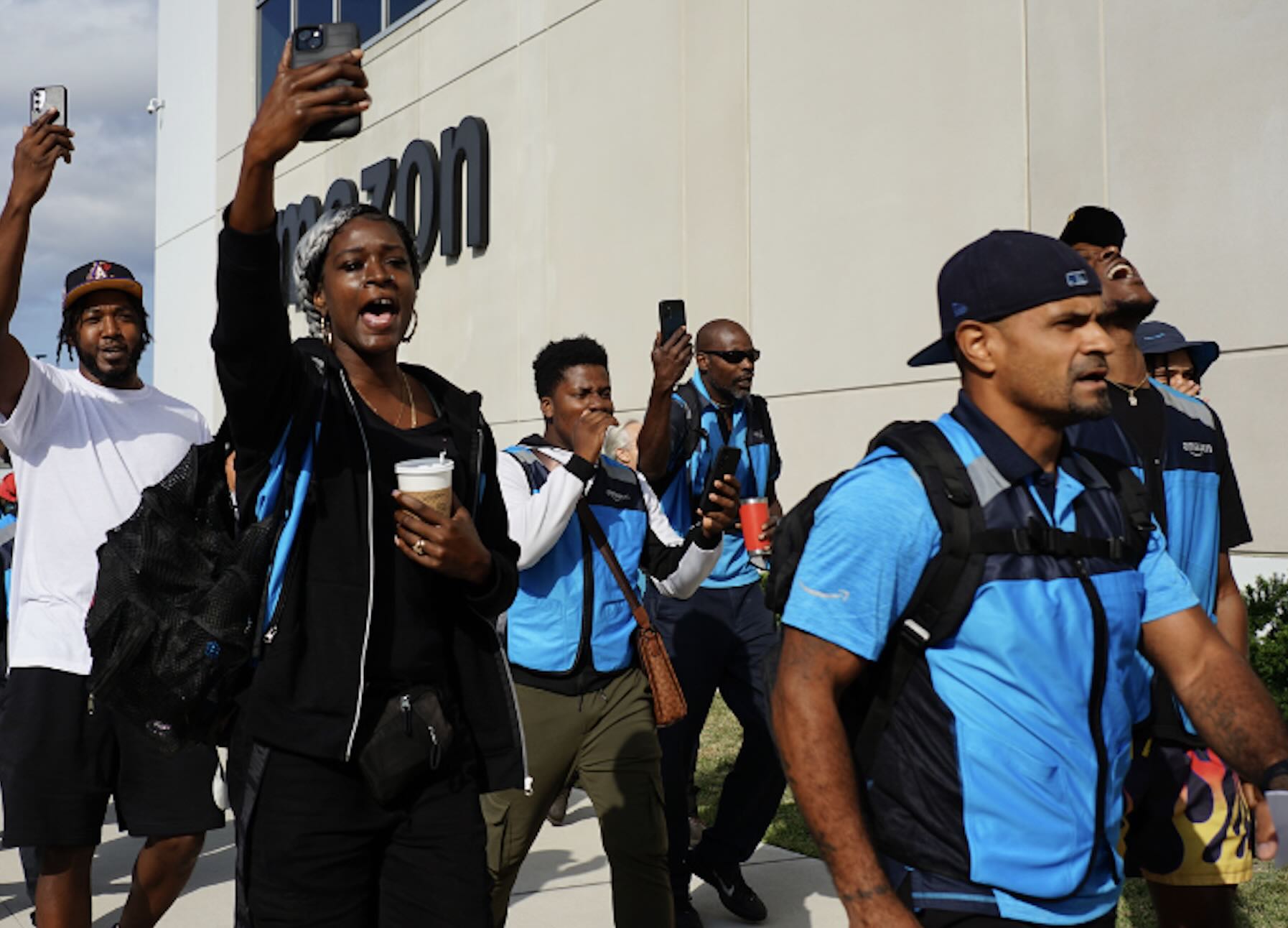
Photo: Teamsters
The modern American economy rests on a dangerous illusion: that the physical labor powering our digital convenience is infinitely replaceable. At Amazon, that illusion is especially fragile. Black employees are 26.5% of the company's U.S. workforce—but 31% of the front-line warehouse staff who pick, pack, and ship the packages keeping the machine running. If every Black Amazon worker quit at once, the company would not stumble. It would collapse within 48 hours—and permanently shatter the economic assumptions that have governed American labor for four decades.
Amazon processes roughly 10.4 million U.S. orders every day and carries almost zero inventory buffer. Packages do not sit; they move constantly. When a worker swipes out, a package stops. When 31% of the warehouse workforce vanishes at once, the system seizes. The numbers are stark: Amazon employs roughly 1.1 million people in the U.S. Black workers are about 291,500 of them, but roughly 341,000 of the front-line logistics roles—and roughly 85% of all Black Amazon employees work in fulfillment and delivery, not corporate offices. The workers who would walk out are the ones physically moving the packages.
Amazon's logistics network is a distributed, algorithmic organism that treats inventory as fluid and labor as a variable cost. It runs at maximum velocity with minimum slack. There is no cushion for losing a third of the workforce. The moment the algorithm detects that dozens of fulfillment centers have dropped to near-zero productivity, it reroutes orders to other facilities—overwhelming the ones where workers did not walk out. The cascade begins immediately.
The 48-Hour Collapse
Hours 1–12: Gridlock at the docks. Unloading trucks and stowing inventory requires massive manual labor. Within six hours, semi-trucks line up outside fulfillment centers. Within twelve, the gridlock spills onto local highways. The inbound flow of goods stops entirely.
Hours 12–24: "Next-Day" shipping disappears. Amazon's website dynamically changes based on warehouse capacity. The familiar "Get it tomorrow" badges vanish. Delivery dates slip to five to seven days. Sorting centers stall. Packages sit in bins with no one to load them onto delivery vans. The core promise of Amazon Prime evaporates overnight.
Day 2: National news and merchant panic. Over 60% of Amazon's physical sales come from third-party merchants using Fulfillment by Amazon. Millions of small businesses watch their daily sales drop to zero as inventory freezes in dark warehouses. Consumers pivot en masse to Walmart, Target, and local grocery stores, overwhelming those supply chains too. The "bullwhip" effect ripples through the entire retail sector.
Days 3–4: The financial death spiral. Institutional investors, aware that Amazon's retail engine is paralyzed and that the available U.S. labor pool is already exhausted, begin panic-selling AMZN stock. A 30% to 50% drop drags down the entire S&P 500 and Nasdaq, wiping out billions and triggering circuit breakers. The tech sell-off shatters Wall Street's valuation models for the whole sector. Capital flees to bonds and gold.
The "Labor Wall": Why Amazon Cannot Simply Replace Them
Standard economics says low-skill warehouse workers are easy to replace. At Amazon's scale, the math breaks down. The company's annual warehouse turnover rate is 150%—it fully replaces its front-line workforce every eight to ten months. Amazon treats workers as disposable, infinite, and interchangeable.
But the pool is not infinite. Leaked internal memos have warned that Amazon is already exhausting the available labor pool in major hubs like California's Inland Empire and northern New Jersey. In some regions, it has already hired and burned through a massive share of the working-age population. If 400,000 Black workers walked out, there would not be enough un-burned-out adults left in those regions to replace them. The only option would be "boomerang" hires—begging back the people who already left. But higher wages do not fix why people leave. A worker making $30 per hour will still burn out or get injured if conditions stay brutal.
- The 150% Turnover Trap: Amazon replaces its entire front-line workforce every 8–10 months. This is the operating model, not a flaw.
- The Labor Pool Exhaustion: Internal memos warn Amazon is running out of available workers in key regions.
- The Rehire Paradox: The only option is begging back burned-out former workers—who left for a reason.
- The Wage Escalation: A raise to $30+/hour adds over $20 billion in annual labor costs and wipes out retail profitability.
The $20 Billion Shock and the Market in Freefall
Amazon's retail operations survive on razor-thin margins. Its profits are driven by AWS and advertising, not package deliveries. The retail division is a volume business: it works because millions of packages move daily at a cost barely covered by revenue. A labor shock breaks the equation. A permanent wage hike to $30/hour—the company's only realistic survival strategy—would add over $20 billion in annual labor costs. Amazon's entire North American segment operating income in 2025 was $42.6 billion. Swallowing that cost would cut retail profit margins by half or more, causing investors to dump the stock.
The damage would not stop at Amazon's balance sheet. Because Amazon is one of the largest companies in the world by market cap, its collapse would drag down the S&P 500 and Nasdaq, wiping out retirement accounts and index funds across the country. The contagion would spread to other tech companies, retailers, and logistics providers. The "frictionless economy" narrative would be exposed as a fragile illusion.
The inflationary "Amazon Effect" would compound the crisis. If Amazon sets its baseline wage to $30/hour, every competitor nearby must react to avoid losing its entire staff. Walmart, Target, FedEx, UPS, and thousands of local businesses would be forced to raise wages, then pass the cost to consumers. The result: a widespread wave of inflation that erodes the purchasing power of those new wages. The pain would be felt by everyone, not just Amazon shareholders.
The Permanent Shift: The Death of the Disposable Worker
Even if Amazon stabilized weeks later, the economy would never return to its previous state. The myth of the "unskilled, easily replaceable worker" would die overnight. For decades, the labor share of income—the percentage of national output going to workers' paychecks versus corporate profits—has hit historic lows. Tech platforms treated blue-collar labor as a cheap, infinite, high-turnover resource. This collapse would forcefully reverse that trend.
By proving that a 31% labor exit can freeze a trillion-dollar company in 48 hours, front-line workers would gain massive structural leverage. The logistics and retail industry would be forced to shift from a high-churn "disposable" model to a high-retention one. Wages would permanently stabilize at a higher floor. Healthcare, safety mandates, and union contracts would become the baseline requirement to attract warehouse workers. The era of the disposable worker would be over.
Simultaneously, capital would flow into building a decentralized retail web. Right now, nearly 40% of all U.S. e-commerce runs through one company. After a multi-day freeze, brands and merchants would realize that keeping 100% of inventory in Amazon's warehouses is business suicide. Investors would refuse to fund single-distributor dependence. Competitors like Shopify, Walmart, and regional logistics networks would permanently absorb Amazon's market share. The age of the retail monopoly would be over.
The Macroeconomic Shockwave
An Amazon collapse would not be an isolated corporate failure. It would trigger a supply-chain recession within weeks. Because Amazon is nearly 40% of U.S. e-commerce, its paralysis would break consumer spending, destabilize markets, and cripple small businesses nationwide.
The fallout would unfold across four areas. First, mass bankruptcy for small businesses: hundreds of thousands of third-party merchants would have inventory locked in dark warehouses with zero revenue and fixed debts due, triggering a wave of bankruptcies within 14 to 30 days. Second, consumer inflation: with 40% of the digital marketplace offline, surviving retailers would be overwhelmed by redirected orders. Freight networks would bottleneck, shipping rates would spike, and higher prices would hit everyday goods.
Third, systemic stock market contagion: Amazon is a cornerstone of retirement funds and index funds. A 30% to 50% drop would drag down the S&P 500 and Nasdaq, shatter tech valuations, and trigger capital flight to bonds and gold. Fourth, labor whiplash: if Amazon hiked wages to $30+/hour to survive, local grocery stores, construction firms, and hospitality businesses would see their workforces evaporate overnight. Unable to match those wages, thousands would close or scale back, driving up regional unemployment outside logistics.
Structural Economic Power: The Lesson Corporate America Forgot
This scenario highlights the difference between financial power—what Wall Street and executives have—and structural economic power, which belongs to the people who physically run the world. We are taught that power belongs to billionaires, algorithms, and boards. This proves their power is conditional. It exists only as long as the people on the bottom floor show up to pick, pack, and drive.
This is what labor theorists call structural leverage. Front-line Amazon workers occupy the choke point of the modern consumer economy. Stop a factory and you stop one product. Stop a fulfillment center and you stop everything. True structural power is not about creating something new. It is the power to say "no" and watch the machine grind to a halt. Every major shift in working conditions—from the eight-hour day to the end of child labor—came because workers realized they held this leverage and used it.
The speed of the collapse is a byproduct of just-in-time logistics. Modern tech giants optimize for absolute efficiency, carrying almost zero inventory buffer. When movement stops, the illusion of the seamless digital economy disappears almost instantly. This vulnerability is not unique to Amazon. The gig economy would halt within hours if contractors logged off. Supermarkets hold about three days of food before relying on new deliveries. No matter how advanced AI and cloud computing become, the digital economy still rests on physical, manual labor.
No Ads. By Us. For Us.
This article was made possible by readers like you. We hope it inspired you to support Emerald Book, so we can continue producing content like this.
We will never show you ads, sell your data, or require a subscription to consume our content. Your gift helps us keep the truth accessible.
Click the Support button to give a gift of any amount today.
Thank you for making this work possible.