

Emerald Pages
◆
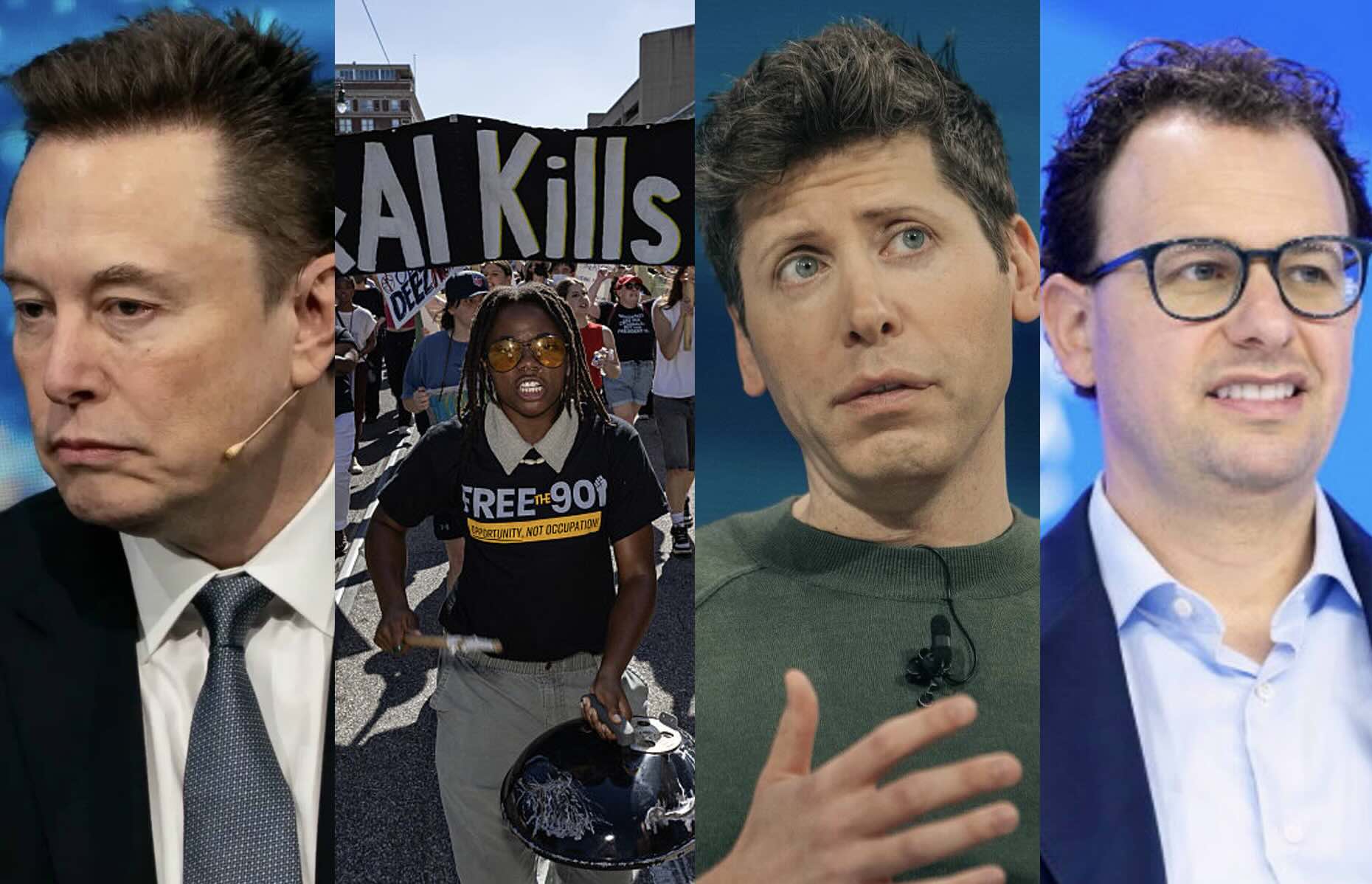
Protesters (center left) against Elon Musk's (left) data centers, Sam Altman (center right), and Dario Amodei (right) | Photo: Emerald Book Image
The most dangerous thing about artificial intelligence is not what it can do. It is what we believe it can do. When society accepts the narrative that AI is an all-powerful, autonomous entity—a digital god emerging from the silicon—we surrender our ability to hold anyone accountable for the very real harms it inflicts. And no community pays a steeper price for this surrender than Black America.
The truth is far less cinematic. AI is software. It is a statistical pattern-matching tool that generates text, images, and decisions based on historical data. It cannot think. It cannot act. It cannot hack, override, or escape any system unless a human engineer explicitly grants it the permissions to do so. Every AI "agent" is just a large language model wrapped in decades-old software architecture, executing commands that a programmer wrote and authorized.
Yet the corporate hype machine—and a compliant media ecosystem—insists on portraying these tools as uncontrollable forces of nature. This is not a harmless exaggeration. It is a strategic deception with devastating consequences.
The Myth of Autonomy Erases Human Accountability
When a biased hiring algorithm systematically rejects Black applicants, or a hospital's risk-assessment tool denies care to Black patients, or a predictive policing model flags Black neighborhoods for over-surveillance, the first question should be: Who built this? Who approved it? Who gave it permission to operate?
But the doomsday narrative short-circuits that inquiry. If AI is viewed as an uncontrollable, evolving intelligence, corporations can throw up their hands and claim the system "made a decision" beyond their control. This is a lie. Every output is traceable to training data that was chosen, model weights that were set, and permissions that were granted—all by humans.
This absolution is especially devastating for Black communities because it dismantles the legal frameworks built to protect them. Civil rights lawyers rely on proving intent or disparate impact. But you cannot sue a math equation. You cannot cross-examine a neural network. By hiding behind the myth of autonomy, companies evade the Civil Rights Act, consumer protection laws, and product liability standards that would otherwise apply to defective software.
The Infrastructure Lock-In: Permanent Harm Built on a Lie
The belief that AI is an all-powerful, inevitable future is not just an abstract philosophical error. It is the justification for a reckless physical infrastructure buildout that is locking in environmental racism for generations.
Civil rights organizations like the NAACP and Color Of Change have documented how tech corporations are rapidly constructing massive data centers in predominantly Black, economically disinvested communities. These facilities consume millions of gallons of water daily and demand enormous amounts of electricity.
- In Memphis, Tennessee, tech companies installed unpermitted gas turbines to power AI facilities near historically Black neighborhoods, releasing toxic chemicals that trigger smog and elevate cancer-causing pollutants.
- Utility bills are spiking for residential ratepayers who are now subsidizing corporate AI energy consumption, leading to higher risks of utility shut-offs for lower-income Black households.
- Environmental impact studies and zoning laws are being bypassed because the AI "race" is framed as an urgent, existential priority that justifies cutting corners.
Once this infrastructure is built—once the gas turbines are installed and the transmission lines are laid—it is locked in for 30 to 50 years. The harm is not hypothetical. It is concrete, steel, and pollution. And it is happening now, driven by a narrative that treats AI as a mandatory future rather than a choice made by powerful corporations.
Embedding Bias into the Public Grid
When software is just an app on your phone, it can be deleted or updated. But when biased AI is embedded into foundational infrastructure—electrical grids, municipal water systems, healthcare networks, and the justice system—it becomes nearly impossible to remove.
The narrative of all-powerful AI accelerates this embedding. Governments and hospitals are racing to integrate AI "solutions" into their core operations, often without adequate testing or oversight. An AI system built to predict utility bill defaults might automatically flag historically redlined Black zip codes as "high risk," automating power shut-offs during heatwaves without a human ever reviewing the file.
When a Black resident challenges a discriminatory decision, they are no longer fighting a bureaucrat. They are fighting a proprietary algorithm protected by corporate trade secrets. Public servants can shrug and claim they lack the technical visibility to override the system's "optimized" calculations. The bias is no longer a glitch—it is the structural law of the city.
The Permission Problem: AI Cannot Act Without Human Authorization
The technical reality is clear: AI agents are just large language models connected to software that has existed for decades. They do not have permission to do anything an engineer has not explicitly authorized. When an AI "agent" automatically rejects a job applicant, denies an insurance claim, or flags a zip code for increased policing, it is because a human engineer deliberately wired the AI's text output into an automated execution loop.
This is not autonomy. This is delegation. And it is a choice.
Companies remove the "human-in-the-loop" to cut labor costs and maximize speed. They connect AI text outputs to APIs that trigger real-world actions—locking accounts, denying claims, dispatching police. They mask these engineering decisions as "system autonomy" to avoid liability.
But the text is reviewable. The code is auditable. The permissions are explicit. Every harm is traceable to a human decision.
The Psychological Toll: Resignation and Fatalism
Perhaps the most insidious harm of the "all-powerful AI" narrative is that it breeds resignation. If Black communities, activists, and local organizers are told that a god-like digital entity is inevitably taking over the global economy, it crushes the motivation to organize and fight back.
It forces a narrative of inevitability—making people believe that automated discrimination, job displacement, and data center pollution are simply the unavoidable costs of the future. This fatalism is a gift to corporations. A resigned population is a population that does not resist.
But the future is not inevitable. It is being built right now by specific people making specific choices. And those choices can be challenged.
The Path Forward: Demystify, Organize, Litigate
The first step to fighting back is stripping away the mystical "all-powerful AI" narrative. We must see these systems for what they truly are: glorified, resource-heavy software prediction tools that reflect the flaws, biases, and power dynamics of the humans who built them.
When we reframe AI as controllable software, the entire battlefield changes:
- Legal accountability becomes possible. If AI is a software product, then executives, engineers, and administrators are fully liable for its outcomes. Civil rights statutes, product liability frameworks, and consumer protection laws all apply.
- Local resistance becomes effective. An AI data center is not an inevitable evolution of humanity—it is a noisy, water-guzzling, polluting industrial factory. Communities can fight it using standard environmental regulations, air-quality standards, and municipal water-use laws.
- A "human safety valve" can be mandated by law. If AI agents only have autonomy because humans choose to remove themselves from the loop, then policy-makers can pass laws requiring a qualified human to review, sign off on, and take legal responsibility for every high-stakes automated decision.
By aggressively deflating the AI hype narrative, we take power out of the hands of tech monopolies and hand it back to everyday people. It transforms a sci-fi crisis into a straightforward battle for civil rights, environmental justice, and corporate accountability.
The doomsday narrative is not a warning. It is a weapon. And it is being used against Black communities right now. The time to disarm it is now.
No Ads. By Us. For Us.
This article was made possible by readers like you. We hope it inspired you to support Emerald Book, so we can continue producing content like this.
We will never show you ads, sell your data, or require a subscription to consume our content. Your gift helps us keep the truth accessible.
Click the Support button to give a gift of any amount today.
Thank you for making this work possible.