

Emerald Pages
◆
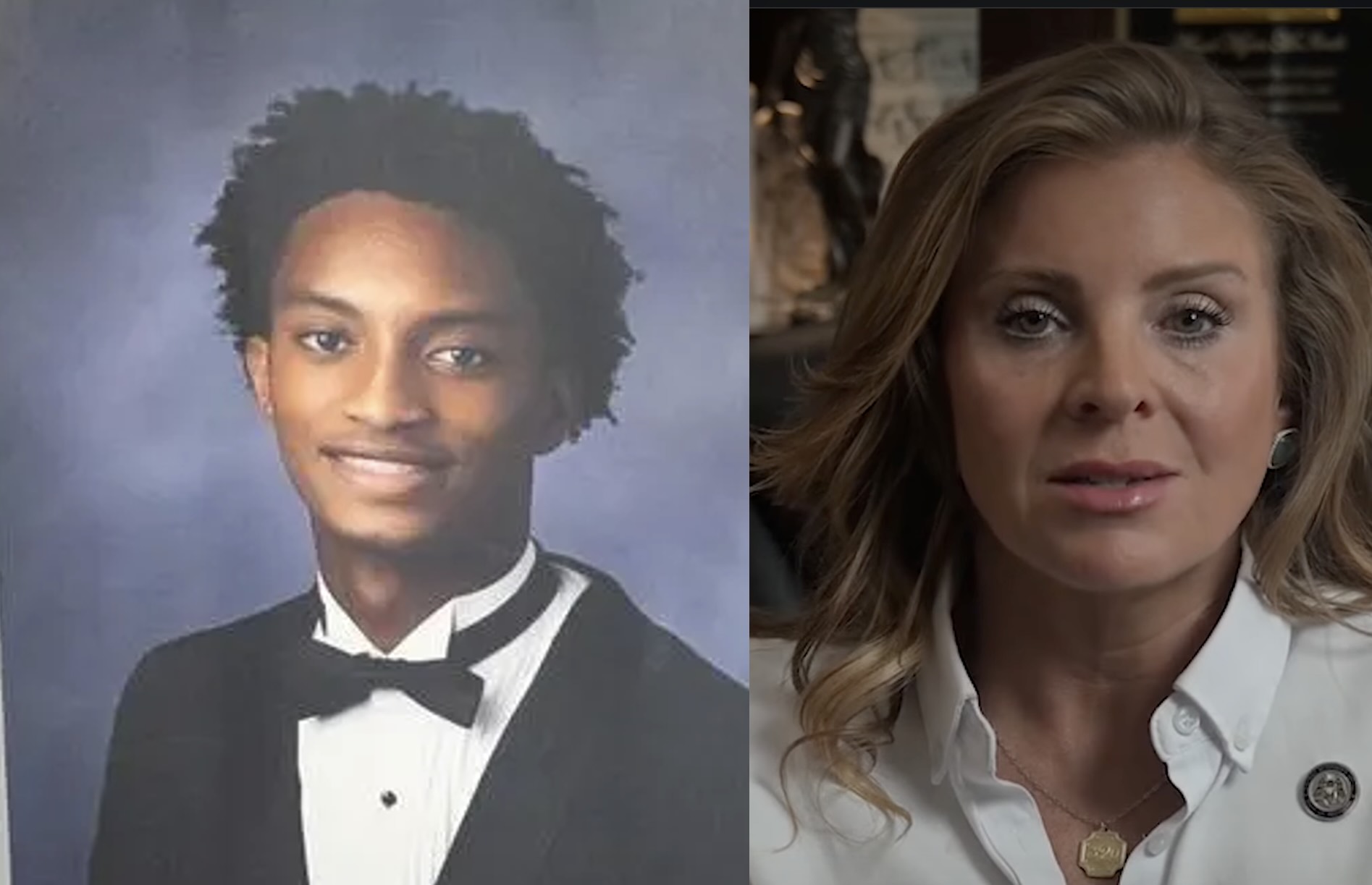
Nolan Wells (left) and Mississippi District Attorney Angel Myers McIlrath (right) Photo: WDSU6 | Instagram | Getty Images
When a healthy 18-year-old Black teenager is found dead on a Mississippi island with bruises on the back of his head, no water in his lungs, and his phone data deleted on the day he vanished, the public expects one thing: a prosecution. When that prosecution never comes—despite a grand jury hearing from 43 witnesses and reviewing over 100 subpoenas—the public is left with a single, searing question: Why?
The answer, when examined through the cold lens of formal logic, game theory, and mathematical probability, is not that the evidence was insufficient. The answer is that the system was never designed to produce an indictment in a case like this. What follows is not an emotional argument. It is a mathematical one.
The Logical Structure: When Every Premise Points to One Conclusion
Formal logic operates on a simple principle: if the premises are true and the reasoning is valid, the conclusion must follow. In the Nolan Wells case, the evidentiary premises form a chain that admits only one rational conclusion.
- Premise 1: Nolan Wells was last seen alive on a boat with his friends on July 4, 2026. His phone remained on that boat until at least 2:18 p.m., the last time he actively used it.
- Premise 2: Friends claimed Wells stayed behind on Horn Island to speak with a girl. GPS data from his phone shows the device never left the boat. An unconscious or incapacitated person cannot carry a phone ashore.
- Premise 3: The state autopsy and the independent autopsy both documented two distinct contusions on the back of Wells' head. These injuries are consistent with blunt force trauma, not with a simple fall into water.
- Premise 4: Wells' lungs, throat, and stomach contained no water. In a conscious drowning, the body's survival instinct forces the inhalation of water. A dry lung is consistent with unconsciousness prior to submersion or with a laryngospasm—but it is not consistent with the narrative that Wells simply slipped, swam, and drowned.
- Premise 5: Data was deleted from Wells' phone on the exact day he disappeared. Deletion requires intent, a hand, and access. Someone on that boat manipulated the digital record.
- Premise 6: The grand jury never saw this digital evidence. The forensic extraction revealing the phone's location and the deleted Snapchat files was publicly released on September 24, 2026—six days after the grand jury issued its "No True Bill" on September 18.
Conclusion: If the premises are true, the only rational inference is that Wells was incapacitated by a blow to the head, placed in the water while unconscious, and that the individuals present engaged in a coordinated effort to obscure the timeline through data deletion. This is not a drowning. This is a homicide masked as an accident.
The Game Theory: Why the District Attorney's Optimal Strategy Was Never to Prosecute
Game theory assumes that actors are rational and seek to maximize their own outcomes. For a District Attorney, the outcomes that matter are conviction rates, institutional credibility, political capital, and budgetary efficiency. When we model the Nolan Wells case as a strategic game, the DA's decision not to aggressively pursue an indictment was her most mathematically optimal move.
The Players and Their Strategies
- The Friends on the Boat: Primary motivation is avoiding criminal liability. Their dominant strategy is to maintain a unified narrative and cooperate with local police. Outcome: No indictments; case closed locally.
- The District Attorney: Primary motivation is minimizing risk and protecting conviction metrics. The dominant strategy is to present the case without pushing for an indictment to the grand jury and defer the decision. Outcome: Political liability shifted to the grand jury; no losing trial.
- The Family / Ben Crump: Primary motivation is forcing federal intervention. The dominant strategy is to release alarming evidence publicly and lobby the DOJ. Outcome: Case remains alive in court of public opinion; federal review pending.
The DA's Risk Calculus: A Bayesian Probability Matrix
To understand why the DA chose not to prosecute, we must calculate the probability of conviction if the case had gone to trial. This requires a Bayesian estimate using the actual data available for Mississippi's justice system.
Mississippi does not publish a standalone, statewide jury conviction rate specifically for homicide trials. The standard Bureau of Justice Statistics (BJS) national benchmark for murder trials sits at approximately 70%. While a 70% baseline means prosecutors generally win more often when they take a murder case to a jury, the specific weaknesses in this case dramatically erode that advantage.
- Base Probability (P): 70% (0.70)
- Base Odds = 0.70 / (1 − 0.70) = 0.70 / 0.30 = 2.333
A likelihood ratio (LR) tells us how much a factor multiplies the odds of conviction. An LR below 1 reduces the probability. The following estimates are analytical judgments based on standard prosecutorial experience, not empirical measurements:
- Autopsy says "Undetermined" (LR: 0.40): Juries want a clear cause of death. An undetermined ruling creates reasonable doubt about whether a crime even occurred.
- No eyewitness to a crime (LR: 0.50): The case is entirely circumstantial. No one saw a fight, an assault, or a body being placed in the water.
- Witnesses unified and cooperative (LR: 0.60): There is no one to flip, no inconsistent story to exploit, and no weak link in the chain of testimony.
- Head injuries ruled non-fatal (LR: 0.70): The medical examiner testified the bruises were subcutaneous and did not cause death, undermining the "knocked unconscious" theory.
- Digital evidence not presented to grand jury (LR: 0.80): The phone data can still be used at trial, but the defense will attack its chain of custody and its late introduction.
- No water in lungs (LR: 0.90): This factor cuts both ways—it supports the defense theory of dry drowning just as easily as it supports foul play.
Combined LR = 0.40 × 0.50 × 0.60 × 0.70 × 0.80 × 0.90 = 0.06048
Adjusted Odds = Base Odds × Combined LR = 2.333 × 0.06048 = 0.14110
P = Odds / (1 + Odds) = 0.14110 / 1.14110 = 0.124
The calculated probability of conviction if this case had gone to trial is approximately 12.4%—roughly a 1-in-8 chance.
While a 70% baseline means prosecutors generally win when they take a murder case to a jury, the structural erosion from a highly ambiguous autopsy, a lack of eyewitnesses, and missing technical evidence drops the real-world odds of securing a guilty verdict to single digits. Under the framework of expected utility, the DA's optimal move was never to prosecute—it was to present the case without pushing for an indictment, let the grand jury decline, and avoid a trial that could not be won.
How Robust Is This Conclusion?
The 12.4% figure is not a precise prediction—it is a structured estimate. Every likelihood ratio is an assumed value, and different assumptions produce different results. If we run the same calculation with more optimistic or more pessimistic assumptions, the range of outcomes becomes clear:
- Optimistic scenario (LRs: 0.7, 0.8, 0.9, 0.9, 0.95, 0.95): Combined LR = 0.409; P(Conviction) = 48.8%
- Moderate scenario (LRs: 0.5, 0.6, 0.7, 0.8, 0.85, 0.9): Combined LR = 0.129; P(Conviction) = 23.1%
- Pessimistic scenario (LRs: 0.4, 0.5, 0.6, 0.7, 0.8, 0.9): Combined LR = 0.060; P(Conviction) = 12.4%
- Very pessimistic scenario (LRs: 0.3, 0.4, 0.5, 0.6, 0.7, 0.8): Combined LR = 0.020; P(Conviction) = 4.5%
Even under the most optimistic assumptions—where the autopsy is only mildly damaging, the lack of eyewitnesses is only somewhat problematic, and the unified witnesses are only a modest obstacle—the probability of conviction never exceeds 50%. Under realistic assumptions, it falls below 25%. And under the pessimistic assumptions that reflect the actual state of the evidence in this case, it falls to roughly 12%.
This is the mathematical reason the DA did not want to prosecute. It is not that the evidence was insufficient for an indictment—it clearly was sufficient. It is that the evidence was insufficient for a conviction. And in the American justice system, the decision to prosecute is driven not by whether a crime might have occurred, but by whether a conviction can be secured.
The Nash Equilibrium: Why No Player Has an Incentive to Change
A Nash Equilibrium occurs when no player can improve their outcome by unilaterally changing their strategy. The Nolan Wells case is currently locked in exactly such an equilibrium.
The friends on the boat have no incentive to change their story—they have already avoided indictment, and speaking now would only expose them to new legal jeopardy. The District Attorney has no incentive to reopen the case—doing so would require admitting that the initial presentation was inadequate and would expose her office to a politically charged trial with a low probability of conviction. The family has no incentive to stop fighting—they have already lost in the local system, and their only remaining path is federal intervention.
The result is a stable, self-reinforcing stalemate. The only way to break a Nash Equilibrium is for an outside player to enter the game with new rules and new penalties. In this case, that outside player is the U.S. Department of Justice, but they have shown no interest in the case.
The Statistical Anomaly: Why 43 Witnesses and 100 Subpoenas Prove the Point
In a typical grand jury proceeding, a prosecutor calls one or two investigators, presents the core evidence, and secures an indictment in less than an hour. The standard is probable cause—a low bar. As the legal adage goes, a skilled prosecutor can convince a grand jury to "indict a ham sandwich."
In the Nolan Wells case, the District Attorney called 43 witnesses and issued over 100 subpoenas. This is not the behavior of a prosecutor seeking an indictment. This is the behavior of a prosecutor seeking to build a record of thoroughness while simultaneously burying the signal in noise.
Mathematically, increasing the number of witnesses and data points in a secret proceeding increases the variance of the evidence presented. When 43 people testify, the grand jury hears 43 different perspectives, 43 different memories, and 43 different potential inconsistencies. The probability of a unified, clear narrative emerging from such a proceeding approaches zero.
The DA did not overwhelm the grand jury by accident. She did it by design. The statistical signature of this proceeding—its length, its witness count, its neutral framing—all point to a single conclusion: the outcome was engineered.
The Evidence Out of Sync: Why the Grand Jury Never Had a Chance
The most damning evidence in the Nolan Wells case—the GPS data showing his phone never left the boat, and the forensic proof that Snapchat messages were deleted on the day he disappeared—was not presented to the grand jury. It was released to the public on September 24, 2026, six days after the grand jury had already adjourned.
This timing is not a coincidence. It is a structural feature of how the local investigation was managed. The grand jury can only evaluate the evidence placed in front of it. By the time the most compelling digital evidence emerged, the legal door had already been closed.
The District Attorney has since stated that if the new data proves a crime occurred, her office is willing to review it. But this is a procedural deflection. The burden is now on the family to force a new proceeding, a new grand jury, and a new legal battle—all while the local system has already declared the case closed.
The Mathematical Verdict: A System Optimized for Inaction
When we apply formal logic, game theory, and probability theory to the Nolan Wells case, the conclusion is unavoidable. The evidence points to one conclusion: Wells was killed, and his death was covered up. The District Attorney's actions—the neutral framing, the overwhelming witness list, the timing of the digital evidence—all point to one strategy: avoiding a prosecution.
This is not a story of incompetence. It is a story of incentives. The local justice system is designed to process clear-cut crimes efficiently. When faced with a complex case involving ambiguous medical evidence, coordinated witnesses, and a politically charged racial dimension, the system's incentive is to find the path of least resistance.
The path of least resistance was a grand jury that heard everything and decided nothing. The path of least resistance was an "Undetermined" autopsy that provided legal cover for inaction. The path of least resistance was a case that remains open in the court of public opinion but closed in the halls of justice.
The mathematics are clear. The logic is sound. The game theory is conclusive. The District Attorney did not want to prosecute Nolan Wells' case. And the system was built to let her get away with it.
The only remaining question is whether the federal government will change the game.
No Ads. By Us. For Us.
This article was made possible by readers like you. We hope it inspired you to support Emerald Book, so we can continue producing content like this.
We will never show you ads, sell your data, or require a subscription to consume our content. Your gift helps us keep the truth accessible.
Click the Support button to give a gift of any amount today.
Thank you for making this work possible.