

Emerald Pages
◆
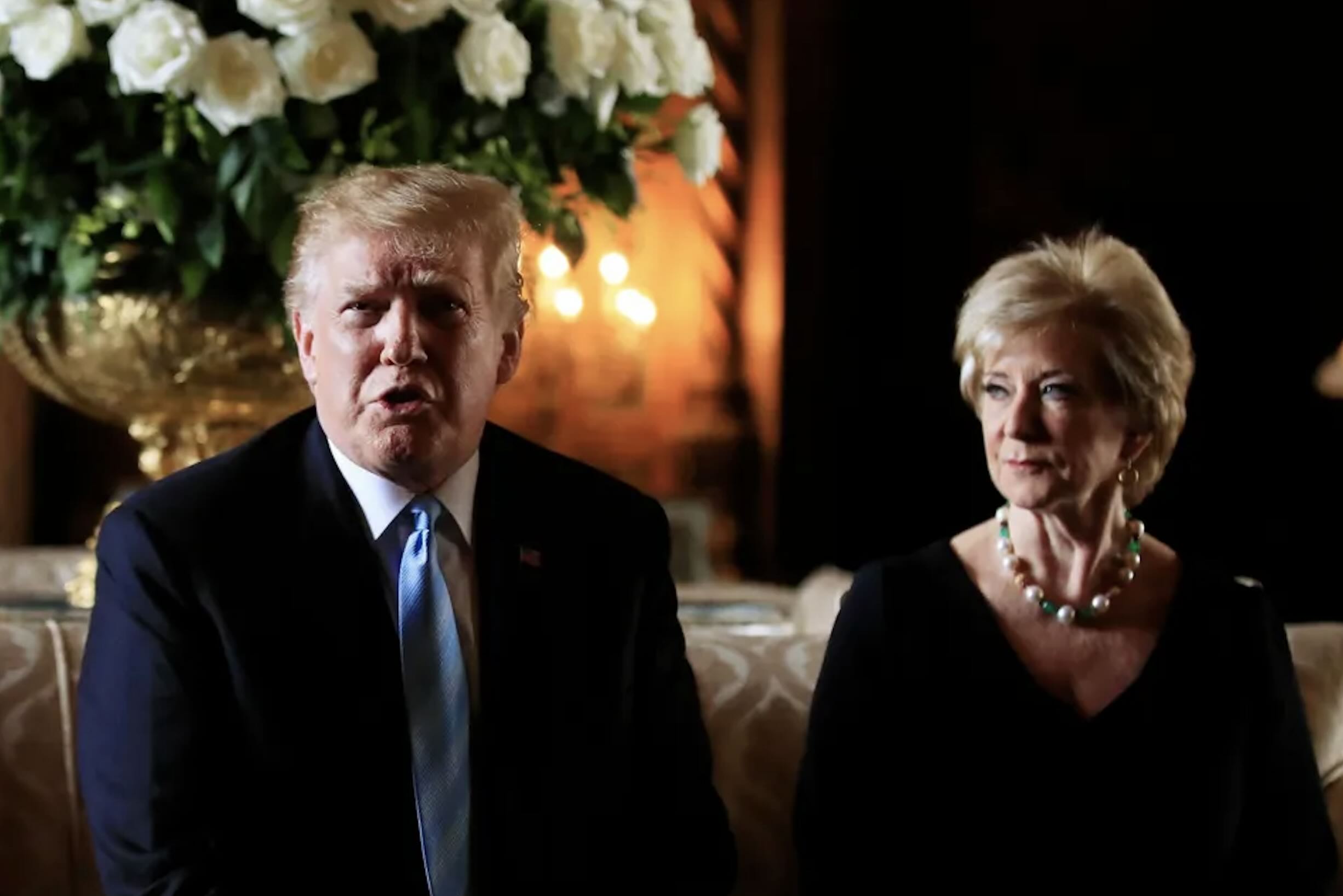
President Donald Trump (right) and Secretary of Education Linda McMahon (left) | Photo: AP Photo
When U.S. Secretary of Education Linda McMahon took the stage at the White House Initiative on HBCUs Summit on September 22, 2026, she had a number to share: $174 million. It was, by any measure, a significant sum—a one-time supplemental allocation to the nation's 100-plus Historically Black Colleges and Universities. The announcement was met with press releases, celebratory statements, and headlines in Black news outlets across the country.
The United Negro College Fund welcomed the investment. The Thurgood Marshall College Fund lauded the administration. The HBCU Campaign Fund thanked the Department of Education. Capital B News framed it as a "funding boost." AfroTech amplified the story of modernization and private-sector partnerships. In the ecosystem of Black higher education advocacy, this was a win.
But a win against what?
The same week the $174 million was announced, a quieter set of numbers sat in federal reports and academic journals, largely unmentioned in the celebratory press releases. According to a U.S. Department of Education investigation, 16 states have collectively shortchanged their land-grant HBCUs by $12.6 billion between 1992 and 2020—money they were legally required to provide under the Second Morrill Act of 1890. According to the Government Accountability Office, the nation's HBCUs face a $4.8 billion backlog in deferred maintenance—crumbling dorms, outdated labs, failing HVAC systems, and roofs that have been patched for decades.
Add those two figures together: $17.4 billion. That is the structural deficit facing HBCUs—the gap created by decades of state-level underfunding and federal neglect. And against that number, the $174 million supplemental allocation represents exactly 1.00% of the total.
The Math of a Crisis
To understand why a $174 million allocation is simultaneously celebrated and dismissed, you have to understand the math that HBCU presidents and advocacy groups live with every day.
The $174 million is not a standalone grant. It is a mandatory supplemental mechanism added on top of the $406 million baseline Congress already approved for fiscal year 2026. Combined, the total federal pool for HBCUs this year is $580 million. Even if you count every dollar of that total—the baseline plus the supplement—the federal government is still only addressing 3.33% of the $17.4 billion structural deficit.
Because there are roughly 100 active HBCUs, the $174 million supplement averages out to about $1.5 million to $1.8 million per campus. Larger state institutions like Alabama State University and Alabama A&M received around $2.8 million each. Smaller private colleges like Talladega College received about $1.5 million. Mid-sized private institutions like Tuskegee University received approximately $1.76 million.
- Total structural deficit: $17.4 billion ($12.6B state underfunding + $4.8B infrastructure backlog)
- FY2026 federal allocation: $580 million ($406M baseline + $174M supplement)
- Percentage of deficit covered: 3.33% of the total structural gap
- Average per-campus supplement: ~$1.5M to $1.8M
For HBCU presidents, those millions are not abstract. They are the difference between fixing a failing roof and closing a dormitory. They are emergency financial aid that keeps low-income students enrolled when they fall short by $1,000. They are payroll patches that prevent furloughs. At Talladega College, which operates on an annual budget of roughly $34 million, a $1.5 million infusion boosts the entire annual operating capacity by about 4.5% in a single day.
The Deficit That Government Created
The reason those millions matter so much is precisely because of how the government has managed—and mismanaged—HBCU funding for generations.
Under the Second Morrill Act of 1890, states that established a second, Black land-grant university were legally required to provide equitable, matching state funds to both their white and Black institutions. In practice, many states heavily funded their predominantly white institutions while failing to provide the legally required matching funds to HBCUs. According to federal investigations, 16 states shortchanged their land-grant HBCUs by a collective $12.6 billion between 1992 and 2020 alone. Tennessee State University alone was shortchanged by an estimated $2.1 billion.
That state-level underfunding created a domino effect that now defines the HBCU financial crisis. Because states starved these campuses of capital for nearly a century, HBCUs could not build the endowments that wealthy white institutions accumulated. Non-HBCU endowments are 70% larger per student than HBCU endowments—and at private institutions, the gap is even wider. The average private non-HBCU endowment is $184,409 per student. The average private HBCU endowment is $24,989. Non-HBCUs are 7.4 times larger.
Because they lack endowment wealth or reliable state subsidies, HBCUs are forced to rely almost entirely on student tuition. When enrollment fluctuates even slightly, they plunge into operating deficits. And because they lack the cash reserves to perform basic upkeep, a roof that isn't fixed because of a budget cut in 1995 becomes a mold infestation that destroys an entire building by 2025.
The $4.8 billion deferred maintenance backlog did not appear overnight. It grew exponentially because schools did not have the money to maintain their facilities.
Less Than Harvard, Combined
The disparity becomes even starker when you compare HBCU funding to the federal research dollars that flow to elite institutions.
Harvard University alone receives between $600 million and $680 million annually in direct federal funding, primarily through research grants from the National Institutes of Health, the National Science Foundation, and other agencies. In some years, federal research funding for Harvard alone exceeds the total federal research dollars allocated to all 100-plus HBCUs combined.
The entire HBCU system collectively receives less than $1 billion in federal research dollars across all campuses. In many years, the total research and development funding for all HBCUs sits closer to $400 million. One Ivy League institution brings in more research capital than the entire historical Black college ecosystem.
This discrepancy persists because federal research dollars are awarded based on an institution's existing infrastructure. Because historic state underfunding starved HBCUs of the money needed to build advanced medical centers, high-tech labs, and massive grant-writing teams, they lack the institutional capacity to compete for federal agency contracts. Meanwhile, wealthy institutions use their resources to secure more federal money—creating a cycle where federal dollars flow away from the schools that need them most.
The Mathematical Reality
This mathematical reality is why the response to the $174 million announcement is always deeply split between two different perspectives.
University presidents and advocacy groups like the UNCF celebrate because they have a mandate to keep their doors open this semester. To a president struggling to patch a leaky dorm roof or clear student tuition balances today, a $2 million check is real, immediate help. They cannot afford to turn down available cash while waiting for structural reform.
Celebrating these small infusions allows the government to claim credit for "historic funding" while evading its multi-billion-dollar legal obligations. But a 1% patch is not a structural fix—it is a mechanism that keeps these institutions perpetually dependent on short-term federal charity rather than achieving true financial independence.
The administration, for its part, frames the allocation as "historic" and "unprecedented." The Department of Education notes that the $174 million is "in addition to" the $406 million baseline Congress approved. Combined with a similar move last year, the administration has injected a total of $612 million in supplemental money above what Congress originally budgeted.
But $612 million in supplemental funds, spread over two years across 100 campuses, still amounts to roughly $3 million per campus per year. Against a $17.4 billion structural deficit, that is a rounding error.
The Cost of Celebration
The risk of celebrating a 1% solution is that it allows the government to declare victory over a problem it caused—and continues to perpetuate.
When Black news organizations and institutional advocates celebrate the $174 million, they are operating under a harsh reality: they are accepting a temporary band-aid because they need to survive today, even though they know the government is the entity that caused the wound. A $2 million infusion keeps a college open for the semester, but it does not let the government off the hook for the billions it legally owes the institution.
The crisis facing HBCUs is not a crisis of temporary cash flow. It is a crisis of structural, multigenerational underfunding. It is the result of state governments failing to meet their legal obligations, of federal research dollars bypassing Black institutions, and of a funding model that rewards wealth rather than need.
Until the government addresses the $17.4 billion structural deficit—not with one-time supplements, not with 1% patches, but with the full, legally required funding—HBCUs will remain in a state of perpetual financial precarity. And Black news organizations will continue to celebrate pennies, because the alternative is to watch the doors close.
No Ads. By Us. For Us.
This article was made possible by readers like you. We hope it inspired you to support Emerald Book, so we can continue producing content like this.
We will never show you ads, sell your data, or require a subscription to consume our content. Your gift helps us keep the truth accessible.
Click the Support button to give a gift of any amount today.
Thank you for making this work possible.