

Emerald Pages
◆
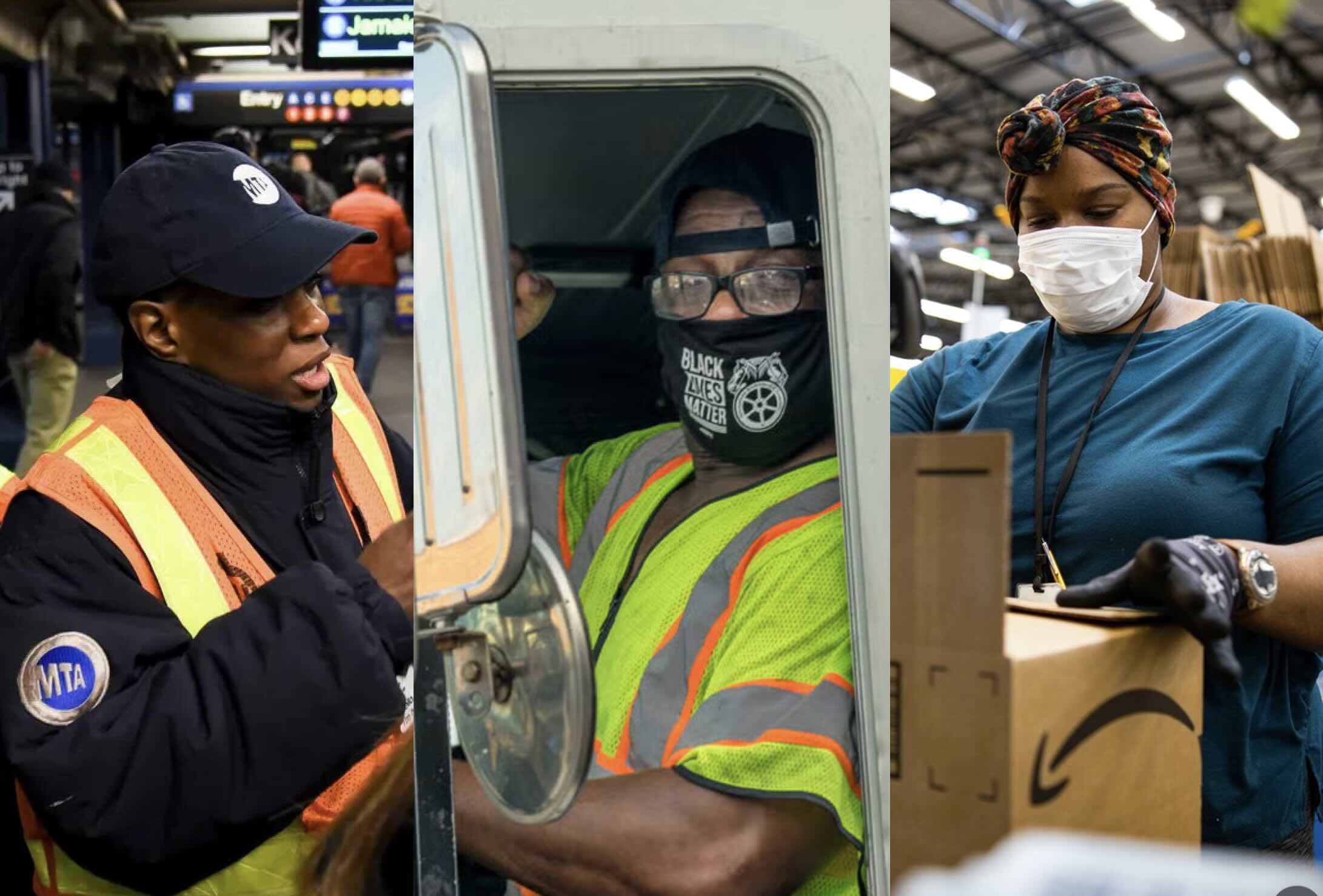
Black transit worker (left), sanitation worker (center), warehouse worker (right) | Photo: Emerald Book Image
Political power is the ability to influence, control, or direct the actions of a government. Economic power, by contrast, is the ability to control the allocation of scarce resources and the behavior of markets. But there is a third, more potent force that sits at the intersection of both: structural power. This is the power not of wealth, but of leverage—the ability to halt the physical systems upon which all other wealth depends. In the United States, this power is disproportionately held by Black workers. While Black Americans make up roughly 13% of the U.S. workforce, they are heavily overrepresented in the essential infrastructure roles that keep the physical economy moving. This concentration is not a coincidence of history; it is a structural choke point that gives Black labor an immense, and often unacknowledged, lever over the American economy.
To understand why this is true, one must first distinguish between earnings and leverage. On a pure wealth metric, these workers are often undercompensated relative to the value they generate. However, they possess an incredible amount of structural economic power because they control the physical flow of the nation. If software engineers go on strike, an app goes down. If transit, warehouse, and sanitation workers go on strike, the entire physical supply chain freezes, cities fill with waste, grocery stores cannot restock, and other workers cannot physically get to their jobs.
This dynamic completely upends the traditional view of economic power. While the white-dominated financial sector controls the flow of digital capital, it is a disproportionately Black labor force that controls the flow of physical reality. Sociologists refer to this phenomenon as a strategic choke point. If you look at the architecture of the American economy, it resembles an upside-down pyramid. At the top sits financial and executive power, holding the vast majority of the country's wealth and income. They make decisions in boardrooms, but their decisions are entirely theoretical without physical execution. At the choke point sits the structural labor power, composed heavily of Black and brown workers who staff the literal foundations—transit, sanitation, logistics, and supply chain hubs. Because of this structure, the wealthy elite are entirely dependent on the very demographic they have historically marginalized.
The Data Behind the Leverage
This concentration is backed up directly by data from the U.S. Bureau of Labor Statistics. Black workers account for 36.6% of transit and intercity bus drivers nationwide. In major municipal transit hubs, that number frequently exceeds 40%. Black workers make up over 40% of postal service clerks and are heavily concentrated in e-commerce fulfillment and trucking. Black men are disproportionately employed in production, transportation, and material-moving occupations compared to any other demographic. Today, Black workers continue to maintain the highest union membership rate of any major racial group in the U.S. at 11.4%, utilizing collective bargaining to turn their essential positions into measurable economic and workplace leverage.
- Transit: 36.6% of all transit and intercity bus drivers are Black, rising to over 40% in major cities.
- Logistics: Over 40% of postal service clerks are Black, with heavy concentration in e-commerce fulfillment.
- Material Moving: Black men are disproportionately employed in production, transportation, and material-moving occupations.
- Union Density: Black workers have the highest union membership rate of any major racial group in the U.S. at 11.4%.
The Timeline of a Total Infrastructure Halt
To understand why the country would cease to function if this workforce stopped, one can look at what happens hour-by-hour. On Day 1, public transit stops. Millions of workers—including nurses, retail workers, and utility employees—cannot get to work. Commuter highways are jammed. Medical supplies, groceries, and packages sit stranded at regional warehouses and postal hubs. By Day 3, grocery store shelves go empty because trucks aren't moving and distribution centers are locked down. Hospitals begin running out of basic medical linens and single-use supplies. Trash piles up on city streets, presenting an immediate public health and pest crisis. By Day 7, without sanitation and transit, major metropolitan areas become completely unlivable. Manufacturing halts because parts aren't being moved from warehouses to factories. The financial markets panic, and the government is forced to declare a state of national emergency.
Why Replacing This Workforce Is Impossible
When corporate executives or politicians face a strike, their historical playbook is to bring in replacement workers. But when it comes to the nation’s fundamental physical infrastructure, trying to replace the workforce is an untenable problem for three massive reasons. First, there is the issue of scale and the skills gap. You cannot simply hire hundreds of thousands of people off the street to drive city buses, operate commercial sanitation trucks, or safely navigate multi-ton forklifts in a fulfillment center. These jobs require specialized licensing, rigorous safety certifications, and specific spatial skills. With the U.S. already facing a severe structural shortage of logistics and transportation workers, there is no backup army of qualified labor waiting in the wings. Second, there is geographic inseparability. If a tech company dislikes its unionized workforce, they can threaten to outsource the jobs to another state or country. You cannot outsource the physical infrastructure of America. The labor must happen precisely where the infrastructure exists. The workers hold the ultimate home-court advantage. Third, there is the power of solidarity. Because infrastructure sectors are heavily unionized, trying to replace one group of workers triggers a massive chain reaction. If a city tries to hire replacement workers to break a transit strike, unionized sanitation workers and truck drivers will often refuse to cross the picket lines out of solidarity.
The Historical Fear of Black Structural Power
The American political and economic establishment has long been deeply aware of this latent power, which is why so much effort has been spent trying to suppress it. When Black workers organize collectively, they are not just asking for a raise; they are demonstrating that they can pause the empire. This is why the civil rights movement shifted so heavily toward labor in its later years. When Dr. Martin Luther King Jr. launched the Poor People's Campaign and stood with striking sanitation workers, he was moving away from simply asking for legal rights and moving toward activating structural economic leverage. He realized that the American government could ignore protests, but it could not ignore the total shutdown of its major cities. Historically, when a national strike threatens the core survival of the state, governments do not simply negotiate; they deploy immense coercive power. During the 1894 Pullman Strike or the 1970 Postal Strike, the U.S. government deployed the military and the National Guard to physically run logistics and break the shutdown.
The Modern Battleground
Today, this structural power is the invisible backdrop to major economic shifts. When we see massive corporate pushes for automation, algorithmic scheduling, and anti-union lobbying in warehouses and transit systems, it isn't just about corporate efficiency. It is an active, ongoing effort by the financial class to break the structural choke point that Black and working-class Americans naturally hold. The system's primary defense is to ensure that perfect solidarity never happens. The entire architecture of modern labor law, corporate management, and political power is designed to disrupt that perfection by exploiting fractures in solidarity, cutting off resources, or using legal and physical interventions. Laws like the Taft-Hartley Act of 1947 explicitly illegalize sympathy strikes, preventing one union from striking in solidarity with another. This law is specifically designed to keep labor actions localized and prevent a chain reaction from scaling into a national shutdown. Corporations also intentionally ensure that union contracts expire at completely different times, fracturing contract timelines across different months and years so management only ever has to fight one localized fire at a time.
However, while a national lever is structurally unstoppable if activated, the system's defenses are constantly being tested. Because of the rise of just-in-time supply chains, companies no longer keep months of inventory sitting in backrooms; they rely on items moving constantly through transit networks. This means that even a highly localized strike at a single massive geographic choke point—such as the Port of Los Angeles or a primary FedEx air hub—effectively acts as a national lever. If one major hub freezes, the ripple effect triggers a national supply chain crisis within 48 hours, forcing the federal government to intervene immediately to protect the economy. This is why, historically, when these specific infrastructure workforces threaten to walk out, the federal government almost always steps in immediately to force a resolution. They don't intervene because they want to; they intervene because they know the alternative is a complete, unfixable freeze of American society.
Ultimately, holding structural power means holding the keys to the engine room of American society. In a theoretical scenario where all external conditions are perfect—where solidarity is absolute, mutual aid networks are flawless, and government coercion is entirely resisted—this form of coordinated structural leverage would hold total, absolute power over the U.S. economy. The physical baseline of the country cannot function without the workers who drive its buses, haul its freight, and collect its waste. If that workforce ever unified and halted in perfect concert, the political and financial elite, stripped of their leverage, would be forced to capitulate to virtually any demand—including reparations—simply to ensure their own survival. Power, in its purest form, is not about who holds the most money or the highest office. It is about who can stop the machine. And the people who keep the machine running are the ones who hold the ultimate key.
No Ads. By Us. For Us.
This article was made possible by readers like you. We hope it inspired you to support Emerald Book, so we can continue producing content like this.
We will never show you ads, sell your data, or require a subscription to consume our content. Your gift helps us keep the truth accessible.
Click the Support button to give a gift of any amount today.
Thank you for making this work possible.