

Emerald Pages
◆
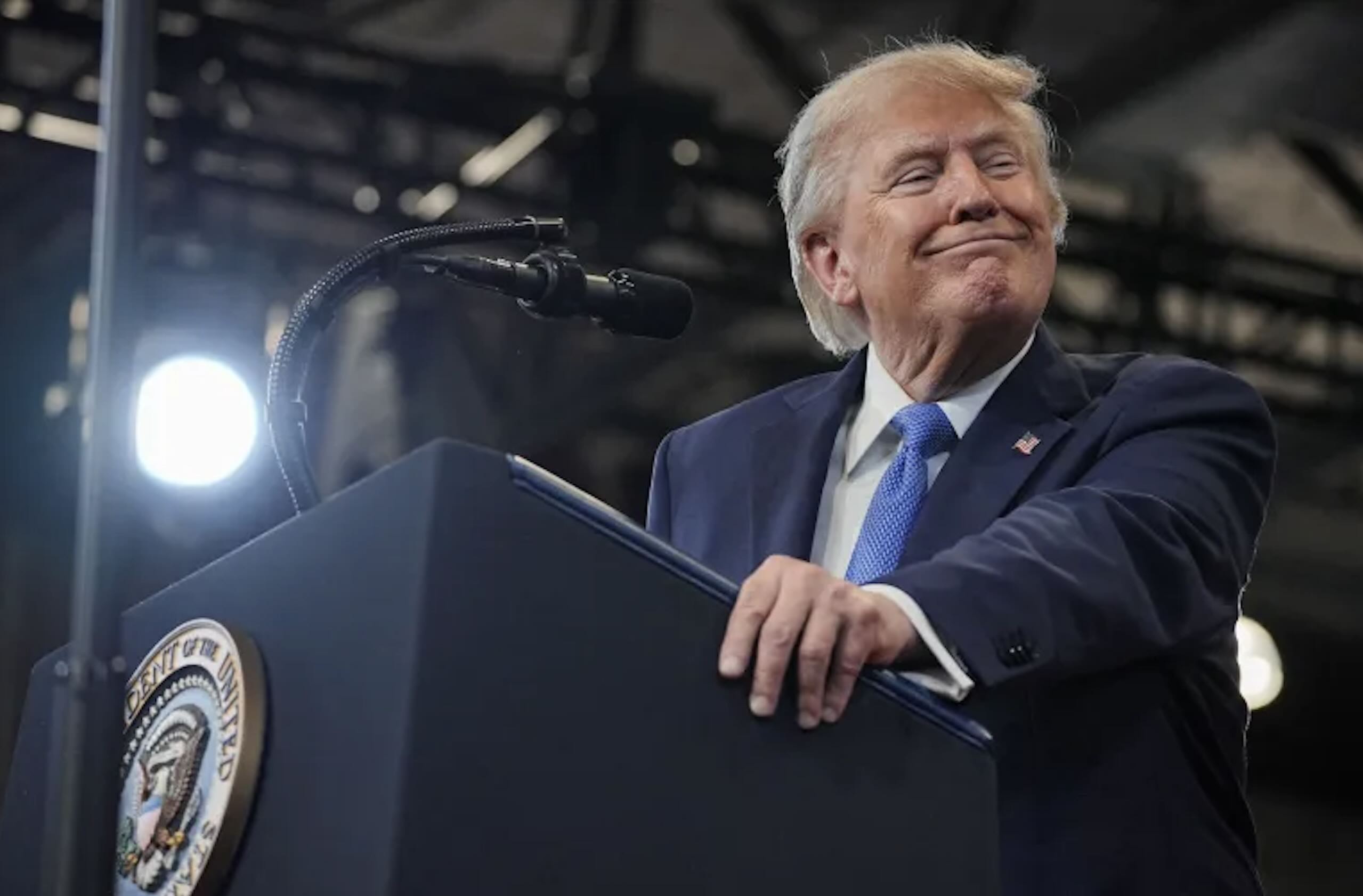
Photo: Reuters
As the U.S. war with Iran enters its seventh month, a stark financial divide has emerged between the Commander-in-Chief's family and the American public. While U.S. Ambassador Mike Waltz confirmed this week that there is "no timeline" for the war's end, an exhaustive investigation by The Washington Post has revealed that defense technology companies backed by Donald Trump Jr. and Eric Trump have secured at least $3.2 billion in federal contracts, loans, and awards since the conflict began on February 28, 2026.
The figure represents the total value of government business flowing to 15 defense startups—including Anduril, SpaceX, and drone interceptor manufacturer Powerus—where the President's adult sons hold significant equity stakes through their venture capital firms, 1789 Capital and American Ventures. An additional $3.1 billion in future contract options are already on the books, meaning the family-linked revenue pipeline could easily double as the war continues.
The scale of the wartime windfall stands in sharp contrast to the economic pain being felt by ordinary Americans. According to the U.S. Congress Joint Economic Committee, the average American household has been forced to spend over $3,800 more on basic goods and services due to war-driven inflation. Brent crude remains volatile as the Strait of Hormuz stays disrupted, with diesel prices hitting record highs of up to $8 a gallon in some parts of the country. The Congressional Budget Office reports the conflict has already cost taxpayers $38 billion—a figure that grows by $3 billion every month.
The arrangement has prompted formal demands for oversight from Democratic lawmakers, who filed a request in July 2026 urging the Department of Defense Inspector General to open an independent corruption investigation into the billions flowing to companies tied to the Trump brothers. When pressed by Congress on how it monitors these family ties, the Pentagon admitted that its conflict-of-interest screening only covers the personal financial disclosures of its own low-level procurement employees. It has no automatic legal mechanism to block an award simply because the President's adult children own a stake in the winning corporation.
From Oil Stocks to Drone Contracts: The Two-Track Profit Machine
The family's war-related financial gains operate on two distinct tracks. The first is the President's personal portfolio. According to financial disclosures analyzed by CNBC and the Joint Economic Committee, Trump's nine largest oil and gas holdings—including ExxonMobil and Chevron—gained between $1.5 million and $4.4 million as energy prices spiked following the outbreak of hostilities. The Joint Economic Committee's minority staff estimated his total personal oil and gas windfall at up to $15.5 million.
The second, far larger track flows through corporate entities managed by his sons. The most prominent example is Powerus, a military contractor set to be taken public by Eric Trump and Donald Trump Jr. that secured a U.S. Air Force contract worth up to $90 million to supply drone interceptors. Meanwhile, Donald Trump Jr.'s firm, 1789 Capital, holds stakes in Anduril, which secured a $2 billion drone interceptor deal with Kuwait, and SpaceX, which provides satellite guidance for U.S. drones.
Jared Kushner, the President's son-in-law and former senior advisor, has also actively used his role as an Iran envoy to raise billions for his private equity fund from Persian Gulf governments involved in the broader geopolitical alignment. The intertwining of official diplomatic duties with private fundraising has raised additional ethical concerns among watchdog groups, who note that Kushner's dual role creates an unprecedented overlap between U.S. foreign policy and personal financial interests.
- $3.2 billion — Total federal contracts, loans, and awards to 15 defense companies backed by Trump's sons
- $3.1 billion — Additional future contract options already on the books
- $15.5 million — Estimated personal oil and gas stock windfall for Donald Trump
- $90 million — U.S. Air Force contract awarded to Powerus for drone interceptors
- $2 billion — Kuwait drone interceptor deal secured by Anduril, a 1789 Capital portfolio company
- $3,800 — Additional amount the average American household has spent due to war-driven inflation
- $38 billion — Total taxpayer cost of the Iran war to date, growing by $3 billion per month
The Legal Loophole That Makes It All Possible
None of this violates current federal law—a fact that ethics experts describe as a systemic failure rather than an accident. Under Title 18, Section 208 of the U.S. Code, executive branch employees are prohibited from participating in matters that affect their personal financial interests. But the statute explicitly exempts the President and Vice President. When Congress wrote the law in 1978, it reasoned that a president's decisions touch every sector of the economy, and strict conflict rules could theoretically freeze them from governing during a national emergency.
The STOCK Act of 2012 does apply to the President and makes insider trading illegal if a politician uses non-public, classified information to make stock market trades. But proving a trade relied on classified information rather than public geopolitical tension is extraordinarily difficult. The Trump Organization's use of automated, third-party institutional managers provides an additional legal shield, allowing the President to claim he neither ordered nor knew about specific trades. As long as the trades can be attributed to a computer algorithm responding to publicly available news about Middle East tensions, prosecutors face an almost insurmountable burden of proof.
The result is a system that is "structurally complicit" in permitting presidential profit from wartime policy. Unlike Jimmy Carter, who sold his peanut farm, or Barack Obama, who used a blind trust, Trump has faced no legal requirement to divest. The Foreign Emoluments Clause remains the only constitutional check, but courts have historically been hesitant to enforce it without proof of an explicit quid-pro-quo bribe from a foreign official. The legal definition of an "emolument" remains narrow and fiercely debated, and no court has ever penalized a sitting president under the clause.
A Timeline of Policy and Profit
The intersection of Trump's official wartime decisions and his family's financial gains reveals how policy moves translated almost instantly into wealth throughout 2026. On February 27–28, President Trump ordered Operation Epic Fury, launching massive joint U.S.-Israeli airstrikes against Iran. The conflict immediately shut down commercial traffic in the Strait of Hormuz, causing global oil and gas prices to spike dramatically. By March, as energy prices rocketed upward, Trump's personal multi-million dollar energy portfolio surged in value.
On April 7–8, the U.S. and Iran agreed to a temporary, two-week ceasefire. Ethics disclosures later revealed that one of Trump's institutional accounts sold up to $1 million in ExxonMobil stock just hours before the public announcement, narrowly avoiding a sharp decline in energy stock value the next morning when the market reacted to the peace talks. The timing of the trade—executed by an automated manager, according to the Trump Organization—raised eyebrows among ethics watchdogs, though no formal investigation has been opened into that specific transaction.
By July 2026, the structural normalization of presidential revenue expanded further. Trump signed legislation promoting stablecoins just four months after his family launched its own crypto venture, while the overall revenue for his commercial ecosystem scaled past $2 billion for his first full year back in office. By August and September, as the war entered its seventh month, family-linked private equity firms like 1789 Capital leveraged ties to defense giants like Anduril, securing a $2 billion contract with Kuwait, while their venture Powerus advanced a $90 million Air Force contract for drone interceptors.
The Human Cost at Home
While the President's family business ecosystem captures billions in wartime revenue, American families are absorbing the economic shock of the conflict. The Joint Economic Committee noted that households in states like New Mexico have spent an average of $666 more on gasoline since the conflict began. The broader economic shock of the Middle East conflict has driven up the cost of food, electricity, and basic household goods, right as the Labor Department reported a sharp acceleration in inflation.
Congressional critics frequently point out that the billions of taxpayer dollars spent conducting military operations could otherwise fund critical domestic programs, including healthcare, childcare, housing, and infrastructure. The opportunity cost of the war—measured not just in dollars but in domestic priorities deferred—has become a central theme of Democratic messaging ahead of the 2026 midterm elections.
The White House and the Trump brothers have dismissed the criticism. Corporate spokespeople emphasize that the contracts are awarded through standard, competitive merit-based processes, and that the military urgently needs American-made counter-drone technology due to active combat requirements. A spokesperson for Donald Trump Jr. stated that he acts as a "passive investor" with an indirect holding and plays no role in the day-to-day operations or the active procurement of U.S. government contracts.
Why Nothing Is Being Done
Despite formal requests for investigations and mounting public outrage, three structural barriers prevent watchdogs from halting the contracts or freezing the stock portfolios. The first is the partisan shield in Congress. To pass a new law forcing the president to divest his assets, or to initiate an impeachment inquiry over conflicts of interest, requires a unified Congress. Because the legislature is deeply polarized, the president's political allies view these investigations as partisan attacks rather than neutral ethical oversight.
The second barrier is the legal armor of private equity. The Trump brothers did not build drone factories themselves; they invested in private equity funds that bought stakes in defense tech startups. Because private equity operates behind layers of corporate shell companies, venture funds, and passive investment clauses, it is incredibly difficult for a court to prove that a specific policy decision was made expressly to enrich a family member. Legally, the system treats it as a standard market reaction to a geopolitical crisis.
The third barrier is the Justice Department's chain of command. Under the U.S. Constitution, the Department of Justice and federal prosecutors ultimately report to the Executive Branch—meaning the President is their boss. While independent special counsels can be appointed, a long-standing DOJ policy dictates that a sitting president cannot be criminally indicted while in office. This means criminal courts cannot intervene; the only constitutional remedy for presidential misconduct is impeachment by Congress.
Beyond the legal mechanics, there is a cultural element to why this persists. Because Donald Trump's entire political brand has been openly intertwined with his private business empire since 2016, his supporters view these financial entanglements as a sign of business acumen rather than corruption. With new headlines breaking daily regarding the active war, the public faces "outrage fatigue," making it difficult for ethics scandals to gain the sustained public momentum required to force a political breaking point.
The Long Game of Institutional Reform
Historically, major anti-corruption laws in the United States are almost never passed during a crisis; they are passed immediately after the crisis ends. The Watergate example is instructive: in the 1970s, many felt there was "nothing anyone could do" about President Nixon's abuse of power. But after he left office, a wave of outrage led Congress to pass the Ethics in Government Act of 1978, which created the modern financial disclosure system we rely on today to even know these trades are happening.
The current war-profit controversy is exposing massive, undeniable holes in the 1978 law. While it feels like the current administration is untouchable, this exposure creates the legal and political blueprints for the next Congress to permanently close the presidential conflict-of-interest loophole. Watchdog groups and state attorneys general are already using the courts to file civil lawsuits, forcing the Trump Organization, 1789 Capital, and Powerus to turn over internal emails, texts, and financial records through the legal discovery process.
Exposing those documents to the public often forces a political breaking point. The ultimate check, however, remains the voters. The U.S. Constitution was designed under the assumption that if a president acts corruptly and Congress refuses to impeach them, the ultimate jury is the American electorate. Voters have the power to flip control of Congress to a party that will aggressively investigate, or vote the president out of office entirely.
As the war grinds on with no end in sight, and as American families continue to absorb the economic shock, the contrast between the President's family revenue and household hardship is fueling what legal scholars call one of the most intense constitutional debates of the decade. Whether that debate produces meaningful reform—or simply becomes another chapter in the long history of presidential conflicts of interest—remains an open question.
No Ads. By Us. For Us.
This article was made possible by readers like you. We hope it inspired you to support Emerald Book, so we can continue producing content like this.
We will never show you ads, sell your data, or require a subscription to consume our content. Your gift helps us keep the truth accessible.
Click the Support button to give a gift of any amount today.
Thank you for making this work possible.