

Emerald Pages
◆
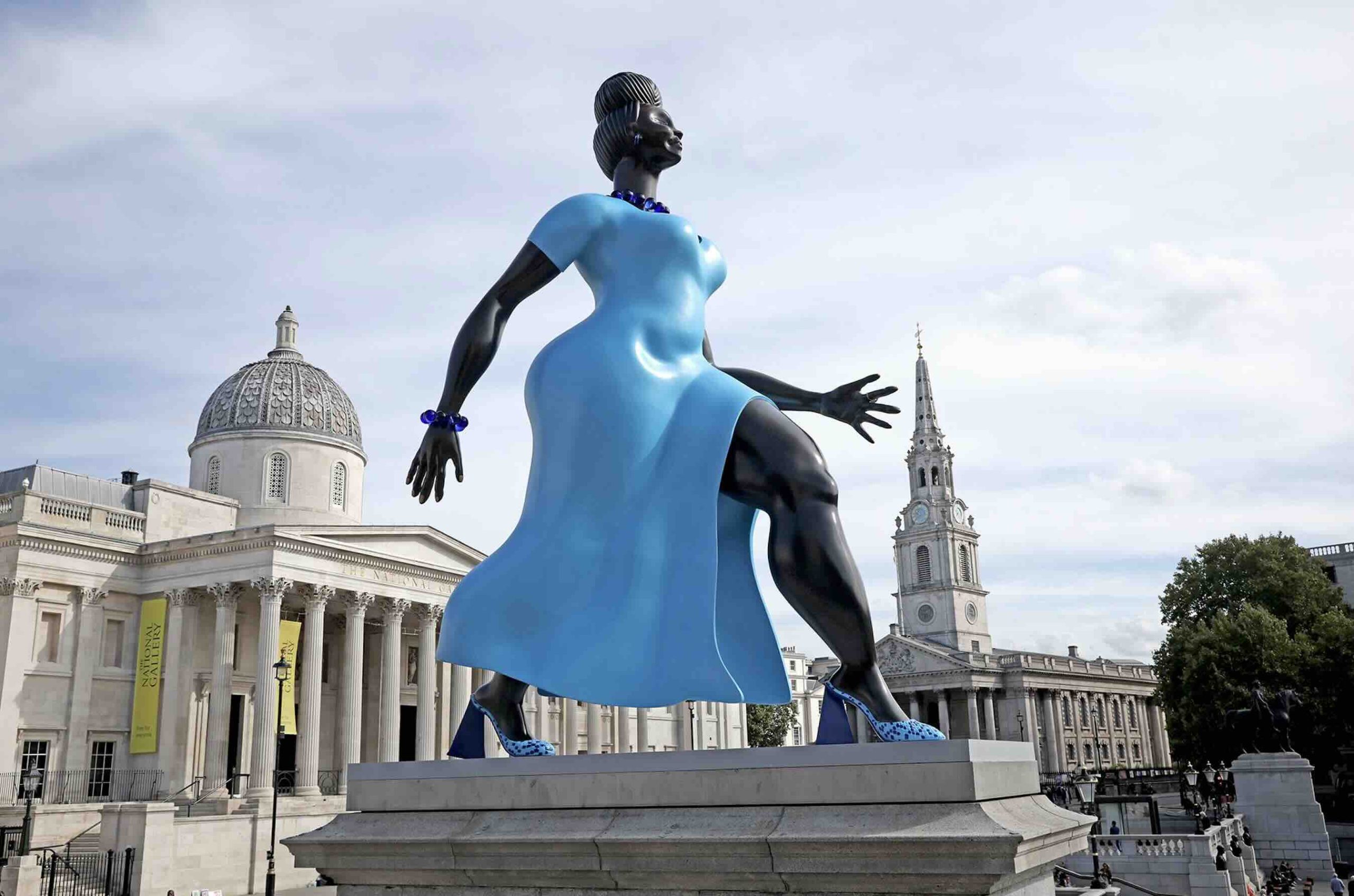
Photo: Getty Images
On September 10, 2026, a five-meter-tall painted bronze sculpture was unveiled in the heart of London. Standing atop the historic Fourth Plinth in Trafalgar Square, Lady in Blue by Harlem-born artist Tschabalala Self is the 16th contemporary artwork commissioned for the site, where it will remain on public display until September 2028. From the moment of its reveal, the sculpture has sparked intense public debate—and that is precisely the point.
The sculpture does not exist in a vacuum. It was designed specifically for that exact spot, and its entire impact relies on the friction between the statue and its surroundings. Bright, glinting blue against drab, weathered grey stone. Fluid, dynamic movement against rigid, formal stillness. An anonymous, living woman occupying the same level of prestige as famous, dead icons. The contrast is the art.
The figure is captured mid-stride, leaning forward into a fast walk. Self designed her this way to signify ambition, purpose, and staving off stasis. The walk symbolizes moving forward into a collective, optimistic future. But the pose is also a deliberate spatial intervention: the statue exploits the geography of the long rectangular plinth, built in 1841 for an equestrian statue that was never completed, to highlight a strong, walking gait that commands the square.
The Symbolism of Lapis Lazuli
The material choices carry similar weight. The deep, glinting blue finish of the dress and jewelry is custom-patinated using refined pigments derived from lapis lazuli, a semi-precious stone historically used by Renaissance masters to create the most expensive and sacred ultramarine blues—a color traditionally reserved in Western art for holy figures like the Virgin Mary.
Applying this pigment to an "ordinary" metropolitan woman gives her ultimate value, sanctity, and respect. The dress itself—form-fitting, with a dramatic thigh-high slit, paired with matching high heels and heavy glass-beaded jewelry—is a costume of confidence and celebration, a stark contrast to the drab, dark bronze military uniforms surrounding her in Trafalgar Square.
Subverting the Traditional Monument
London's Trafalgar Square is dominated by 19th-century statues glorifying male military generals and monarchs, most notably Nelson's Column. Self explicitly stated that Lady in Blue is "not an idol to venerate or a historic figurehead to commemorate." By elevating an ordinary contemporary Black woman onto the historic Fourth Plinth, the artwork challenges who society deems worthy of public space and remembrance.
- Bright Blue vs. Drab Grey: A vibrant, shimmering lapis lazuli figure sitting directly against the grey, weathered stone architecture of historic London.
- Fluid Movement vs. Rigid Stillness: A woman captured in a dynamic, heavily stylized stride next to stiff, formal 19th-century military generals standing rigidly at attention.
- Anonymous Living Person vs. Famous Dead Icons: A contemporary, fictional "everywoman" occupying the same level of prestige as actual historical kings and conquerors.
Out of roughly 1,500 statues in London, only a tiny handful represent women of color. The sculpture gives structural visibility to a demographic that has historically been left out of public monuments. London is a deeply multicultural, global city—with over 1.1 million Black residents and roughly 46.2% of the population identifying as Asian, Black, Mixed, or another minority ethnic group—and the statue reflects the living, breathing population walking through the square today rather than people from the 19th century.
An Ode to Forward Movement
Self designed the character as a "metropolitan everywoman" and a reflection of a modern Londoner. Crucially, she stated that while the artwork physically centers a Black woman, its message is meant to be universal. Ultimately, the choice challenges the long-standing artistic norm that a white male figure can represent "all of humanity," while arguing that a Black female figure is equally capable of symbolizing universal human values like ambition, optimism, and moving forward into the future.
If you placed this statue inside a modern art museum, it would just be another colorful sculpture. By putting it in Trafalgar Square, the contrast becomes the art itself. It forces everyone who looks at it to mentally compare the past with the present—and to reckon with who belongs in public space.
No Ads. By Us. For Us.
This article was made possible by readers like you. We hope it inspired you to support Emerald Book, so we can continue producing content like this.
We will never show you ads, sell your data, or require a subscription to consume our content. Your gift helps us keep the truth accessible.
Click the Support button to give a gift of any amount today.
Thank you for making this work possible.