

Emerald Pages
◆
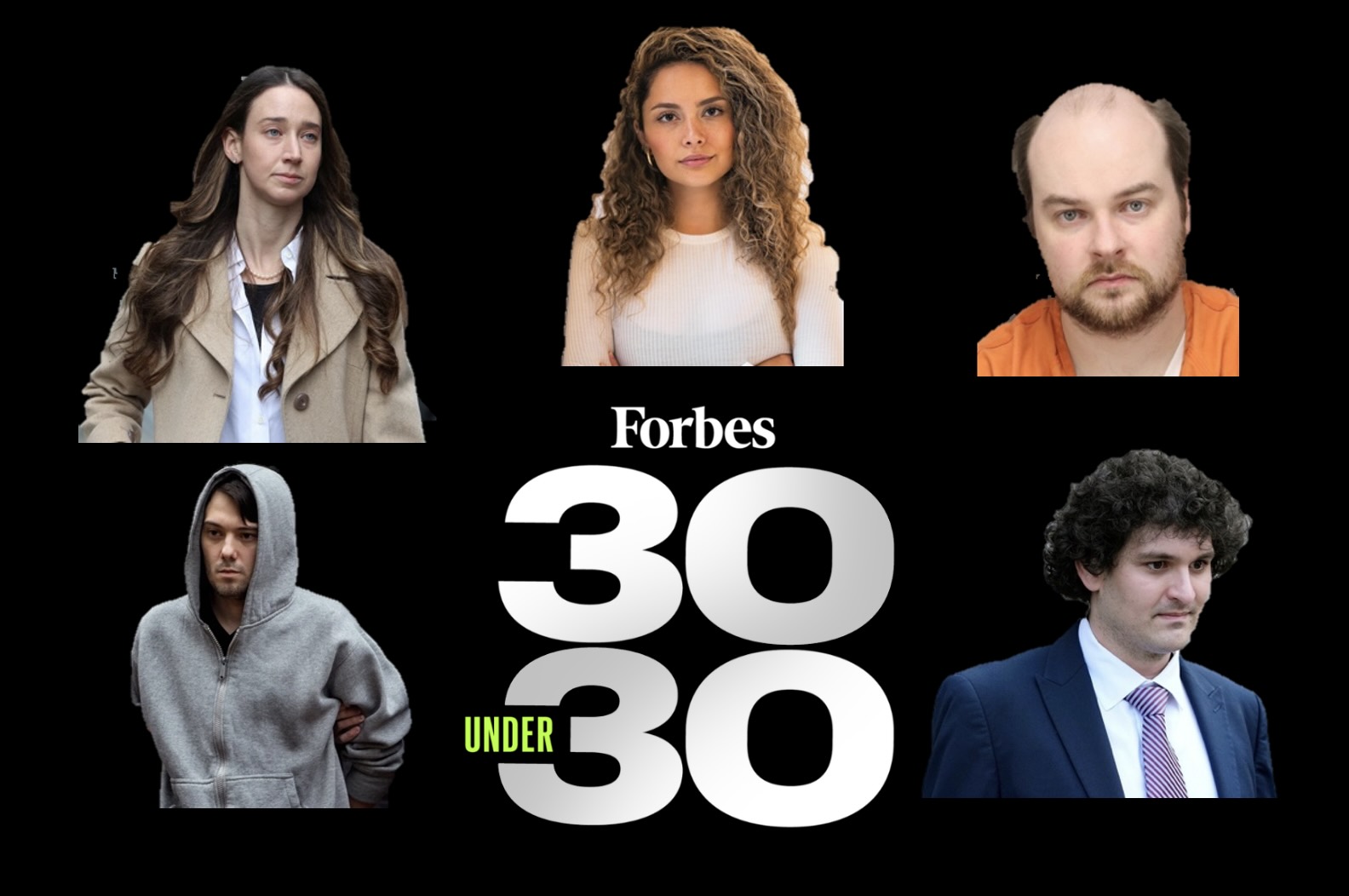
The Forbes 30 Under 30 "Hall of Shame" | Photo: Emerald Book Image
The infamous "Forbes 30 Under 30 to prison pipeline" has claimed its newest additions. In September 2026, energy-tech founder Meade Lewis, CEO of mIQroTech, entered a plea agreement with federal prosecutors, admitting to defrauding investors and facing up to 20 years in prison. He is just the latest in a wave of 2026 cases, following fintech founder Gökçe Güven, who was hit with federal charges in February 2026 for allegedly fabricating $1.2 million in recurring revenue and forging signatures to obtain an O-1A visa. These cases add to a remarkably long list of alumni—from Sam Bankman-Fried to Charlie Javice—who have faced severe criminal charges.
By some tech analyst calculations, while 30 Under 30 alumni have collectively raised billions in funding, the total value of scams and fraud linked directly to people on the list has surpassed $18.5 billion. The pattern has become so prominent that even Forbes published its own "Hall of Shame" to address the ongoing curse. But the question remains: why does a list that is supposed to be a prestigious milestone keep producing criminals?
The answer lies in the fundamental nature of the list itself. Despite its glamorous presentation, the Forbes 30 Under 30 is not a rigorous selection process in a traditional academic or forensic sense. It is fundamentally a PR and curation process, designed to identify people who are great at playing the startup game, not necessarily people who have built legally compliant, long-lasting businesses.
The Illusion of Prestige
It is supposed to be a prestigious milestone, and for a long time, it was treated as the ultimate gold standard for young entrepreneurs. However, the list is currently facing a massive credibility and reputational crisis. What was once a badge of honor has increasingly turned into a punchline—often mocked online as a "predatory target list for the FBI" or a "pipeline to prison."
The illusion of its prestige has cracked due to a few systemic flaws. The nomination process heavily rewards massive valuation numbers, hyper-growth narratives, and media buzz. Tech analysts note that the list judges who is "successful" based on how much venture capital money a founder has raised, rather than checking if their technology actually works or if their revenue numbers are real.
- Hype Over Substance: The selection criteria heavily weight investor pedigree and projected growth potential over boring metrics like profitability or audited financials.
- Flawed Vetting: Forbes relies too much on self-reported data and aggressive PR campaigns. If a founder is a charismatic liar who can spin a great story to investors, they can usually spin that same story to the Forbes selection committee.
- The "Fake It Till You Make It" Culture: The pressure to hit the "Under 30" milestone before time runs out incentivizes cutting corners, inflating user metrics, and outright fraud.
Forbes has fiercely defended the list, pointing out that they have vetted over 100,000 candidates and named 10,000+ honorees over the years. They argue that a few bad actors slipping through is just a statistical inevitability. They even noted that their process successfully filtered out high-profile fraudsters like Elizabeth Holmes and Billy McFarland before they could make the list.
Not a Rigorous Selection Process
While Forbes editors put in a massive amount of hours sorting through thousands of names, the actual vetting relies on structural shortcuts that make it highly vulnerable to manipulation. The process lacks true rigor due to three main vulnerabilities.
First, Forbes staff writers are journalists, not forensic accountants or private investigators. They do not audit corporate tax returns, view bank statements, or run deep forensic background checks on the 600+ winners chosen each year. Instead, they largely rely on self-reported data from the founders or the official press releases provided by their public relations teams.
Second, the selection committee operates on a massive assumption: "If a major venture capital firm invested $10 million in this founder, the investors must have done the background checking." Forbes uses investor backing as a proxy for legitimacy. However, as the collapses of FTX and Frank proved, venture capitalists are often blinded by FOMO and frequently fail to do their own rigorous due diligence. Forbes simply inherits those blind spots.
Third, the selection rubric heavily rewards "buzz." A founder who has a flashy, charismatic story, an aggressive PR firm, and a high-profile VC backing them will almost always beat out a founder running a quiet, highly profitable, boring logistics business. The judges are looking for influence and cultural relevance, which are highly subjective and easily faked.
A Magnet for Fraud
The lack of rigorous checking creates a massive security vulnerability that corporate grifters are highly trained to exploit. When a system inherently values hype, massive numbers, and media narratives over audited financials, it creates the ultimate magnet for white-collar criminals.
The process doesn't just accidentally let criminals in; the system's structural flaws actively reward the exact traits that lead to fraud. Fraudsters love the validation. If you are running a multi-million-dollar scam, a badge of legitimacy from Forbes is an invaluable shield. Bad actors aggressively target the list—hiring expensive PR agencies specifically to construct the perfect narrative—because making the list makes future investors ask fewer questions.
The "Fake It Till You Make It" escalation is also a factor. The tech startup ecosystem heavily encourages exaggerating metrics early on. A founder might start by inflating their user base by 10% to secure a seed round, get rewarded with a spot on the 30 Under 30 list, and then feel trapped into fabricating entire balance sheets to keep the illusion alive.
Why Forbes Won't Fix It
At the end of the day, Forbes gets massive global brand relevance and tens of millions of dollars in highly profitable revenue from the list. While the list has damaged Forbes' journalistic reputation among serious business analysts, it has been an absolute goldmine for their bottom line. The 30 Under 30 franchise single-handedly transformed Forbes from a dying, old-school print magazine into a thriving, modern digital media empire.
Forbes is a global media company and lifestyle brand, not a traditional daily newspaper. A traditional newspaper makes money by selling factual news to subscribers. Forbes makes money by selling status, access, and networking to corporate professionals. The list is designed to manufacture prestige, package it as an elite credential, and sell access to that prestige through events, ads, and sponsorships.
- The "Under 30" Summits: Massive multi-day, in-person conferences where tickets cost up to $9,000 each for attendees to network.
- Exorbitant Corporate Sponsorships: Blue-chip brands pay millions for multi-year franchise sponsorships just to get their products in front of the list's audience.
- A Massive Traffic Engine: The annual release of the list drives upwards of 6 million extra web visitors to Forbes per year, as winners immediately share their profiles across social media.
Forbes has essentially built its own elite private club. This network feeds back into the magazine—alumni eventually become the judges for future lists, purchase high-end corporate packages, sponsor events, and provide a steady stream of inside corporate narratives for Forbes journalists to write about.
Ultimately, the list functions as an amplifier. It packages existing momentum and magnifies it. If that momentum happens to be built on an outright lie, the Forbes 30 Under 30 list ends up putting a spotlight—and a crown—on a criminal. For Forbes, the occasional public embarrassment of an alum going to prison is just a minor tax on a massively profitable business model. The hype machine makes too much money for them to ever shut it down.
No Ads. By Us. For Us.
This article was made possible by readers like you. We hope it inspired you to support Emerald Book, so we can continue producing content like this.
We will never show you ads, sell your data, or require a subscription to consume our content. Your gift helps us keep the truth accessible.
Click the Support button to give a gift of any amount today.
Thank you for making this work possible.