

Emerald Pages
◆
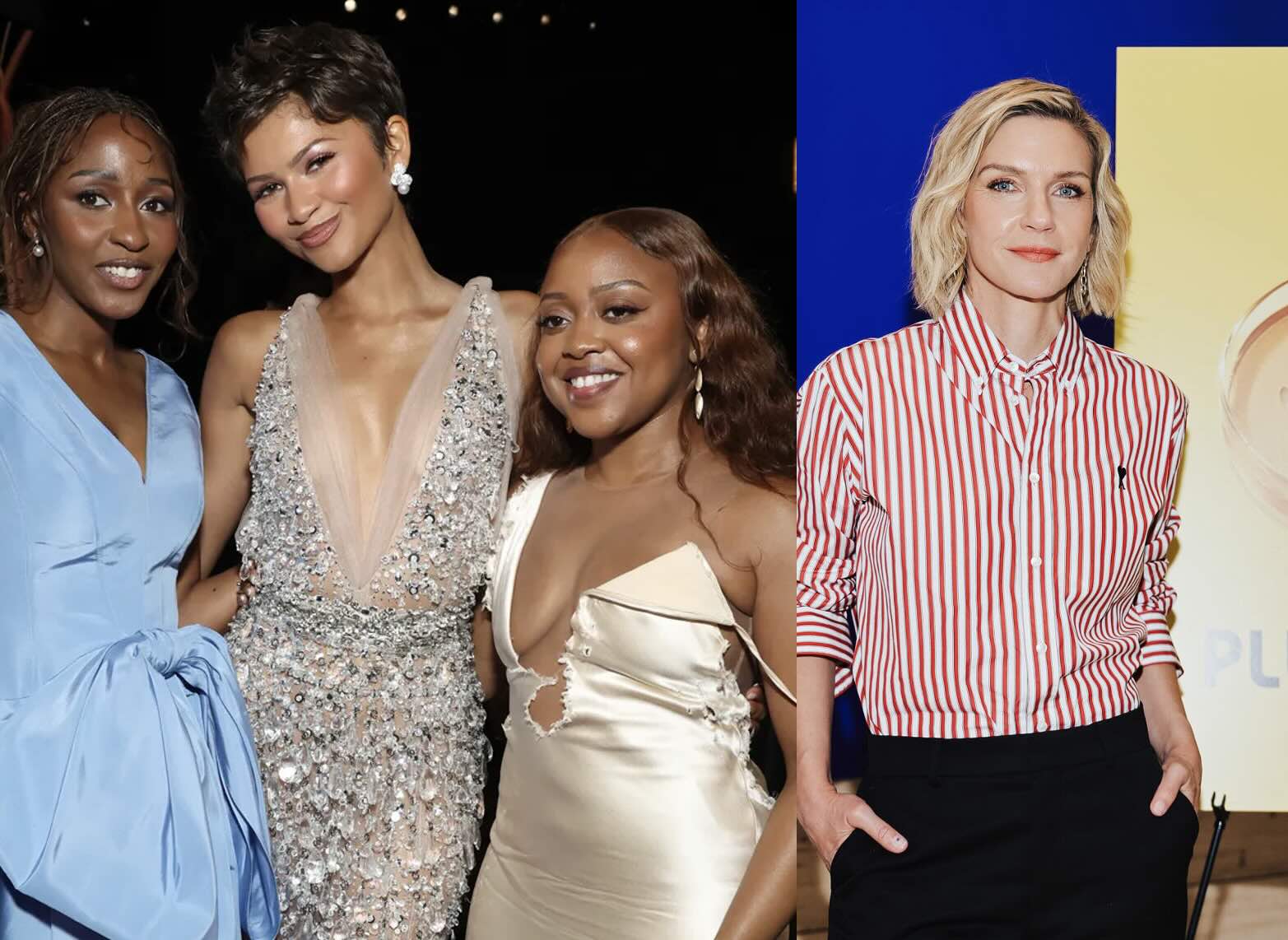
Ayo Edebiri, Zendaya, and Quinta Brunson (left to right) and Rhea Seehorn (right)| Photo: Getty Images
The 78th Primetime Emmy Awards, broadcast Monday, September 14, 2026, was supposed to be a coronation. Instead, it became a referendum on who gets to decide what great acting looks like. Apple TV+'s Widow's Bay shattered the record for most Emmy wins by a comedy series in a single year with 14 trophies. HBO's The Pitt won Outstanding Drama Series for the second consecutive year. Matthew Rhys became the first performer ever to win two lead acting Emmys in one night, for Widow's Bay and The Beast in Me. Jean Smart tied the all-time acting Emmy record with her eighth win for Hacks. Michael J. Fox received the Bob Hope Humanitarian Award.
And yet the dominant story was what did not happen: for the first time in five years, all 10 major acting categories presented during the live telecast went to white performers. Not a single Black person won on the main stage. The hashtag #EmmysSoWhite resurfaced within minutes.
The explanation lies in a combination of structural forces: a voting body that is nearly 70% white, a ballot system that rewards down-the-ballot sweeps for buzzy shows, a nomination pool that shrank dramatically in diversity, and a multi-million-dollar campaign apparatus that tells older voters which shows count as "prestige." The result is an awards ceremony that increasingly functions as a private banquet for an insular professional class — one that honors its own version of craft while treating global stardom as irrelevant.
The Numbers Behind the Shutout
According to the Television Academy's own transparency reports, 69.2% of its voting membership identifies as white. Black voters make up 10.0%, Latino voters 7.9%, multiracial voters 5.8%, Asian voters 5.1%, and Indigenous voters just 0.6%. The oldest and largest voting brackets — ages 56 to 100 — are the most heavily white, while younger generations entering the Academy are significantly more diverse. But older industry veterans hold a massive percentage of the voting power, and their preferences continue to dictate who wins.
That baseline was compounded by a nomination pool that was dramatically less diverse this year. By Variety's count, 17 performers of color were nominated in the lead and supporting acting races, down from 28 the year before. Out of 91 unique actors nominated across all categories, 74 were white — 81.3% of the field. This was the least diverse slate of Emmy nominations in a decade, making the sweep by white performers statistically probable before the first envelope was opened.
- Voting body demographics: 69.2% white, 10.0% Black, 7.9% Latino, 5.8% multiracial, 5.1% Asian, 0.6% Indigenous.
- Nominations dropped sharply: 17 actors of color nominated in lead and supporting races, down from 28 the prior year.
- Overall nomination pool: 74 of 91 unique acting nominees were white — 81.3%.
- Creative Arts exceptions: Ernest Harden Jr. won Guest Actor in a Drama for The Pitt; Octavia Spencer won Outstanding Narrator for Lost Women of Alaska: The Missing — both off-air a week earlier.
How the Sweeps Locked Everyone Else Out
The Academy's two-round voting system is highly vulnerable to the "straight-ticket" phenomenon. When thousands of voters fall in love with a single buzzy show, they check the box for that show's series award, writing, directing, and cast all the way down the ballot. This year, Widow's Bay swept the comedy categories, while The Pitt and Pluribus dominated drama. Actors on less dominant ensembles — like the cast of Abbott Elementary, Sterling K. Brown, or Colman Domingo — were mathematically blocked from winning.
Vote-splitting made it worse. In Lead Actress in a Comedy, both Quinta Brunson and Ayo Edebiri were heavily favored, but their shared support paved the way for Jean Smart to win for Hacks. Meanwhile, the Academy had quietly moved five categories — including Supporting Actor and Actress in a Limited Series — off the main broadcast and into the Creative Arts Emmys, further reducing on-air diversity.
What "Craft" Actually Means to Emmy Voters
There is no official rubric for acting at the Emmys. Voters are given a list of names, a set of episode tapes, and a checkbox that says "Vote for One." Because the voters are themselves actors, directors, and writers, their definition of "craft" tends to reward what industry insiders call "most acting" — extreme crying, screaming, physical transformations, heavy accents — over subtle, grounded performances. A quiet, naturalistic turn that makes a character feel real frequently gets overlooked because it doesn't "look" like hard work. Voters also conflate great writing with great acting: a beautifully written monologue gets praised as craft, while brilliant improvisational comedy is dismissed as "being funny."
There is also a technical bias. A long emotional monologue delivered in a single unbroken shot wins votes because insiders know how hard that is to execute — even if a shorter, edited scene was culturally more impactful. The Pitt is precisely the kind of technically demanding, prestige-coded production the Academy loves to reward. It is also the kind of show most viewers have never heard of.
The Stardom Gap: Zendaya in the Room, Not on the Stage
The most jarring aspect of the night was the gap between who was in the building and who actually won. Zendaya — a global superstar nominated for the final season of Euphoria — was present, stole the red carpet, and lost to Rhea Seehorn for Pluribus.
Global superstars are invited to the Emmys to present awards and draw ratings. They are not, as a rule, the ones taking home trophies. The Academy treats mainstream stardom — especially when driven by Black, Latino, or Asian artists — as "pop culture hype" rather than "serious art," repeatedly passing over culturally dominant performances to reward intense, quiet roles in obscure streaming dramas. To be fair, many winners are industry legends: Allison Janney, Sally Field, Jean Smart. But the shows they won for — Widow's Bay, Pluribus, The Diplomat — are niche streaming titles with small viewership compared to the cultural phenomena that were shut out.
The Campaign War Nobody Sees
The Emmy voting period is a multi-million-dollar marketing war. Streamers spend heavily to court the Academy's 27,000 members, launching targeted "For Your Consideration" campaigns in the specific Los Angeles and New York neighborhoods where voters live. They don't need to convince the global public — only a few thousand specific voters. This year, Apple TV+ and HBO poured record-breaking budgets into pushing Widow's Bay, Pluribus, and The Pitt. Smaller or more traditional network shows — even massively popular ones like Abbott Elementary — got outspent. Since there is no official rubric, the campaign effectively writes one.
This creates a self-reinforcing loop: deep-pocketed streamers campaign aggressively, win Emmys, gain prestige, and justify even bigger campaign budgets next year. Shows that cannot afford to play the game are left out entirely, no matter how much cultural traction they generate.
A Pendulum That Never Fully Swings
None of this is new. #EmmysSoWhite first trended in 2021, when every major acting trophy went to white performers despite a then-record 49 non-white nominees. Things briefly improved: at the 75th Emmys, performers of color tied an all-time record with 5 of 12 major acting wins. But the improvement did not last. Over the past decade, roughly 80% of all acting nominations have consistently gone to white performers.
The pattern is a pendulum — backlash, progress, slide back — because the core voting system and voter demographics have not actually changed. The Academy has published transparency reports and made incremental reforms, but the fundamental structure remains intact: an older, whiter, insider-dominated voting body, a ballot that rewards sweeps, a campaign system that favors deep-pocketed streamers, and a subjective definition of "craft" that skews toward traditional prestige.
The 2026 Emmys will be remembered for Widow's Bay's record-breaking 14 wins, Matthew Rhys's historic double, and Jean Smart's record-tying eighth acting Emmy. But the story that will define the night is the one that was not on the script: a complete shutout of Black winners on the main stage, in a year when Black actors and creators dominated the cultural conversation. The Emmys are not a measurement of objective quality. They are a measurement of what a specific, insular group of industry professionals values at a specific moment in time. Until that group, that system, and that definition of craft change, the gap will persist — and the hashtag will keep coming back.
No Ads. By Us. For Us.
This article was made possible by readers like you. We hope it inspired you to support Emerald Book, so we can continue producing content like this.
We will never show you ads, sell your data, or require a subscription to consume our content. Your gift helps us keep the truth accessible.
Click the Support button to give a gift of any amount today.
Thank you for making this work possible.