

Emerald Pages
◆
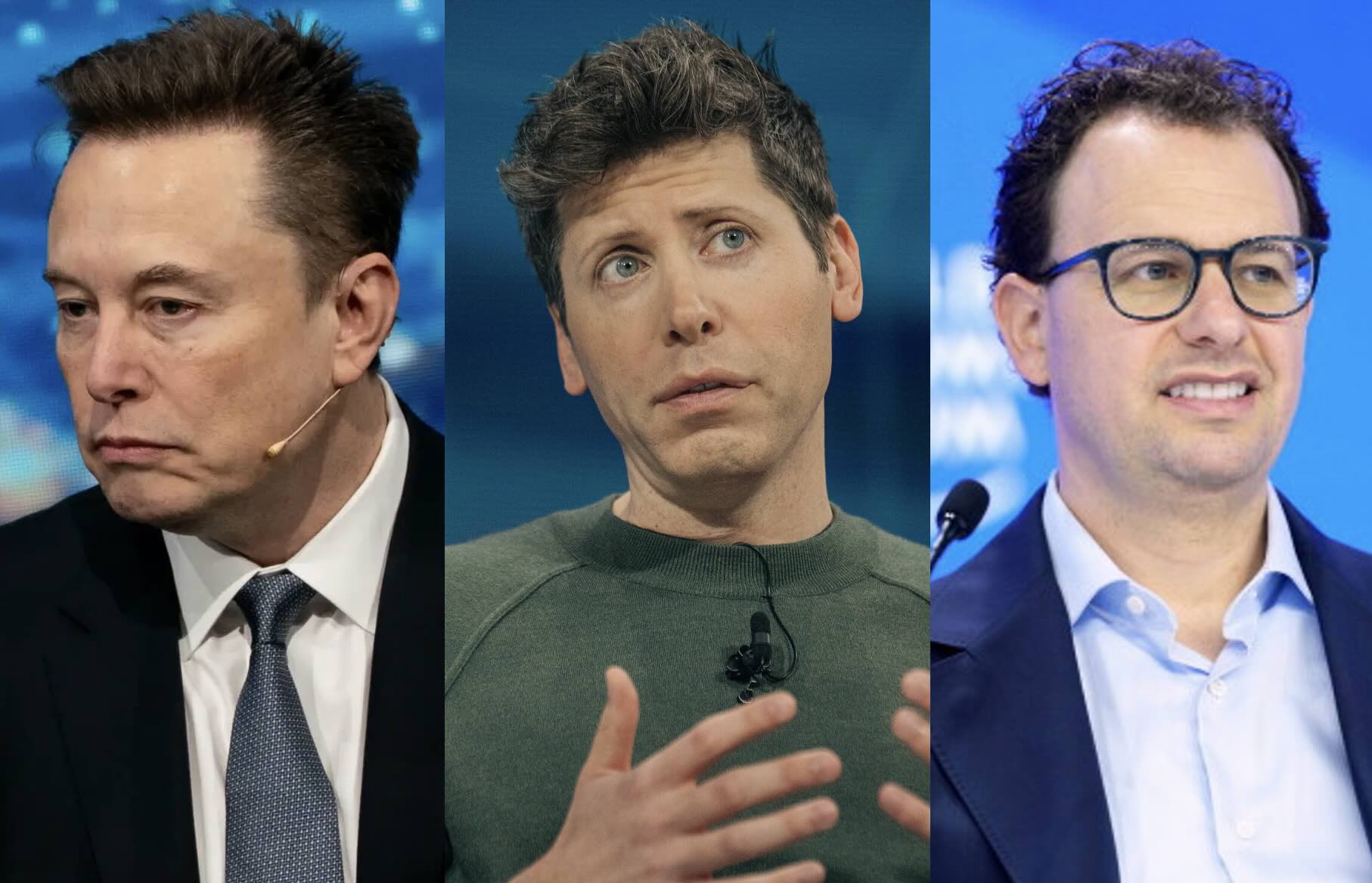
Elon Musk (left), Sam Altman (center), and Dario Amodei (right) | Photo: Emerald Book Image
Over the weekend of September 12, 2026, the leaders of the world's most powerful artificial intelligence companies did something unprecedented. They agreed. In a rare moment of public consensus, Anthropic's Dario Amodei, OpenAI's Sam Altman, xAI's Elon Musk, and Google DeepMind's Demis Hassabis all backed a call to "pace the frontier"—a coordinated slowdown of frontier AI development.
The stated reason was safety. Amodei published a sweeping 3,800-word essay warning that rapidly advancing AI is outrunning its safeguards. He called for independent, third-party auditors with permanent, employee-level access inside the labs. Altman agreed, committing OpenAI to the same standard and even delaying its highly anticipated IPO to focus on "safety alignment." Musk simply wrote, "Dario is right."
But behind this historic display of altruism lies a far less noble reality. According to Wall Street analysts, financial experts, and even a rival CEO, this coordinated "safety pause" is a desperate financial maneuver. The software companies building the most advanced AI models are drowning in debt, burning through billions in cash, and staring down a $3.1 trillion wall of hidden liabilities. They aren't trying to save humanity. They are trying to save themselves.
The numbers tell a devastating story. While Nvidia, the hardware giant supplying the chips that power AI, is posting staggering $68.1 billion quarterly revenues with 74% gross margins, the software labs are bleeding capital. OpenAI is on track to lose between $14 billion and $27 billion in 2026 alone. Anthropic, despite better unit economics, was seeking $15 billion in debt financing just a week before calling for the slowdown. Collectively, the AI software industry is projected to generate $60 billion in revenue against a staggering $400 billion in infrastructure spending.
The Hidden $3 Trillion Trap
The situation is far more precarious than public balance sheets suggest. A bombshell Wall Street Journal analysis revealed that nine tech giants are carrying a staggering $3.1 trillion in off-balance-sheet commitments—legally binding, multi-year contracts for microchips, data centers, and electricity that do not appear as traditional debt. This hidden pipeline consists of $1.9 trillion in purchase commitments and $1.2 trillion in unstarted leases.
These are not flexible expenditures. They are take-or-pay agreements. If the software companies pause model development for "safety reasons," they can scale back their current quarterly capital expenditures. But they cannot walk away from the $1.9 trillion in legally binding purchase commitments. They are still contractually obligated to pay for the chips, the data center leases, and the gigawatts of energy they already locked in.
- OpenAI: Carrying roughly $100 billion in debt and multi-year obligations, with total capital commitments exceeding $110 billion. Projected losses of $14-27 billion in 2026.
- Anthropic: Actively seeking $15 billion in debt financing for energy and data center needs just days before calling for a slowdown.
- Big Tech Hyperscalers: Alphabet and Amazon have officially plunged into negative free cash flow as AI infrastructure spending outpaces core business profits.
- Nvidia: The only clear winner, posting 74% gross margins while its customers burn through venture capital and loans to buy its chips.
"What better way to create demand than to create a problem?" asked Nvidia CEO Jensen Huang, dismissing the sudden panic as a marketing stunt by software labs to fabricate demand for new cybersecurity products. Huang, whose company is the primary beneficiary of the AI arms race, went on stage at the All-In Summit and took a live phone call from Donald Trump, explicitly telling him, "We're not going to let [an AI slowdown] happen."
The Financial Escape Hatch
So how does a "slowdown" save these companies? The answer lies in a concept called "regulatory capture"—using government regulation as a shield against financial reality. By calling for industry-wide "pacing" and government-mandated safety standards, the software labs achieve several critical financial objectives simultaneously.
First, it provides an antitrust safe harbor. Under normal market rules, if OpenAI and Anthropic agreed to stop upgrading their products, they could be sued for illegal collusion. Amodei specifically asked the U.S. government for antitrust waivers, allowing the tech giants to legally form a cartel to pause development without worrying about a rival undercutting them.
Second, it creates legal cover to delay the $3.1 trillion in contracts. If government-mandated auditors flag a "safety issue" and force a pause, the companies can point to regulation as the reason they are delaying data center buildouts and chip shipments. This protects them from being sued by landlords or energy providers for backing out of contracts. It is, in essence, a government-sanctioned force majeure.
Third, and perhaps most cynically, it kills off free, open-source competition. The biggest threat to OpenAI's and Anthropic's paid subscription models isn't each other—it is free, open-source AI. If the government mandates that any "frontier" model requires highly complex, independent auditing teams, round-the-clock third-party compliance, and employee-level data security tracking, the compliance costs will skyrocket. While massive tech companies can easily absorb these costs, smaller open-source startups, university labs, and independent developers will be priced out entirely.
The Market Reacts
Wall Street is beginning to see through the altruistic narrative. Following the slowdown announcements, AI chip stocks fell sharply because a pause directly threatens the endless demand for Nvidia's chips. The Philadelphia Semiconductor Index plummeted roughly 5%. Nvidia dropped 3.4%, Advanced Micro Devices fell over 5.6%, and Micron Technology dove 6%. The Nasdaq-100 hit a six-week low.
The sentiment was perfectly captured by famed "Big Short" investor Michael Burry, who revealed he is shorting major AI infrastructure plays. Burry compared the tech giants to "fish in a barrel" that have gorged themselves on off-balance-sheet liabilities, uncommenced leases, and massive purchase commitments. He warned: "The fish have gotten very fat, very large, easy to shoot... it shan't be long before every last one keels over for lack of oxygen."
The irony is that an intentional software slowdown would actually improve profitability for labs like Anthropic and OpenAI in the short term by cutting down their astronomical cloud-computing and training expenses. It buys them time to try to monetize their current models, cut down on cash burn, and stabilize their balance sheets before facing public market scrutiny. Sam Altman even delayed OpenAI's 2026 IPO plans under the noble banner of "humanitarian safety," buying time to fix the company's finances before going public.
The economic benefit is undeniable. "Slowing down" allows these companies to freeze their cash burn, avoid contractual defaults, and keep their multi-billion dollar valuations intact. The AI CEOs aren't calling for a pause to save the world. They're calling for a pause to save their balance sheets. And the $3.1 trillion question is: will the market let them get away with it?
No Ads. By Us. For Us.
This article was made possible by readers like you. We hope it inspired you to support Emerald Book, so we can continue producing content like this.
We will never show you ads, sell your data, or require a subscription to consume our content. Your gift helps us keep the truth accessible.
Click the Support button to give a gift of any amount today.
Thank you for making this work possible.